The Art of Cherishing Time
Words of Namo Amituofo
Recorded by Venerable HaiZe on 13 January 2024
The Illusion of a Busy Life
My children, do you often find yourself troubled by the feeling that there is never enough time in your day? Do you wonder why, despite many years of diligent practice, you have yet to see significant progress? You work hard every day to perform your duties, you rise early to complete your morning service, and you dedicate yourself to the work of the Buddha. Have you ever stopped to consider where the true problem lies? The issue is not a lack of time, but a failure to make good use of the scattered moments throughout your day. Often, when you become drowsy, your drifts into space, consuming precious time. Furthermore, your mind wanders into endless delusions, which drains your energy and exhausts your physical strength.
Reclaiming Your Scattered Moments
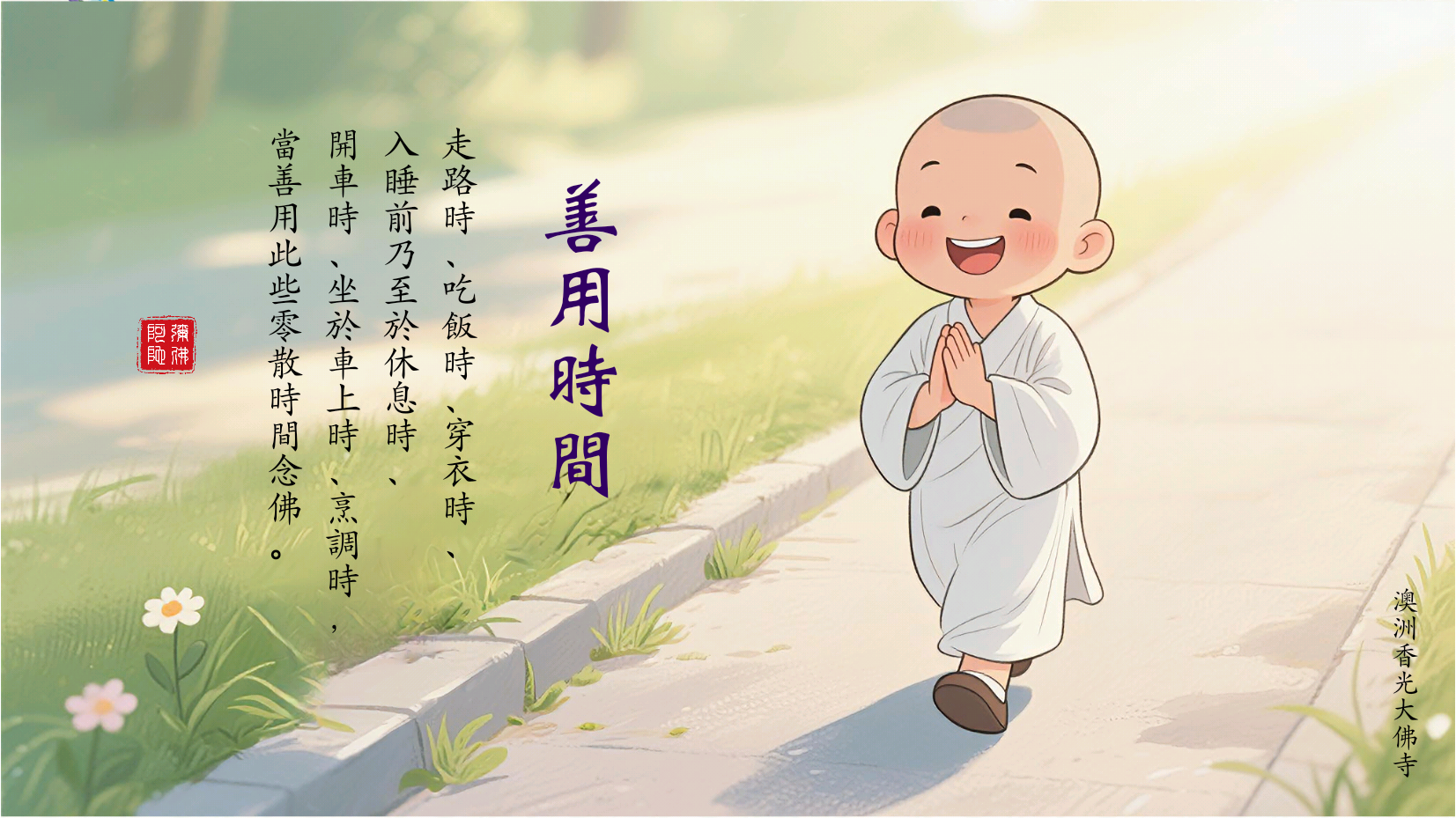
What exactly is meant by scattered time? It refers to the many small intervals that occur throughout your daily life. You should learn to use these moments to chant Buddha's name. These include:
- While you are walking from one place to another.While you are eating your meals.While you are dressing or preparing for the day.Before you fall asleep at night.During your periods of rest.While you are driving or sitting as a passenger in a vehicle.While you are cooking or preparing food.
When your body is busy with the necessities of life, where is your heart? If you are not careful, your heart will wander aimlessly.
Where Does Your Heart Wander?
When you are not focused on the Buddha-name, your heart is likely caught in one of many traps:
- Looking around and observing the external world with attachment.Thinking of this and that, lost in idle chatter.Being swept away by a whirlwind of delusions.Engaging in unnecessary conversation with others.Planning for the future or ruminating on the past.
In all these possibilities, is there any room for the answer of chanting Buddha's name? The cultivation of your skills in chanting is built upon the foundation of daily, persistent effort. You must learn to bring your heart back to the Buddha-name in every single moment.
The Discipline of Constant Chanting
When you perform your daily prostrations, hold tightly to the Buddha-name to avoid becoming drowsy or drifting into space. When you are walking in meditation, ensure that every word of the Buddha-name is grasped firmly; this prevents you from becoming drowsy or pausing your progress. When you recite the Sutras, you must read every word clearly and distinctly. Keep your heart and your eyes focused on the scriptures, reading one character at a time. This focus will protect you from the interference of and the tendency to drift into space. Those who use the time that would otherwise be lost to drowsiness or distraction to chant Buddha's name are the ones who truly know how to cherish time.
Through the
When you listen to the teachings and hear the Dharma, you must make good use of both your eyes and your ears. Look directly at the teacher and listen intently to the sound of the teaching being spoken. If you notice your eyes closing and feel drowsiness approaching, you should immediately change your posture and kneel to listen to the teachings. At such moments, whether it is other beings or demon crowds causing interference, they will see you kneeling and understand that you are repenting. They will recognise that you are aware of your past mistakes. Often, they will be willing to retreat and leave, or they may even see the light of the Buddha and choose to follow Him to the of Ultimate Bliss. This is the magnificent advantage of the Hsiang Kuang Pure Land Buddhist Centre. My children, you must make these changes. Cherish your time, practise diligent practice, and work to change your personality traits. Do this at all times, in every place, and in every passing second.
Namo Amituofo
More by Hsiang Kuang Pure Land Buddhist Centre
The Final Curtain Call of Chu Ke-liang
A candid reflection from the late Taiwanese entertainer Chu Ke-liang on his life, his career, the karmic weight of his influence, and his ultimate deliverance to the Western Land of Ultimate Bliss.
The Soul's True Equality: A Conversation with Mahatma Gandhi
This is a record of an interview with Mohandas Karamchand Gandhi, who sought deliverance at the Hsiang Kuang Pure Land Buddhist Centre in Australia. He now resides in the Western Land of Ultimate Bliss. This account reflects upon his life and his journey to the Pure Land.
A Reflection from the Western Pure Land
This is a record of an interview with Zhao Puchu, who sought deliverance at the Hsiang Kuang Pure Land Buddhist Centre in Australia. He now resides in the Western Land of Ultimate Bliss. This account reflects upon his life in the 20th century. Recorded by the chief writer, Shi Fa Hui, on April 18, 2026.
The Truth Behind My Rebirth: A Message from Liu Suqing
Liu Suqing, the elder sister of the renowned practitioner Liu Suyun, shares her harrowing journey through the spirit realms and her ultimate deliverance to the Western Land of Ultimate Bliss through the Hsiang Kuang Pure Land Buddhist Centre.
The Burden of a Historical Name
This is a record of an interview with Lin Biao, who sought Chao Du at the Hsiang Kuang Pure Land Buddhist Centre in Australia. He now resides in the Western Land of Ultimate Bliss. This account reflects upon his life approximately 54 years ago. Recorded by the chief writer, Shi Fa, on May 18, 2026.
The Poet’s Journey to the Western Pure Land
A reflection on the life, tragedy, and ultimate spiritual liberation of the ancient statesman Qu Yuan, who found peace through the teachings of Practitioner Su.
About the Author
Hsiang Kuang Pure Land Buddhist Centre
Contributed to Pure Land Buddhism knowledge library