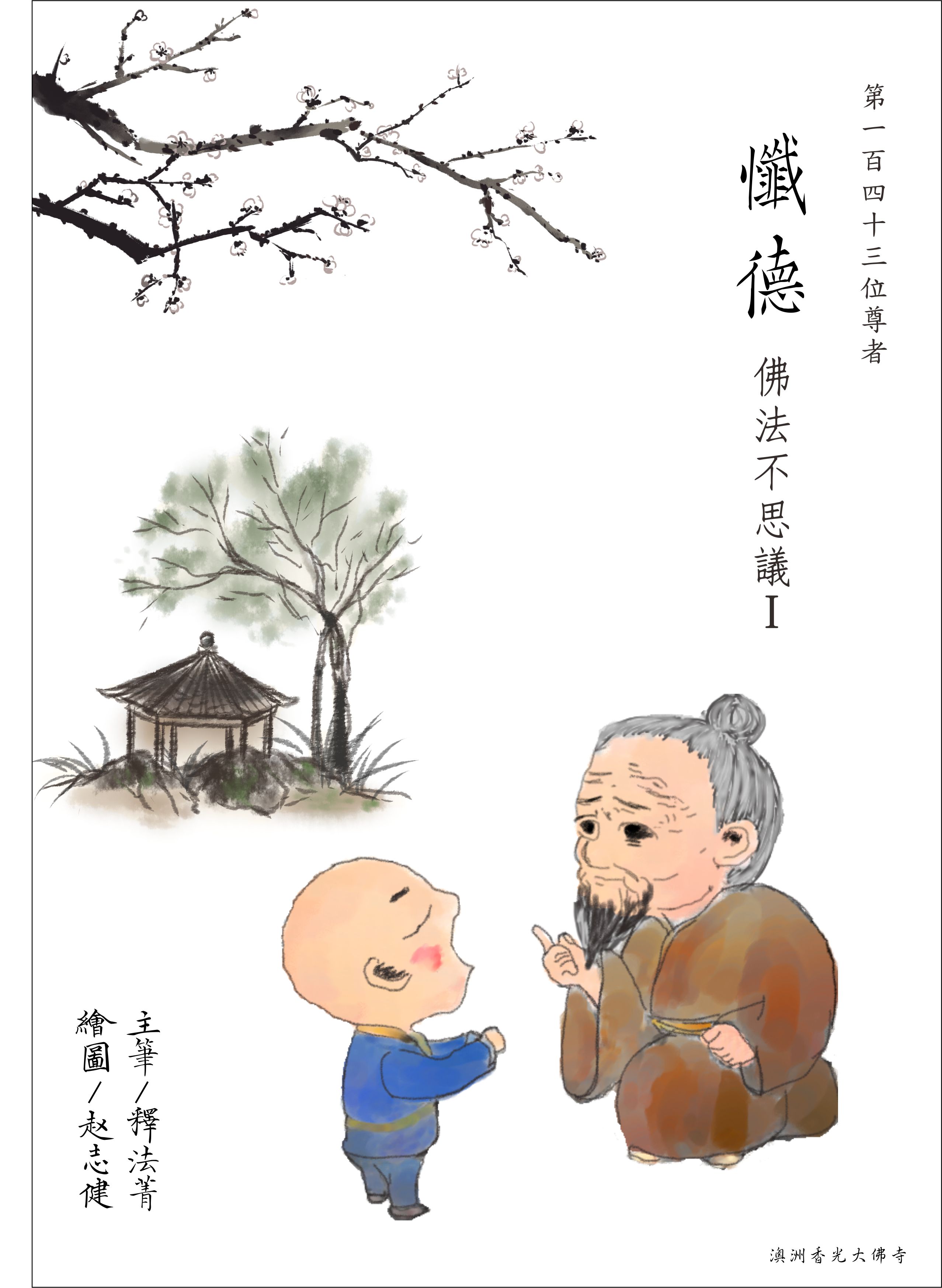
This is a record of an interview with Qing Long-en, who sought at the Hsiang Kuang Buddhist Centre in Australia. He now resides in the Western Land of Nature. This account reflects upon his life approximately 1,450 years ago. Recorded by the chief writer, Shi Fajing, on November 1, 2019.
Venerable Qing Long-en speaks:
". I am Qing Long-en. In this lifetime, I was born into the Qing family, a household of immense renown in our town. To mention the Qing family was to speak of a name everyone knew. If travellers from distant lands wished to visit my grandfather or my father, any passerby could point the way, for our estate was the largest and most prominent in the entire region.
A Household of Renown
One day, while I was in my room practicing how to walk, I heard a rhythmic knocking at the door. 'Knock, knock, knock! Is anyone home?' Our servants hurried to answer. It was Feng Ming, an old friend of my father's. Uncle Feng Ming had only recently moved back to our town. Many years prior, he had travelled alone to seek his fortune elsewhere, and word had it that he had returned with a significant amount of wealth. Recently, his parents had been pressuring him to take a wife and settle down, but he was incredibly particular and could not find a suitable match. My father often teased him, saying, 'You are getting on in years and still so shameless! If a young woman were willing to marry you, you should be grateful, yet you remain so picky. Don't wait until you are old and frail, unable to walk, only to marry some ugly woman just to have someone to lean on!' My father always enjoyed making such jokes, and to Uncle Feng Ming, these words were merely expressions of my father's genuine care. He would listen, laugh, and feel a sense of warmth in his heart.
Uncle Feng Ming had a booming voice. As he walked from the main gate to the living room, his conversation could be heard clearly even from my room. I leaned against the wall, slowly making my way out, and heard him say to my father, 'I have heard that a neighbouring town has been invaded by foreign forces. Their food and water supplies have been poisoned, and they are now suffering from a severe famine. We must think of a way to help.' My father replied immediately, 'The solution is simple: we must send rice and provisions at once. Time is of the essence; the civilians cannot be left to starve or freeze.' No sooner had he finished speaking than he ordered the servants to prepare hundreds of shi of grain, along with cart after cart of dried rations that the people could store in their homes.
A Father's Pride
I stood at the doorway, watching my father's back. His shoulders were broad, his stature tall and imposing. Whether standing or sitting, he always held himself with such dignity and grace. He was a father I truly admired. As I prepared to return to my room, I stumbled and let out a cry. My father turned instantly, asking, 'What was that sound?' I replied, 'Father, it is me.' He walked over at once, helping me up from the floor, and asked, 'Why did you come out alone? Why did you not call for a servant to assist you?' I told him, 'I wanted to practice walking on my own. I cannot rely on servants to help me forever.' My father smiled and said, 'Our Long-en is a child of great ambition. It is precisely this courage and strength that will allow you to move forward, step by step, on the path of life.' He turned to Uncle Feng Ming and asked, 'Look at our Long-en, has he not grown quite a bit?' Uncle Feng Ming laughed, 'Indeed! It was only a few weeks ago that I last saw him, yet he has grown so quickly—he is making me feel old!'
As they laughed, my father suddenly remembered something and called out to the servants, 'Prepare the carriage! I heard a new bakery opened in town, and business is booming. I must take my precious Long-en to taste their goods!' I hesitated, saying, 'But my feet...' My father interrupted, 'Father will always be proud of you!' Uncle Feng Ming added, 'Indeed! I am also proud of Long-en. If it were not for his in saving that bullied child, the boy might have lost his life under the carriage wheels. To be willing to sacrifice oneself to save another is something not everyone can do.' Hearing them speak this way, I felt relieved. Given the reputation of the Qing family, I had always feared that if people discovered I was a child with a limp, it would bring shame upon my father and grandfather.
The Legacy of the Qing Family
Although our family was famous, we were far behind others when it came to having children. My father had married several concubines, yet none had been able to conceive. My mother was the twelfth concubine my father took into his home, and I was the only descendant of the Qing family. It took my father marrying so many wives and concubines before he finally had me. In our household, every concubine was expected to bear children for the family. Although I was born to my biological mother, I was required to call her 'Auntie,' for in the Qing family, the duty of a concubine was simply to produce an heir. The children born to them were to call the father's principal wife 'Mother,' and their own birth mother 'Auntie.' Thus, as soon as I was born, I was handed over to the principal wife to be raised. By the time I arrived, my father was already past fifty. His friends often joked that he was like an old clam producing a pearl. My mother told me that when my father first held me in his arms, he wept tears of —a rare sight for a man—showing just how much effort he had poured into his quest for a child.
A Heart Untethered by Wealth
In this house, everyone doted on me. The servants treated me with the utmost respect, for they knew I was the sole heir to everything the Qing family possessed. Even strangers would come to our door, eager to flatter and curry favour with me. Yet, for some reason, I felt absolutely no interest in the wealth and status of this world. Even when boxes of gold and jewels were placed before me, I felt not a single ripple of desire in my heart. Once, when my father returned home and saw me sitting alone in the living room, he asked, 'What became of the box of jewels that Master Wang sent over yesterday?' I replied calmly, 'I have already sent men to deliver it to that impoverished village in the remote hills.' My mother, who was sitting nearby drinking tea, jumped from her chair and cried out, 'What did you say? You gave it away?' I nodded firmly, which infuriated her. But my father’s reaction was quite different. He praised my actions, saying, 'Long-en is a child of true goodness. I have some silver I just exchanged; take that as well and give it to those in need.' I nodded happily and asked, 'Father, may I also give the pastries that were sent yesterday to the beggars on the street?' My father laughed, 'Of course! When one has good things, one should share them with others. Don't you agree, Long-en?' I immediately agreed, 'Yes, Father, your teachings are truly wonderful.'
My father and I would often sing each other's praises, much to my mother's annoyance. She would stand to the side, her cheeks puffed out in anger, for she could not bear to part with anything that entered our home. Whenever gifts arrived, she would immediately order the servants to hide them, fearing that my father or I would see them. We loved to share; whenever someone was in need, we felt no reluctance at all and would give immediately. Because of this, my father was known throughout the town as a 'Great Philanthropist' and a 'Great Benefactor.' Yet, he never took pride in these titles. He only told me, 'This is simply what we ought to do.'
The Boy on the Street
Whenever my father had time, he would take me out. I would sit in the carriage, lifting the curtain to watch the street scenes. Many people were out shopping, children were playing, and vendors were calling out their wares—it was incredibly lively. 'Stop!' I suddenly shouted to the coachman. He pulled the reins sharply, and the carriage came to a halt. My father was startled and asked, 'What happened?' I pointed, 'Father, look at that boy crying over there. He is standing all alone, sobbing, and no one is paying him any mind. Should we go down and see if he needs help?' My father replied, 'It is a small effort, of course. Coachman, turn the carriage around!'
Once the carriage stopped, a servant helped me out, and I walked over to the boy. He was about my age, perhaps fourteen or fifteen. I asked, 'What is the matter?' The boy sobbed, 'I lost the money bag my mother gave me to buy groceries. It was the money my father worked so hard to earn, and I was so careless. How can I go home and face them?' He continued to wail. I told him, 'Do not worry, do not worry!' and immediately took out all the money I had on me. The boy saw the money and politely refused, 'I cannot take your money. My father taught me better.' A passerby walked past us and muttered, 'Don't be fooled by him. He has no parents, and he didn't lose any money bag. He is just trying to trick you.' The boy's expression changed instantly upon hearing this, though he quickly reverted to his pitiful look. I told the boy, 'Please, take this money. If your father asks, just tell him it is a gift from me.' With that, I had my servant help me back to the carriage. Just as I was about to board, the boy called out, 'Wait!' I stopped and turned. He asked, 'Why did you give me the money even though you knew I was lying?' I gave him a bright smile and said, 'I believe in you.' Back in the carriage, my father asked, 'Tell me, what were you thinking just now?' I replied, 'The passerby said the boy was a liar, that he had no parents. When I heard that, my heart ached even more. A child without parents to care for him must fend for himself; he is the one who needs help the most. I believe there must be some way I can assist him, and I hope this small amount of money brings him some relief.' My father smiled and patted my head. Suddenly, the carriage came to a sharp halt. My father lifted the curtain and asked, 'What is going on?' The coachman replied, 'It is that boy from before.' I leaned out to look, and the boy was standing directly in front of the carriage. Namo Amituofo."
I slowly stepped down from the carriage and walked toward the boy, asking, "Why would you do something so dangerous?" The boy replied, "Thank you for being willing to believe in me." I saw that the boy's eyes were filled with deep emotion. He continued, "Since I was small, I have lived under another's roof, staying with a young couple. They did not know where my parents were. When they mistakenly thought I was a thief and accused me of stealing their money, they immediately threw me out of the house. But in truth, I did not steal that money; it was their own biological child who had snuck into their room and taken it. From that day on, I was branded a thief. No one was willing to believe in my innocence, and I did not bother to explain myself further. Today, I truly had no choice but to lie, because I was so hungry I had no strength left. When I accepted the money you gave me, besides feeling touched, I also felt a profound sense of unease. I could not lie and keep your money, so I kept chasing your carriage just now, simply to return it to you." I looked at the boy's feet. He had no shoes, and his running had already injured them. I was about to ask my servant to help the boy tend to his wounds, but the boy stopped me, telling me, "These minor injuries are nothing; they will heal very quickly." Looking at the boy's resilient appearance, my heart ached for him. We were of a similar age, yet our fates were so vastly different.
A New Brother and a Shared Vision
I asked the boy, "Would you be willing to become my brother and come live with me at my home?" The boy looked at me in surprise but politely declined, saying, "How could I? I cannot disturb your lives." At this moment, my father also stepped down from the carriage and said to the boy, "Of course you can! I am En'er's father. For our Qing family to have one more child is the best thing that could happen. Please, set your mind at ease and move in with us!" The boy's expression seemed to suggest he had something difficult to say. I asked him, "Is there something you find hard to speak of?" The boy said, "In the most remote part of town, there are many children in the same situation as me—orphans whom no one wants. Whenever I have anything good, I always share it with them. If I follow you home, those children will have no one to look after them." My father smiled and said, "You truly are a good child! Even while living such a hard life yourself, you can still think of others. This heart of yours is truly precious. Do not worry about those children; I will immediately find people to help them. Perhaps we can find a place to settle them so they no longer have to sleep on the streets." When the boy heard my father say this, he instantly let go of the heavy burden in his heart and joined us in the carriage.
Suddenly, there was a new brother in our home. I was overjoyed, and my father was just as happy, for the Qing family had gained another son.
The Lesson of the Earthworm
The boy's name was Changxin. He was one year older than me, so I called him Brother. Brother told me, "I am willing to be your other leg." I was so grateful to him; no matter where I went, he truly stayed by my side. Brother asked me, "You were born into the Qing family and lack for nothing; do you still have dreams?" I answered him, "Of course! My greatest dream is that everyone in the world can live in peace and happiness." Brother looked at me and said, "You are truly a good child. Since I moved into the Qing family, I have seen that you consider others in everything you do. Even when a servant accidentally kills a bug, you feel pity for that tiny life." I told my brother, "It is precisely because I have had such a good living environment since I was young that I must understand the hardships of others. As for that tiny life, I still remember when I was five years old. Once, I was playing alone in the backyard, digging in the soil to build a castle. As I dug, I suddenly uncovered a pile of bugs. They were all gathered together, looking just like a family. When I suddenly dug them up, they were so nervous, wriggling their bodies. I quickly covered them back up with soil so they wouldn't be too frightened. From that time on, I understood that it is not only humans who have families; even the bugs in the soil have families. We and these bugs are no different; only our physical shells are distinct. So, when that bug was crushed alive by a servant, I felt so sad that such a life was lost just like that." Brother nodded in agreement as I spoke. At that moment, we made a pact: as long as we lived in this world, wherever help was needed, we would do our utmost to assist others.
The Passing of Elders and the Path to Dharma
When I reached the age of thirty, my father was already eighty-two. One day, he told me, "Uncle Fengming has passed away." I was heartbroken, as Uncle Fengming had cherished me dearly; he was as close to me as a second father. Father said, "He left this world without ever taking a wife. I went to the town where he lived to visit him, and before he died, he secretly told me that he never intended to marry or start a family. The money he earned throughout his life was not meant for his own use; he had long planned to donate it to the many places that needed help." Uncle Fengming's heart of service moved me deeply, and I told my father that I, too, wanted to emulate his mind-capacity. A year after Uncle Fengming passed, my father also quietly left the human world one night. He did not suffer from any major illness and passed away without pain. Although I felt sad and reluctant to let him go, seeing that he had reached a ripe old age and could depart this world so peacefully, I felt nothing but gratitude.
My father had long since divided all the Qing family assets between my brother and me. Brother asked me, "What are your plans for the future?" I told him, "I have no need for these things. A person living in this world, if he takes a wife, must spend half his life caring for her; if he has children, he must spend the other half caring for them. I have only one life. If I do not marry or have children, I can dedicate this life to more people." Brother nodded, agreeing with my perspective.
My brother and I searched for many places, eventually donating the money to various temples and impoverished areas. For over a year, we two brothers were busy handling the family estate, but it was through these Causal Conditions that we came into contact with the Buddha’s teachings.
The Magnificence of the Buddha’s Teachings
The monks in the temple pointed us toward the right path, and the compassionate Master gave teachings to my brother and me. The moment we heard the scriptures, we both shed tears of emotion. It turned out that the Buddha’s teachings were so magnificent and vast, and the Buddha was so compassionate.
For three full years, we focused on learning the Buddha’s teachings and traveled to various places to study. Every person in society was a Goodness teacher for us; there was no such thing as a good person or a bad person—they were all people helping us become a Buddha.
My brother and I traveled to different regions. Whether walking in favorable or adverse winds, we continued to forge ahead. A smooth stone needs to be tempered by earth, water, fire, and wind over time, constantly rubbing against others, before it can smooth out its sharp corners and become a perfectly round stone.
Life can be lived to the fullest. A life of learning the Buddha’s teachings understands how to dedicate oneself to saving others. A life without the attachment to "self" is the most perfect life. Dedicating this body and heart to the dust-motes of the universe, always benefiting others, one is filled with Dharma joy.
The Final Step to the Western Land
After becoming monastics, we practiced even more diligently, specializing in the study of the Buddhist scriptures and actively giving Dharma talks to benefit all beings. As the years passed, our Wisdom grew year by year.
When I saw a corpse being buried, with the soil constantly covering it until the hole was completely filled, the land returned to its original state. At that moment, I realized that everything is originally "empty" and "non-existent." Having a body is also non-existent; the ultimate state of possession is emptiness, purity, and nothingness. Why then should one be stained by anything in this world? It was all "nothing" to begin with.
I spent my whole life striving to deliver sentient beings. On the final day of my life, leaning on my cane, I climbed to the highest peak of the mountain. I threw away the cane that had accompanied me my whole life, took one step forward, and entered the pure Western Land of Ultimate Bliss. I am grateful for the compassion of the Buddha.
Practitioner Su’s Deliverance
One bird, two birds, three birds fly past. Ordinary people see birds, but Practitioner Su sees them as suffering spirits. With one Buddha-name and meditative concentration for deliverance, he does not save only the three birds before him, but immeasurable and boundless bird spirits, all liberated by Practitioner Su’s single Buddha-name.
One ant, two ants, three ants crawl past. Ordinary people reach out and crush them, instantly ending their lives. Practitioner Su visualizes countless ant spirits, all of them souls entering the ant space. In the mountains, forests, oceans, deserts, skies, and even the vastness of the universe, Practitioner Su is everywhere. His Dharma Body travels to every corner for deliverance, and endless spirits follow him in chanting the Buddha-name to receive salvation.
Souls fly everywhere, suffering with no path to follow. Who will pity these spirits with no one to save them? Practitioner Su’s compassion is extreme, his mind-capacity is boundless. The suffering of beings is never far from the Buddha-heart. He never forgets to deliver beings, and every thought is for their suffering. Practitioner Su’s life is lived for all beings; he does not waste his life on his own enjoyment. He only wishes for this physical body, still living in this world, to exert greater power to deliver sentient beings. This ultimate purity and stillness is the peak of compassion, manifesting greater ability to deliver beings and saving countless myriad spirits.
Gratitude to the compassion of Practitioner Su.
Namo Amituofo.
● Question: Where have the Venerable’s father and uncle reincarnated?
Venerable’s father: Qing Tian, in the third heaven of the heavenly realm.
Venerable’s uncle: Liu Fengming, in the second heaven of the heavenly realm.
They have already been invited by Practitioner Su to the Western Land of Dharma Nature to listen to the teachings, awaiting their transfer to the Western Land of Ultimate Bliss.