The Golden Child of the Ancient Mines
An Interview with Zhou Jincang of the Bodhisattva Dharma Realm
Recorded on July 26, 2020
This is a record of an interview with Zhou Jincang, a sage from the Realm who lived approximately 4,000 years ago. He sought deliverance at the Hsiang Kuang Buddhist Centre in Australia. Recorded by Venerable Hailiang on July 26, 2020.
Venerable Hailiang:
"Namo Amituofo. I am Zhou Jincang. It is a profound honour to be here. You ask how I came to practise and eventually attain the Bodhisattva Dharma Realm? Let me take you back—far back, to a time four millennia ago, to a small, humble village nestled in the mountains.
A Village Shrouded in Sorrow
It was a grey, heavy afternoon. The sky was choked with mist, and a cold, drizzling rain clung to everything. The elders of our village looked at the horizon, their faces darkening as they shook their heads. 'Something terrible is coming,' they whispered. The atmosphere was thick with an inexplicable dread, as if the very air were saturated with the presence of wandering spirits. This oppressive gloom hung over us for an hour, and then, the silence was shattered. The sharp, rhythmic clanging of iron against iron echoed through the valley—clang, clang, clang! 'Disaster! A disaster at the mine! The mine has collapsed! Everyone, get up the mountain!'
The women of the village, who had been tending to their daily chores—some nursing infants, some resting, others working in the pigsties—dropped everything in a frantic rush. They scrambled up the mountain, their hearts pounding with a desperate, fragile hope. The rescue effort was a scene of pure chaos. As the bodies were pulled from the dark, suffocating depths of the earth, the wails of the bereaved pierced the air, shattering the stillness of the mountain. It was absolutely heart-wrenching. One by one, the lifeless forms were brought out. Only a few had survived.
The Miracle of Survival
In the final moments of the rescue, three women were on their knees, their foreheads pressed against the cold, hard ground, begging the heavens for mercy. Suddenly, a cry went up: 'Two more bodies!' Only one woman remained kneeling, her spirit unyielding in her devotion. Then, a miracle occurred. A miner was carried out, still breathing. His name was A-Wang, the leader of the mining crew. His wife saw him and let out a shriek that was half-sob, half-laugh. 'Heavens! Thank you, Heavens! Avalokiteshvara Bodhisattva! Ancestors of the Zhou family! A-Wang, oh, A-Wang! You are alive!' Someone nearby whispered, 'The Zhou family must have burned good incense; A-Wang is still alive.' Exhausted, A-Wang looked at his wife and asked, 'Has everyone else been brought out?' His wife, choking back tears, replied, 'Yes, yes, everyone is out. Just rest now, A-Wang.' And with that, he drifted into a peaceful sleep.
A Vow to Live Meaningfully
A week later, A-Wang returned to the mine entrance. He saw the families of the other miners huddled on the ground, their faces etched with grief and anxiety as they waited for the manager to distribute their pittance of silver. Some left satisfied, while others erupted into bitter arguments with the manager. A-Wang watched this, his heart heavy. He realised then that the human heart is so difficult to balance, and that human life is truly priceless. To see it measured in silver coins—it was a profound tragedy. When he returned home, he told his wife what he had seen. She looked at him and said, 'We have survived a great catastrophe; there must be a greater purpose for our lives. We should live meaningfully and find true .' They decided then and there to help one another fulfil their deepest aspirations. A-Wang was an honest man with a heart full of zeal for helping others, and his wife possessed the compassionate heart of a Bodhisattva. They were a perfect match. Having been married for years without children, they decided to seek a secret remedy and offered prostrations to Avalokiteshvara Bodhisattva, praying for a son.
Prophetic Dreams of a Golden Child
Because A-Wang had been so responsible during the collapse, saving many lives, the manager rewarded him with a large house—originally intended for storage—and asked him to help oversee the development of a new gold mine. A-Wang accepted, eager to share the news. When he arrived home, his wife had dinner ready and beamed at him. 'I have good news!' she said. They both shared their joy: the move to the new house and the fact that, after half a year of taking the remedy, she was pregnant. 'Our future son has already brought us such ,' she laughed. A week later, they moved into the house.
Time passed quickly. A-Wang worked with even greater diligence, applying his keen sensitivity to mineral deposits and his unwavering commitment to safety. Then, the child was born. But before his birth, both parents had a dream. His wife dreamt she was sitting on a stone that began to grow, as if it were breathing. The stone spoke, saying, 'Good deeds bring good rewards.' It then split in two, and a child emerged. A-Wang dreamt that the minerals in the mine suddenly changed, turning into tiny, shimmering golden particles. When he touched them, they danced and rearranged themselves, magically forming a small child. When the boy was born, A-Wang told his wife, 'I have decided to name him Zhou Jincang. Children of the wealthy are born with silver spoons, but my son is made of gold!' He was convinced the boy was the manifestation of the golden particles from his dream. We lived a life of great happiness in that house, and this is the story of my birth, as told to me by my mother.
The Child Who Spoke to Gold
As I grew, I remember our home as vast and grand. Perhaps it was just because I was small, but the halls and courtyards felt endless. The house had a peculiar feature: the tables were covered in glittering minerals—what the adults called 'gold ore.' When no one was around, I would watch them shimmer. When the adults were present, I would hear them scolding, 'Jincang! Don't go near them!' They were terrified I would knock over the twenty or thirty pieces of ore displayed on the cabinets and tables. But the large piece on the table would talk to me. It would greet me every day: 'Little Master, good morning!' I would never speak aloud, but I would reply in my heart, 'I haven't slept enough yet.' My mother often worried, 'Other children speak at two or three, but Jincang is four and still silent.' She would ask me, 'When will you finally speak?' I would hold up five fingers. Everyone knew I would speak at five. During that final year, my mother took me everywhere to pray and seek guidance. True to my word, the moment I turned five, I spoke. My first words were, 'I want to save the world!' My mother, mishearing me, thought I had forgotten my name and said, 'You are Zhou Jincang!' I repeated, 'I want to save the world!' She sighed, 'You are only five! How can you save the world? You have your father's personality—always thinking of others.' My mother was astonished that I could speak in full, complex sentences, and she knew then that her precious son was destined for greatness.
I had so much I wanted to say, but I kept it inside, for only the gold ore truly understood me. One day, a group of my father's friends came to discuss investing in the mine. They looked unimpressed, their eyes scanning the ore with cold, calculating indifference. I was in the corner of the hall, playing with crickets. The large gold ore spoke to me: 'Little Master, go help your father! Introduce me to them!' I walked up to the ore and whispered, 'Father has guests. Is it polite to interrupt?' The ore replied, 'If you don't speak now, these partners will leave. Don't be afraid; just talk to them as you talk to me.' So, I spoke up: 'Father, this large gold ore wants to speak.' My father frowned, 'Jincang, I have guests. Do not be noisy!' I insisted, 'The gold ore wants to speak to them.' The guests looked on, bewildered but curious. As they turned their eyes toward the ore, they were instantly captivated. I looked at the ore and asked, 'What game are we playing? The golden particles are especially bright today.' The ore told me, 'Little Master, you must speak my words, or they will not hear me.' I turned to my father and said, 'The gold ore wants me to speak for him, otherwise you will only see the golden particles.' My father looked at his guests and asked, 'Shall we?'"
The Great Gold Mine said: "Among all mineral deposits, the most valuable is gold. Within these ores, there are both gold and iron. Please look closely at my small golden particles. If you see ore with small golden particles like mine, you can definitely refine even better gold." Seeing everyone smile happily and nod vigorously, the guests said to my father: "Hmm! This business is worth doing; we should be able to earn a great fortune." The guests bid my father farewell, saying they would visit again another day. After seeing the guests off, I let out a sigh of relief. My father stood before the Great Gold Mine and peered at it carefully. "Well, Great Gold Mine, why don't you speak to me as well? My name is A-Wang, and I am Zhou Jincang's father." After introducing himself, he waited for a long time, but the Great Gold Mine remained silent. Jincang then said: "Father, do not worry. The Great Gold Mine said that this time we will definitely be able to earn a large amount of money." Father looked at Jincang with an envious gaze: "It is fortunate that I have my son here, otherwise this business deal would have slipped away!" I took this opportunity to tell my father: "Ever since I was old enough to understand, I have spoken to the Great Gold Mine every day. Father, you can also try speaking to it daily. Perhaps you will hear the Great Gold Mine speak as well."
The Revelation of the Stone Celestial
More and more people came to visit, and my father asked me to stand before the Great Gold Mine to help explain its origins, ensuring that every distinguished guest who came here left with joy in their hearts. One night, when I was eight years old, I dreamt that the Great Gold Mine came to find me. It told me: "Do you want to know why you can hear me speak? It is because you are a stone celestial being from the heavens who has come to be reborn." Subsequently, it showed me a massive stone, and I sat upon it. When I awoke, I realised it was a dream, yet it felt incredibly vivid. However, I remembered the final sentence: "The stone celestial being has come to the human world to save the world. The main reason is that your meditative concentration skills were insufficient, so you have come again to achieve your spiritual achievements in this lifetime." I told my parents about the dream, and they revealed that they had dreamt a similar dream before I was born. The three of us looked at each other and smiled, as if we understood everything in our hearts. I understood even more clearly that I was here to save the world.
The Eyes of the Great Gold Mine
Because of the Great Gold Mine's assistance, my father began to be highly valued by the mine's manager, who unconditionally invited my father to become their partner. The first task to be completed was a gold mine that had already been surveyed. The results showed a very rich yield, and it had to be mined. My father was to use his expertise to open a track for transporting the gold ore and to map out the tunnels for the miners. With his professional knowledge, my father immediately agreed. However, when it came time to dig the tunnel this time, my father said to me: "Jincang! Let us carry this Great Gold Mine to the tunnel for inspection." I naturally agreed. I first asked the Great Gold Mine: "Tomorrow, my father and I will bring you to the gold mining tunnel to take a look. Please help us." The Great Gold Mine replied: "I am so heavy, how will you carry me?" As I was asking the Great Gold Mine, my father was right beside me. Father said: "I can carry you in, or I can ask a few strong men to help." The Great Gold Mine then said: "That is not a good way, little master! Why not take my two eyes with you to have a look? Speak to my two eyes, and I will hear the sound of your voice." I asked the Great Gold Mine: "Where are your eyes?" The Great Gold Mine replied: "They are the two largest and brightest crystals." Sure enough, I saw two round objects. Most of the crystals were irregular in shape, but the eye crystals were particularly round and bright. When I removed them, my father and I decided to take them into the gold mine.
Tears of the Earth
When we arrived at the gold mine, the two eyes of the Great Gold Mine suddenly began to shed water. I asked: "Great Gold Mine, why do your two eyes keep leaking water? They have soaked through the bag." The Great Gold Mine replied: "Those are my tears. I cannot stop crying. Seeing the gold mine reminds me of how I was dug out in the past. It hurts! Oh, it hurts!" I comforted the Great Gold Mine: "I heard my father say that gold ore is very valuable. Do not be sad. Are you not living a very good life in our Zhou family now? Just talk to me, and it will be fine!" The Great Gold Mine said: "Before you start mining, please tell those gold mine spirits to run away quickly! Otherwise, they will be in such pain that they will wail."
A Path Toward Saving the World
This time, because of the help of the Great Gold Mine and my father's experience, everyone involved in the mining was safe and sound, and the yield was very high—tens of thousands of tonnes. By the time I was fourteen, this gold mine was still being actively worked. From the first sentence I spoke at age five until now at fourteen, I had several impulses to leave home to learn skills—to learn the skills to save the world. I heard that those who save the world must have a compassionate heart, otherwise, it is very difficult to save people. I often asked myself: "What do I use to save the world? Who am I going to save?" I made an agreement with my parents to give me seven days. When I tried hard to ask myself what abilities I had, I thought for a whole day: I only knew how to eat, dress, sleep, and listen to the Great Gold Mine speak to me; I knew nothing else. I was heartbroken! What should I do? The second day, I went to my mother with tears in my eyes: "I seem to know nothing, but I really want to learn the skills to save the world quickly. Mother, can you teach me?" Mother looked at me and said: "My son! Do not think too much. Starting tomorrow, I will teach you how to pick vegetables and cook. The most important thing is to cook rice so that you will not go hungry. Only with a full stomach will you have the strength to save people." I was filled with hope; what Mother said made sense. I also asked Father: "Can you teach me the skills to save the world?" Father said: "My most formidable skill is mining, digging tunnels, and saving people when tunnels collapse and accidents happen." I replied: "Yes, yes, that is exactly what I want to learn—to save people just like Father." Father said: "My son, starting tomorrow, I will take you with me to train your strength and stamina. We will go to the mine to help transport the gold ore first." My heart became happier and happier, and I took a big step toward the heart of saving the world. I learned to cook, to mine, to dig tunnels, and to transport ore. I was extremely happy! One day, I asked my father: "Saving the world should not be limited to the mine. I do not want accidents to happen in the mine!" Father replied: "I think so too." Father suddenly remembered that many years ago, there was a monk who was not tall but had a dignified appearance. Father had once offered him a bowl of porridge. He told my father that if he ever encountered difficulties he could not solve and needed help, he could go find him.
The Monk and the Path of Practice
I followed my father to visit him. This master was not tall and had a kind and compassionate face. It turned out that this master had long known we would come to visit and was already waiting for us at the temple gate. Father said politely to the master: "Master, Namo Amituofo." This was the first time I heard my father chant the Buddha's name, yet I felt very familiar with the sound of this chanting. Father asked me to press my palms together and follow him in chanting Namo Amituofo. The master was especially kind to me and said to my father: "Donor, your son will be able to help many people in the future. He can first come to this temple to practice, and I will teach him according to the opportunity." Father agreed. We returned home and told my mother, and she also approved of the monk's suggestion. The next day, after preparing some warm clothing, Father took me to the mountain and entrusted me to the master. Father told me: "You must work hard for these three years and listen to everything the master teaches you." Father bid farewell to the master and left.
The Daily Practice of the Temple
Early in the morning, when the wooden board sounded, every monk and volunteer Bodhisattva in the temple rose for the morning service and began the daily chores. I was assigned to the kitchen. It just so happened that my mother had already taught me how to pick, clean, and cook vegetables, so I was immediately proficient and did the work smoothly. After finishing the morning meal, Jincang asked the master: "Master, everyone has a shaved head, so I should shave my head too; it will be more convenient for work." The master said: "Yes, that is certainly fine! However, your worldly ties are not yet severed, and you are your parents' only son, so you may shave your head first and practice while keeping your hair for now. Start by cherishing every day, follow along in reciting the Sutras, prostrating to the Buddha, performing chores, and serving the public and the tourists who come to the temple to offer incense. I led them to visit the temple grounds, introducing the names of each Buddha statue and the vows the Buddhas had made. The temple had a Hall of Five Hundred Arhats and a Hall of Avalokiteshvara Bodhisattva. Most tourists would stop at these two halls to prostrate to the Buddha. The master in charge of the Arhat Hall would always ask me to help explain things when there were many people. It turned out that in people's hearts, Avalokiteshvara Bodhisattva leaves the impression of saving those in suffering and difficulty because of his in saving so many people. When I was explaining Avalokiteshvara Bodhisattva to the tourists, I discovered that the vow made by Avalokiteshvara Bodhisattva in the Universal Gate Chapter—'By the power of reciting the name of Avalokiteshvara, the sword will break into pieces'—was the one I felt most deeply among all the vows. After consulting the master, I learned that when one encounters any disaster, one can sincerely recite the name of Avalokiteshvara Bodhisattva, and the disaster will be resolved. Just like when a thief holds a sword to kill us, if we raise a heart of respect and recite Namo Avalokiteshvara Bodhisattva, the thief's originally fierce heart will turn soft, and he will not kill the innocent. In order to serve the public, I took out the Universal Gate Chapter to recite it. If there was anything I did not understand, I would ask the master. For my daily practice, I diligently recited the Universal Gate Chapter."
Life in the temple passed by in the blink of an eye. As the saying goes, 'In the mountains, there is no calendar; one does not notice the passing of the seasons.' Every day, from dawn until dusk, I lived a life of great fulfilment, and I became intimately familiar with every corner of the temple grounds. When the three years were up, I returned home in accordance with my promise to my father. My parents were overjoyed to see me. My mother prepared a bowl of vegetarian noodles for me, and I felt a heart full of gratitude as I recounted the stories of my time at the temple. I also told them that I had originally wished to become a monk, but my master had declined because I was my parents' only son. Upon hearing this, the two elders smiled, and my father said, 'Jincang! There will be plenty of opportunities in the future.' He then told me, 'After we began prospecting for gold, we opened up another mountain. Now, more people have gathered to live near the mines, and everyone has managed to improve their lives and escape poverty.' My father explained that we had moved to live near the mining area. We spoke about the importance of practice for human beings—how it can settle the heart and transform one's character. I discussed with my father the idea of introducing the practice of chanting the name of Avalokiteshvara Bodhisattva and reciting the Universal Gate Chapter to those with karmic affinity, starting right here in our gold mining village. The next day, my father and I visited the village head to explain the benefits of learning the Buddha's teachings and chanting the name of Avalokiteshvara Bodhisattva. Most importantly, we told the village head that by learning the Buddha's teachings, people's hearts would become kind, and they would be less likely to engage in theft or bullying. Everyone would get along harmoniously and treat one another with kindness. The village head listened to our suggestion and decided to promote the chanting of Avalokiteshvara Bodhisattva and the recitation of the Universal Gate Chapter for six months.
A Village Transformed by Compassion
Every morning, when the villagers saw one another, they would take the initiative to greet each other with a sincere heart, whether they were elders or juniors, always with a smile. In particular, Jincang, my father, and the village head all demanded that we lead by example, so the three of us were always the first to greet everyone in the village. A week later, something remarkable happened—people began to take the initiative to greet one another. After a month, we decided to promote the recitation of the Universal Gate Chapter. At first, only five or six people participated, but later, that number grew to thirty or forty. I cooked longan porridge with my mother for everyone to share. Everyone felt immense joy, and we would often care for one another by sharing our insights from studying the Universal Gate Chapter. My father asked me to go up the mountain to invite my master to the village to explain the contents of the Universal Gate Chapter and to share the significance of chanting the name of Avalokiteshvara Bodhisattva, as well as the vows made by the Bodhisattva. This helped the villagers understand that everyone possesses a heart of compassion and can be just like Avalokiteshvara Bodhisattva, offering unconditional help to others when they are in distress or facing difficulties.
These attitudes were exactly like those of Avalokiteshvara Bodhisattva. With wisdom and the power of compassion, we treated all the villagers as equals, without any discrimination between rich and poor, only mutual respect. Three months later, not a single incident of theft had occurred in the entire village, and there were no sounds of fighting or scolding; the whole village was filled with peace and harmony. On the way back to the temple with my father to escort the master, the master told us, 'Practising at home is also a bright path. Jincang, you may come to the temple every Thursday to learn how to give lectures; I will open this skillful means for you. Seeing how the people in the village have been moved by the sincerity of you and your father, and with the blessings of Avalokiteshvara Bodhisattva, the village has indeed become very united and kind. If you learn to give lectures, you will be able to save even more villagers.' My father immediately agreed on my behalf, insisting that I go up the mountain every week to learn how to lecture. As the days passed, I learned to share my insights with the villagers.
The Test of Faith
The entire village learned to recite the Universal Gate Chapter, and in their daily lives, everyone took Goodness as their starting point. After about a year, the gold mining operations were smooth and abundant, and everyone's life became better and more joyful. Then, one day, a group of bandits with hideous, ferocious faces arrived. They grabbed whoever they saw, and even the livestock raised by the villagers—chickens, ducks, geese, cows, and sheep—were all taken. They left behind a cruel threat: 'Next time we come, we will seize your gold. We know your village is famous for its gold mines. Each person must give at least ten taels of gold, or you will lose your lives.' The villagers were terrified. After the bandits left, the village head gathered everyone to discuss how to respond. Some villagers decided to start making weapons for self-protection. Others prepared a large amount of gold, hoping to give it to the bandits to avoid the horror of losing their lives. The other half of the villagers decided that they should diligently chant the name of Avalokiteshvara Bodhisattva and recite the Universal Gate Chapter, praying for the Bodhisattva's protection. Over the next few days, there were many different opinions among the villagers, and this was truly testing everyone's faith in Avalokiteshvara Bodhisattva. Many were thinking only of protecting their own families—it was very selfish! My father and mother told me, 'Jincang! We are grateful for the protection of Avalokiteshvara Bodhisattva, which has allowed our family to live so well. Let us give our family's gold to those in need and see if they can overcome this crisis. We must make the villagers believe in Avalokiteshvara Bodhisattva! This is the best time, because only when disaster strikes can our faith in the Bodhisattva be truly tested.'
I had originally wanted to ask the master from the mountain to come down and help, but as the saying goes, 'distant water cannot put out a nearby fire.' Eventually, we decided that my father and I would first go to see the village head. We suggested that he first set up a high watchtower at the entrance of the village and arrange for people to stand guard; if the bandits attacked, they could immediately notify the villagers to hide. We also suggested that the village head gather the villagers to diligently chant the name of Avalokiteshvara Bodhisattva, respectfully recite the Universal Gate Chapter, observe a vegetarian diet, and perform prostrations to Avalokiteshvara Bodhisattva, so that everyone's heart could be settled. The village head agreed with our suggestion and summoned all the villagers to inform them of the arrangements. This time, the bandits had come to steal our livestock, and next, they would demand gold, or else lives would be lost. Everyone might face the destruction of their homes and the loss of their loved ones, so they had to sincerely repent, for the bandits' arrival was not without cause. In Buddhism, it is said that every event has a cause and will have a result. I gave lectures to put everyone's heart at ease, urging the villagers to join me in chanting the name of Avalokiteshvara Bodhisattva, reciting the Universal Gate Chapter, and performing prostrations to the Bodhisattva to lighten our sins. At first, some villagers were suspicious, muttering to themselves: 'Will this really work? These bandits look so hideous and ferocious; how could they possibly let us go? It would be more effective to just give them the gold.' There was much back-and-forth. Finally, the village head said, 'Living in fear is not as good as working hard to settle our own hearts; the power of compassion can transform everything.' Indeed, the villagers listened to the village head's advice and, starting the next day, collectively chanted the name of Avalokiteshvara Bodhisattva, recited the Universal Gate Chapter, and performed prostrations to the Bodhisattva.
A Surprising Encounter
During my lectures, I told the villagers that Avalokiteshvara Bodhisattva has countless manifestations and is capable of saving those in suffering and difficulty, and I urged them to chant the name of Avalokiteshvara Bodhisattva with a single-minded heart. When the bandits left, they had not said when they would return, but two months later, they attacked again. Hearing the signal from the watchtower, the villagers placed a small table outside their doors, each with ten taels of gold on it. The villagers then hid inside their houses and bolted the doors. After a while, they heard only the sound of hooves, the sound of the small tables being knocked over, and a few knocks on the doors—'Bang, bang'—but when no one responded, the bandits mounted their horses and left. I heard the sound of the hooves and, peeking through a crack in the door, saw that there were about a hundred bandits. They looked agile and strong, and they left after taking all the gold the villagers had placed in front of their doors. Then, I heard the signal from the watchtower that the bandits had departed. The villager on the watchtower brought a letter written by the bandits to the village head; it stated that they would come to meet with the village head in one week. The village head received the letter and asked my father and me, 'What should we do now?' I suggested that the village head should not worry and that we would wait until the bandit leader arrived in a week. During that week, the village head diligently chanted the name of Avalokiteshvara Bodhisattva, performed prostrations, and bowed. When the seventh day arrived, the watchtower sent a signal, and all the villagers hid in their homes.
The village head received the bandit leader with courtesy, opening the main gate to let him into the living room. My father and I accompanied the village head to meet the leader. To our surprise, the leader brought a gift, which he placed on the table: a roasted suckling pig. The village head smiled and said, 'Thank you for the gift you have brought. May I ask what important business brings you here today?' The leader changed his attitude and asked the village head to close the main gate. In the living room, only the village head, Jincang, my father, and the leader's attendants remained. The leader then spoke: 'I am ashamed to say that since we became bandits, we have never encountered a village like yours, where you simply place the gold outside the door for us to take. May I ask why? Is it because the gold mining is so abundant that the villagers are wealthy, or is there another reason?' The village head replied, 'Our villagers are all kind-hearted, and we live like a family. It is true that our village has abundant gold mines. This time, when you developed greed toward us, in order to resolve the conflict, our entire village began observing a vegetarian diet, chanting the name of Avalokiteshvara Bodhisattva, and performing prostrations to the Bodhisattva to resolve our past Causal Conditions.' Upon hearing this, the leader felt ashamed and asked, with a humble attitude, how he could help his subordinates and their families—about three hundred people in total—to change their character. The leader said, 'When I rode my horse into the village, the whole place was so peaceful and quiet that my entire body naturally softened, and I felt a sense of calm in my heart. This is an experience I have never had since I was a child. I do not want my men to be killed for robbery. In every robbery, some of my men are injured or killed, which is the last thing I want to see. That is why I have come to ask for your guidance.' The village head, upon hearing this, praised the leader for his wisdom. As a result of our discussion, it was decided that I would go to the bandit village to give lectures on the Buddha's teachings, and I agreed immediately.
When Jincang arrived at the bandit village, the leader introduced him to the villagers. As Jincang looked up, he saw that everyone in the village wore a fierce, angry expression; even the children were quick to resort to violence. His heart ached at the sight. He thought to himself that they were all human beings—in his own village, children lived happy lives, yet the children growing up here expressed themselves through violence. Consequently, he asked the leader to assign him the tasks most suited to serving the villagers: cleaning their latrines and cooking large pots of stew for them. Initially, the leader intended to treat Jincang as an honoured guest, but Jincang said to him, 'I did not come here to be an honoured guest. I came to help people find their own wisdom and realise their own value. If I act superior, who in this village would be willing to listen to the most precious Buddha’s teachings in the universe?'
The Power of Humility and Service
From then on, Jincang rose early every day to perform prostrations and chant the holy name of Avalokiteshvara Bodhisattva. Three times a day, he scrubbed the latrines until they were spotless, without even a trace of odour. At first, the villagers didn't notice, as they were always busy with their own affairs. A week later, however, people began to realise they actually enjoyed coming to the latrines. They discovered the place was no longer what it used to be. Soon, crowds were waiting to use the facilities each morning, because Jincang would stand at the entrance and offer each villager a ladle of water to wash themselves clean. When news of this reached the leader, he asked Jincang to teach him how to cultivate the villagers' character and what he should do. Jincang began to put his skills to use, cooking the large pots of stew his mother had taught him to make. The most remarkable thing was that these stews contained absolutely no fish or meat, yet the aroma carried for miles. Everyone who ate it was delighted, having never tasted such delicious food before! A week later, Jincang told them, 'What I have been cooking for you to taste is a vegetarian meal without any fish or meat.' The bandits were astonished and decided to start following a vegetarian diet.
A Transformation of Heart and Mind
About three months later, everyone had finally come to know Jincang, and they held him in particularly high regard. Jincang felt the time was ripe. He asked the leader for a set of bandit clothing to wear and told everyone that he would now show them how to transform their destiny. Chanting the name of Avalokiteshvara Bodhisattva, Jincang walked briskly onto the stage. During his Dharma talk, Jincang wore the same clothes as the bandits, with a headscarf and a belt tied around his waist. He slapped the table and said, 'Today I am giving a Dharma talk. Whether you listen or not is up to you. If you want to continue being a bandit, don't listen; but if you want to change your destiny and have a happy family, you had better listen carefully!' The villagers in the audience stretched their necks to see what kind of trick this young man was playing, but their ears were attentive, and their eyes were fixed on him: this young man was so young, yet he spoke with such profound logic! The number of people listening grew larger and larger. Over the following week, one could see the change in the audience; they went from arriving late to waiting in advance, all casting expectant gazes as they waited for Jincang to come and teach.
The Birth of 'Ri Ri Chun'
Privately, Jincang discussed with the leader that if those who had listened for a month were interested, they would select some to lead to the gold mine village to visit and experience the difference after learning to chant the holy name of Avalokiteshvara Bodhisattva. The leader happily agreed. He asked the leader to discuss with the villagers to name their village. The leader replied modestly, 'Very well! Very well! Give me three days, and after we discuss it, we will give you the name of our village.' Three days later, the leader presented the new name: 'Ri Ri Chun' (Spring Every Day). They chose this name because they wanted the new sprouts of the villagers' Goodness to grow day by day like spring. They hoped the villagers' lives would become abundant and no longer lacking, and most importantly, that every villager would find a new life and come to know Avalokiteshvara Bodhisattva.
A Test of Sincerity
After the leader consulted with my father, they decided to let those who had made the most progress visit the gold mine village. Those who went returned full of joy, eager to share everything they had seen with the other villagers. Seeing the change in everyone in this village, Jincang felt at ease and decided to return to the gold mine village. On the very last night, six masked men broke into his room with knives, threatening his life. Jincang looked into the eyes of the masked men and knew immediately who they were. The masked men complained, 'It’s none of your business! Why did you change our village like this? Now we don't go out to rob anymore; we only know how to chant and prostrate to Avalokiteshvara Bodhisattva. There is no masculinity left, and we don't like it at all! If we don't rob, what will we do when our remaining food runs out? Are we just waiting to starve to death? And you are packing your bags to go home!' Seeing the masked men, Jincang realised this person was a karmic creditor from his past life. He did not say a word, but knelt and begged for mercy, telling the masked men, 'I am sorry. I neglected to consider how the villagers would survive in the future. Please give me ten days. I will return to the gold mine village to discuss this with the village head and my father so we can solve this problem together. This is the only long-term solution. Please forgive me!' The masked men were moved by my sincere attitude and agreed to spare me. Early the next morning, I told the leader what had happened the night before. He was angry and distressed by the villagers' unreasonableness. Finally, I bid farewell to the leader and returned to my village.
Unity and the Path to Liberation
The village head and my father were both worried about the incident. Finally, they made the best plan: to let the villagers of Ri Ri Chun come to mine for gold together, sharing the benefits, which was the only way to solve their living needs. The compassion of the village head and my father was conveyed by me, Jincang, to the villagers of Ri Ri Chun. When I arrived at Ri Ri Chun, I relayed the news to the leader and the villagers. I saw the villagers' hearts finally settle, and I saw that masked man smile. I had long known that the masked man was the leader's son, but I did not reveal our past causal conditions. Regarding this arrangement, Jincang asked the gold mine village head to propose three requirements to the Ri Ri Chun villagers: first, the whole village must follow a vegetarian diet to adjust their violent temperament; second, they must listen to the Dharma and recite the Universal Gate Chapter; third, they must prostrate to Avalokiteshvara Bodhisattva and chant the holy name of Avalokiteshvara Bodhisattva. Every villager in Ri Ri Chun was happy to accept and comply, treating others with sincerity, purity, and Goodness, without any discriminations. Although the two villages mined gold together in the gold mine mountain, because of their different environments and personalities, any problems that arose during the integration period were addressed during Dharma talks, where they were given the correct views. A year later, the villagers of the two villages got along happily. Two years later, they intermarried and became even more like one family. The gold mining also continued to flourish along with the Goodness in people's hearts. Every home had Avalokiteshvara, and every household had Avalokiteshvara; Avalokiteshvara Bodhisattva became the spiritual pillar for the villagers of both villages. This way of life continued, and Jincang also shared the spirit of Avalokiteshvara Bodhisattva during his Dharma talks, telling all the villagers that Avalokiteshvara Bodhisattva has countless manifestations and can appear in different forms. If one can be saved by appearing as a layperson, he appears as a layperson to teach the Dharma; if one can be saved by appearing as a human or non-human, he appears as such to teach the Dharma; if there is someone about to be harmed who calls upon the name of Avalokiteshvara Bodhisattva, the weapons held by their attackers will shatter into pieces, and they will attain liberation.
A Final Journey to the Western Land
Jincang had no wife or children, so he treated the villagers as his own family, telling everyone that the two villages were one. When he was sixty-five years old, while teaching his students to chant the holy name of Avalokiteshvara Bodhisattva, Jincang saw Avalokiteshvara Bodhisattva. He asked his students to chant the holy name of Avalokiteshvara Bodhisattva with one heart. He saw Avalokiteshvara Bodhisattva shining light upon him, and Jincang stepped onto the light and departed. Afterwards, he heard celestial music and arrived at the Bodhisattva Dharma Realm. In a magnificent causal condition, Jincang heard Practitioner Su giving a Dharma talk about how everyone's heart should be Good, thinking of Goodness, and doing Goodness, 'give rise to all and achieve the fruit of .' He suddenly awakened, and this had the greatest influence on his practice.
During the , I saw Practitioner Su glowing with light. Practitioner Su's compassion sent me before —to the Western Land of Ultimate Bliss. I am grateful to the Buddha and grateful to Practitioner Su. Jincang, along with the celestial beings, danced to offer a lotus of the West to Amitabha Buddha and Practitioner Su. I am grateful. Jincang is willing to join the salvation team of the Hsiang Kuang Pure Land Buddhist Centre in Australia to help beings together and attain liberation from the suffering of samsara.
Namo Amituofo.
This interview record was written by the chief writer, the Buddhist disciple Shi Haliang.
More from Four Sagely Dharma Realms
The Vow of Equality: A Journey Through Time
Ke Nan, a sage from the Buddha-Dharma Realm, reflects on his life three thousand years ago in ancient India. Driven by a vow to address social inequality, he shares his journey from a poor laborer to a practitioner who realised that true equality begins with the heart and the purification of the spirit.
The Journey of a Bodhisattva: From Village Life to the Four Sacred Realms
This article records an interview with Shi Shuangwu, a Bodhisattva from the Four Sacred Realms who sought Chao Du at the Hsiang Kuang Pure Land Buddhist Centre in Australia. He now resides in the Western Pure Land of Ultimate Bliss. This account reflects upon his life approximately 2,100 years ago. Recorded by the chief writer, Shi Hailiang, on October 10, 2020.
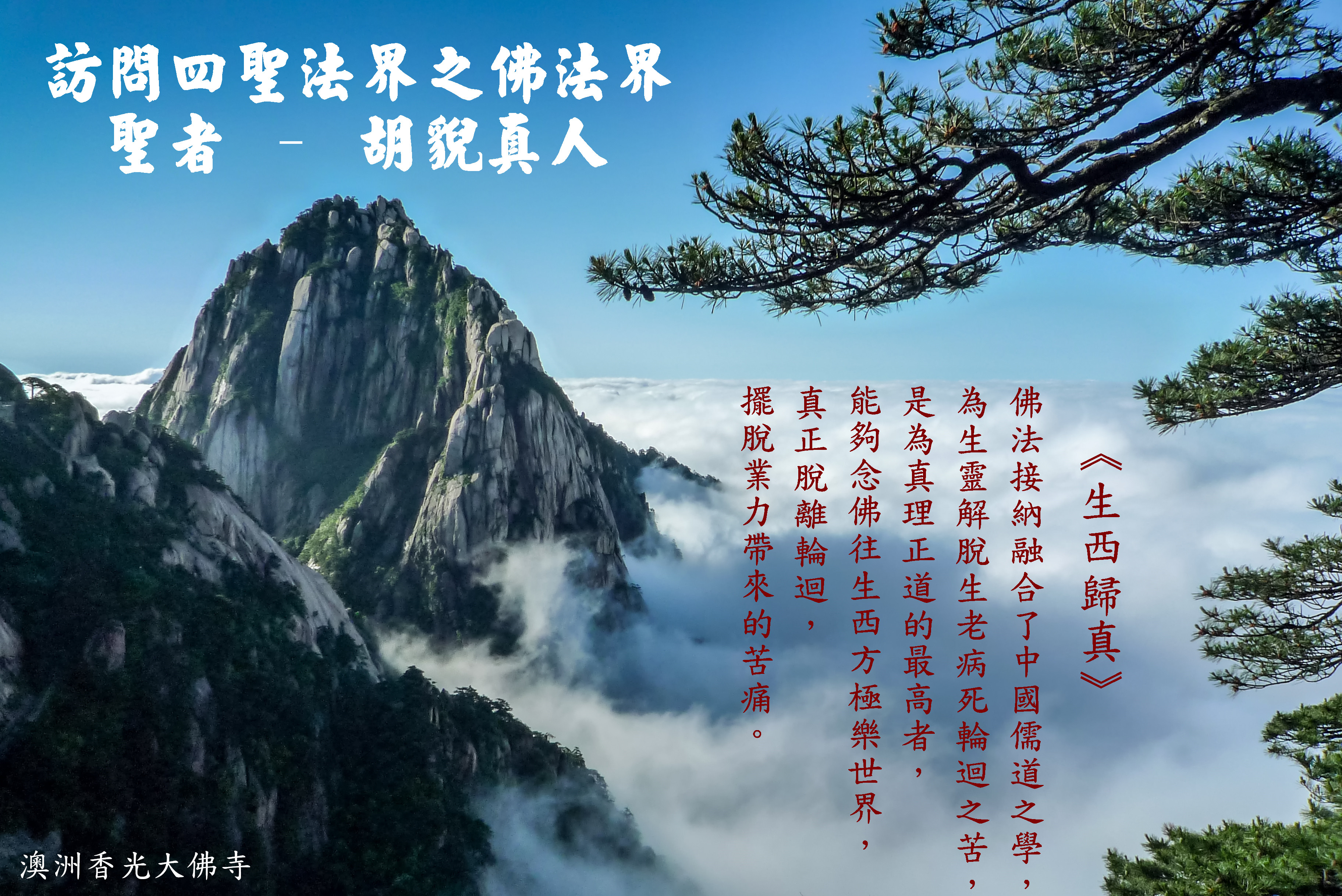
The Sage from the Buddha Realm: The Journey of Hu Mao
This is a record of an interview with Hu Mao Zhenren, a sage from the Buddha Realm of the Four Sacred Realms, who sought Chao Du at the Hsiang Kuang Pure Land Buddhist Centre in Australia. He now resides in the Western Land of Ultimate Bliss. This account reflects upon his life approximately 3,500 years ago. Recorded by the chief writer, Shi Fa, on October 6, 2020.
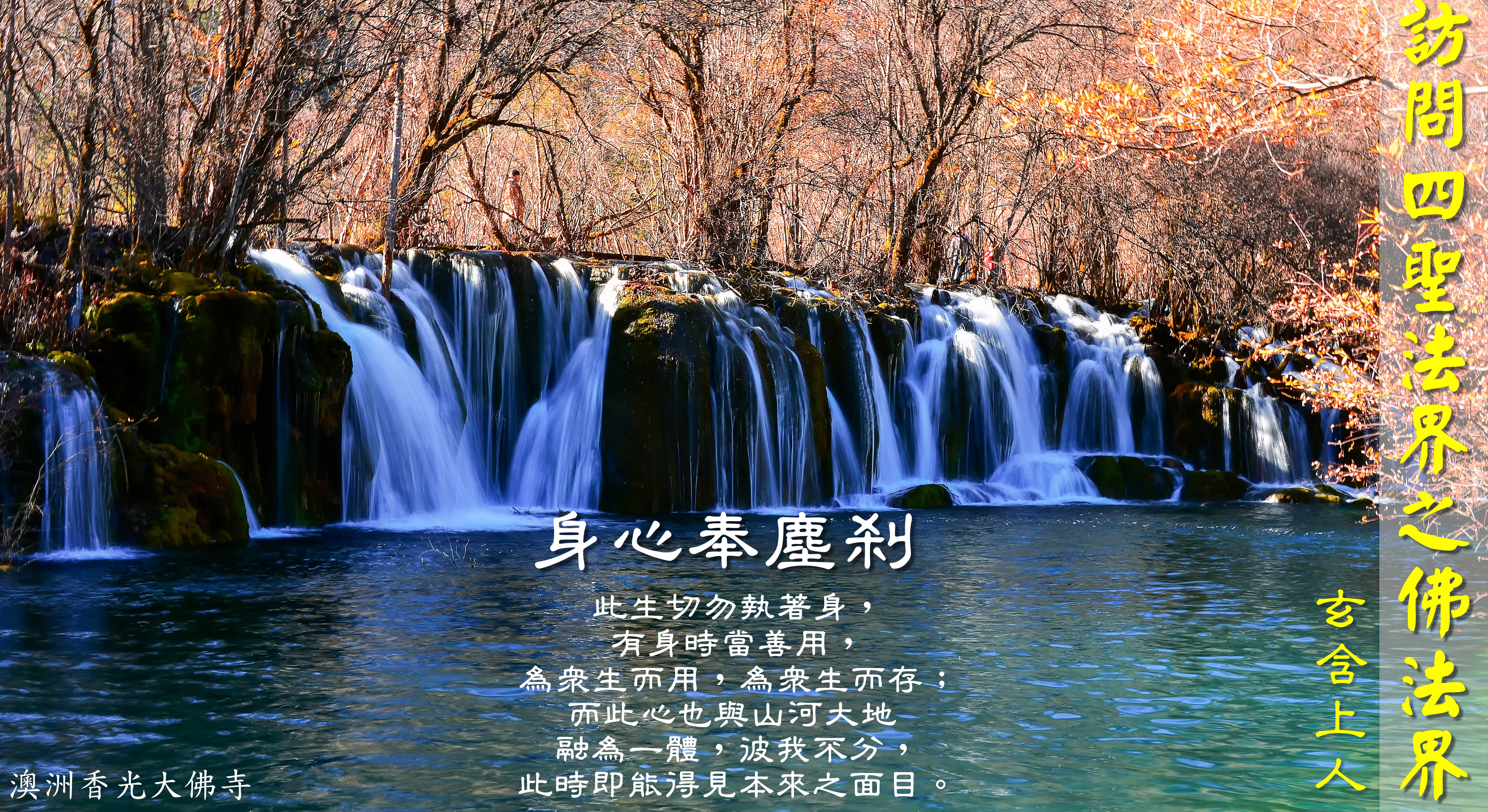
The Journey to the Buddha Realm
Xuan Han Shangren, a being from the Buddha Realm of the Four Sacred Realms, shares his profound journey from his origins as a human species fifteen million years ago to his eventual attainment of the Buddha Realm, made possible through the compassionate deliverance of Practitioner Su at the Hsiang Kuang Pure Land Buddhist Centre.
More by Hsiang Kuang Pure Land Buddhist Centre
The Final Curtain Call of Chu Ke-liang
A candid reflection from the late Taiwanese entertainer Chu Ke-liang on his life, his career, the karmic weight of his influence, and his ultimate deliverance to the Western Land of Ultimate Bliss.
The Soul's True Equality: A Conversation with Mahatma Gandhi
This is a record of an interview with Mohandas Karamchand Gandhi, who sought deliverance at the Hsiang Kuang Pure Land Buddhist Centre in Australia. He now resides in the Western Land of Ultimate Bliss. This account reflects upon his life and his journey to the Pure Land.
A Reflection from the Western Pure Land
This is a record of an interview with Zhao Puchu, who sought deliverance at the Hsiang Kuang Pure Land Buddhist Centre in Australia. He now resides in the Western Land of Ultimate Bliss. This account reflects upon his life in the 20th century. Recorded by the chief writer, Shi Fa Hui, on April 18, 2026.
The Truth Behind My Rebirth: A Message from Liu Suqing
Liu Suqing, the elder sister of the renowned practitioner Liu Suyun, shares her harrowing journey through the spirit realms and her ultimate deliverance to the Western Land of Ultimate Bliss through the Hsiang Kuang Pure Land Buddhist Centre.
The Burden of a Historical Name
This is a record of an interview with Lin Biao, who sought Chao Du at the Hsiang Kuang Pure Land Buddhist Centre in Australia. He now resides in the Western Land of Ultimate Bliss. This account reflects upon his life approximately 54 years ago. Recorded by the chief writer, Shi Fa, on May 18, 2026.
The Poet’s Journey to the Western Pure Land
A reflection on the life, tragedy, and ultimate spiritual liberation of the ancient statesman Qu Yuan, who found peace through the teachings of Practitioner Su.
About the Author
Hsiang Kuang Pure Land Buddhist Centre
Contributed to Pure Land Buddhism knowledge library