The Heart of the Buddha: Transforming Personality Through Chanting
Words of Namo Amituofo, Recorded by Venerable HaiZe
February 25, 2024
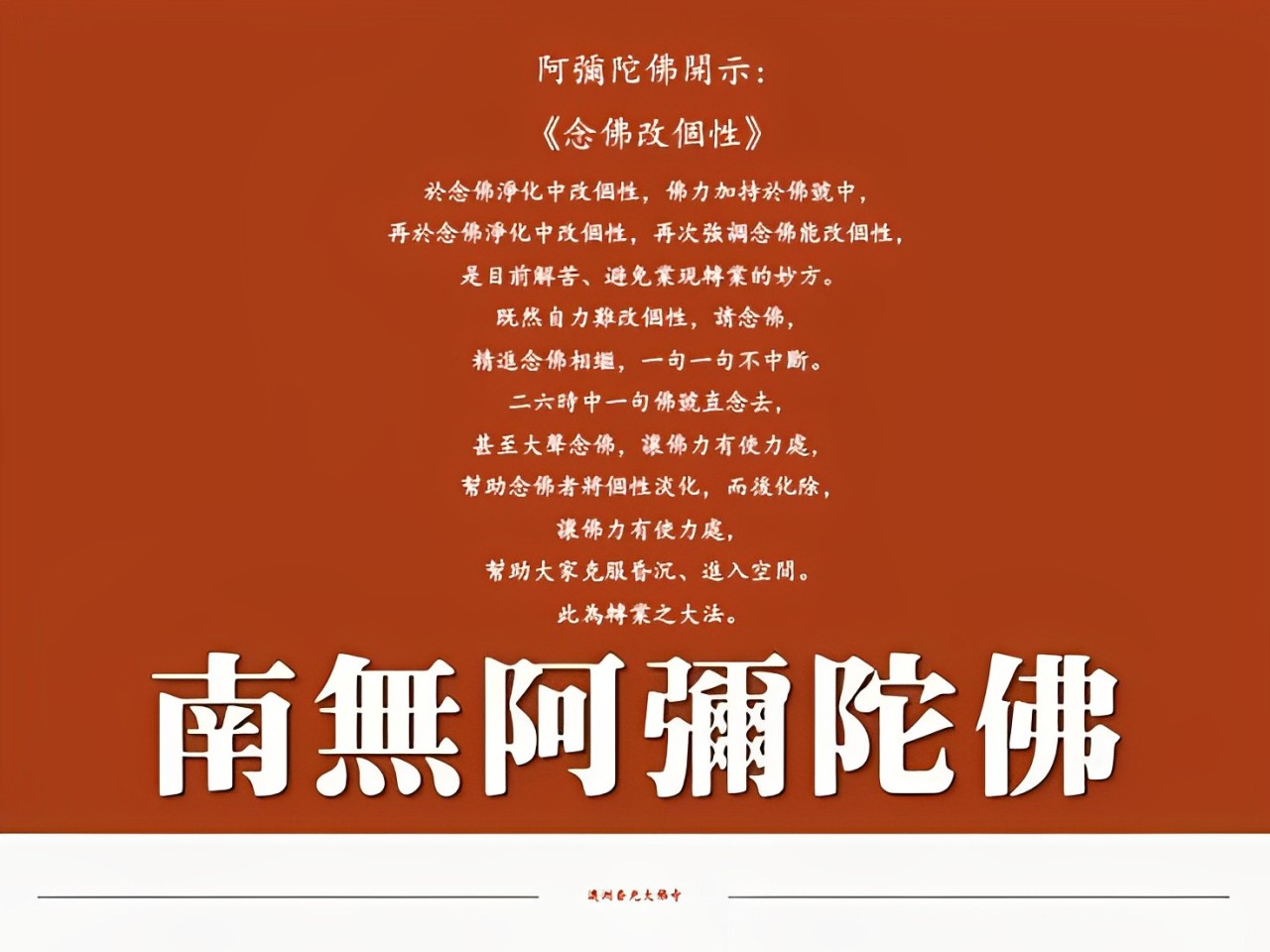
Words of Namo Amituofo:
As you look out into the world, what do you see beyond yourself? My dear children, open your hearts and open your eyes. If you truly wish to engage in serious practice, you must move beyond aimless, blind efforts. You cannot simply let the days pass by without purpose. Instead, you must cultivate a clear attitude and set a definitive goal. This begins with the power of a vow.
The Sacred Alignment of Vows and Action
A vow must serve as your guide, but it cannot stand alone. For a vow to be realised, it must be perfectly aligned with your actions. If your vows and your daily actions are not connected—if they run parallel to each other or, worse, drift further apart—then your goals will never be achieved. They will remain nothing more than distant, unfulfilled wishes. This is not the true intention of the Buddha’s teachings.
The Journey of Shakyamuni Buddha
Consider the example set by Shakyamuni Buddha. He witnessed the suffering of birth, aging, sickness, and death, and he vowed to find a way to leave this suffering behind. He endured the hardships of extreme asceticism, yet he found that this did not lead to the ultimate truth. It was only when he sat beneath the tree and witnessed the morning star that he attained great, thorough . He realised that all beings possess the same wisdom, virtues, and auspicious characteristics as the Tathagata. The only reason we cannot realise this is because of our delusions and attachments. By rediscovering his original nature, he attained Buddhahood.
Looking Inward to Find the True Self
Because he saw the suffering of the world, he sought the path of liberation. Through his practice, he understood that the solution was not to torture the physical body or to seek answers in the external world. Instead, one must look inward, toward the heart and the mind. You must peel away the layers of impurity to reveal your true self. Once you find your original, boundless wisdom, virtues, and auspicious characteristics, you will realise that you are already complete. You no longer need to seek anything outside of yourself. You will possess the strength and ability to remain unmoved by the pull of confusion and . You will no longer be bound by the chains of your past, and you will cease to create the karma that harms both yourself and others.
The Skillful Means of the Path
After attaining Awakening, one must pass this experience and ability on to future generations, helping more people find their way back to their true nature. This is the only way to truly leave suffering behind and find lasting happiness. However, we must be realistic: not every being has the opportunity to engage in such deep practice. Therefore, the Pure Land method of chanting Namo Amituofo, combined with the vow to be reborn in the Western Pure Land of Ultimate Bliss, is the most effective skillful means for all.
Chanting as the Ultimate Transformation
Through the purification that comes with chanting, you can change your personality. The Buddha’s are contained within the Buddha-name itself. I must emphasise this again: chanting is the most wonderful method for resolving suffering and transforming your karma before it manifests. Since it is difficult to change your personality through your own strength alone, you must rely on the Buddha. Practise diligent chanting, one phrase after another, without interruption.
You should chant the Buddha-name 24/7, even chanting aloud so that the Buddha’s power has a place to manifest. This will help you to soften your personality, eventually dissolving your negative traits entirely, and will assist you in overcoming the that hinders your progress, allowing you to enter into the space of the Pure Land. This is the supreme method for transforming your karma. Namo Amituofo.
More by Hsiang Kuang Pure Land Buddhist Centre
The Final Curtain Call of Chu Ke-liang
A candid reflection from the late Taiwanese entertainer Chu Ke-liang on his life, his career, the karmic weight of his influence, and his ultimate deliverance to the Western Land of Ultimate Bliss.
The Soul's True Equality: A Conversation with Mahatma Gandhi
This is a record of an interview with Mohandas Karamchand Gandhi, who sought deliverance at the Hsiang Kuang Pure Land Buddhist Centre in Australia. He now resides in the Western Land of Ultimate Bliss. This account reflects upon his life and his journey to the Pure Land.
A Reflection from the Western Pure Land
This is a record of an interview with Zhao Puchu, who sought deliverance at the Hsiang Kuang Pure Land Buddhist Centre in Australia. He now resides in the Western Land of Ultimate Bliss. This account reflects upon his life in the 20th century. Recorded by the chief writer, Shi Fa Hui, on April 18, 2026.
The Truth Behind My Rebirth: A Message from Liu Suqing
Liu Suqing, the elder sister of the renowned practitioner Liu Suyun, shares her harrowing journey through the spirit realms and her ultimate deliverance to the Western Land of Ultimate Bliss through the Hsiang Kuang Pure Land Buddhist Centre.
The Burden of a Historical Name
This is a record of an interview with Lin Biao, who sought Chao Du at the Hsiang Kuang Pure Land Buddhist Centre in Australia. He now resides in the Western Land of Ultimate Bliss. This account reflects upon his life approximately 54 years ago. Recorded by the chief writer, Shi Fa, on May 18, 2026.
The Poet’s Journey to the Western Pure Land
A reflection on the life, tragedy, and ultimate spiritual liberation of the ancient statesman Qu Yuan, who found peace through the teachings of Practitioner Su.
About the Author
Hsiang Kuang Pure Land Buddhist Centre
Contributed to Pure Land Buddhism knowledge library