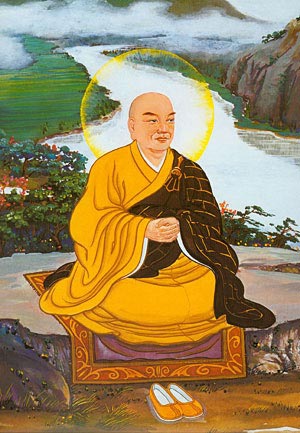
An Interview with the Spirit of Master Ouyi
Ending the Dusty Journey: Teachings from Master Chewu
The Essence of Sincerity: An Interview with Master Shaokang
The Great Deliverance of the Earth and Space: An Interview with Master Chengyuan
Aligning Hearts and Righteous Power: An Interview with Great Master Lianchi
The Dharma Body Deliverance: An Interview with Master Shandao
Record of Interviews with Deceased Modern Chinese Celebrities (Preface)
Interview with Xi Zhongxun (Former Vice Premier of the State Council of China, Father of Chinese President Xi Jinping)
Precious Interview Data from Chinese Elites Released on the Global Internet
Seeing the Peril of China, They Descend to Save the World
A pure heart, a new hope
Between the 29th of April and the 4th of May in 2017, the disciple Shi Haiyuan performed ten prostrations to the Buddha. With a sincere heart, I invited the Ninth Patriarch of the School, Master Ouyi, to join us. I sought to interview the Master regarding his life, his lineage, and the profound journey of his spiritual practice. I humbly requested his compassionate guidance and teachings, .
Master Ouyi replied: "I take up my brush to write for those who have come. We share an immeasurable and boundless connection within the Buddha-land."
I responded, "Yes, Master Ouyi. I have already prepared the memorial tablets for the sentient beings connected by karmic affinity. We are deeply grateful for your . Please, Master, share with us the magnificent story of your spiritual practice, Namo Amituofo."
Master Ouyi began:
"It is a magnificent morning for the Buddha's disciples. That you have the light of the path before you is a great blessing. The Hsiang Kuang Pure Land Buddhist Centre is a place of immense magnificence. To encounter such a chance in a thousand kalpas is no easy feat. That you can now reap the fruits of this life is a testament to the power of the Buddha's teachings."
"I grew up in a grand, wealthy estate. My grandfather, grandmother, uncles, and aunts all lived together under one roof. My father was the third son, and I was his only son—the eldest grandson of the household, receiving much attention and care. My uncle had three daughters, and my younger uncle was blessed with a son in his later years—that son is you. Thus, our relationship is rooted in deep karmic connections; we have met again because of our shared affinity. We are eleven years apart, and both of us have eventually taken refuge in the Buddha's path.
Let me first share how I came to be a disciple of the Buddha. I was born into a life of great privilege. My father and grandfather were strict in my upbringing; they never indulged me. Only my mother would occasionally find ways to let me relax, though I soon had to return to my diligent practice. My birth brought much hope to the family, particularly regarding the continuation of our lineage. Our family had long struggled to produce an heir, and my grandfather had even considered adopting a child, as our family held women in high regard. Although it was common for men of that era to have multiple wives and concubines, such practices were not permitted in our home. The men in our family were deeply loyal to their wives, just as my father was to my mother.
My parents had been married for thirteen years without children. My father was the second son. His older brother, my uncle, had passed away in an accident after fathering three daughters, and my younger uncle had also remained childless. Consequently, my father carried the heavy burden of continuing the family line. We sought out every famous physician, including the most renowned healers of the time. Every doctor would promise success after checking the pulse and prescribing medicine, yet for thirteen years, we were met with disappointment. Throughout this, my father never wavered in his respect and love for my mother, nor did he place any pressure upon her. My grandparents, though eager for a grandson, were reasonable and compassionate people. They were often more understanding than my mother, who would sometimes weep in her anxiety. No one in the house ever blamed her; we simply accepted the situation as it was. Our family was a scholarly, official household that had studied Buddhism for generations. My grandfather had been a high-ranking court official before retiring in his middle years to focus entirely on his spiritual practice. Because the court had provided a generous salary, we had enough to live on without needing to earn more. We lived frugally, dedicating ourselves to practice, and the entire family studied together. Any surplus resources were used to help the poor and save the world. We maintained excellent relationships with the local community.
"Everyone affectionately called my grandfather 'The Old Buddha.' He possessed a truly dignified appearance, and many local people believed he was an incarnation of Amitabha Buddha. Our family was unique in that we did not follow the custom of having multiple wives; our household was upright and pure. There was no lust in our home, save for the necessity of continuing the lineage. Under my grandfather's leadership, no one harboured such desires or habits. We each had our own daily lessons, and we lived together in mutual respect. My grandfather led the household well; there was no distinction of status, and even our servants were devoted to Buddhist practice. Many monastics enjoyed visiting our home to discuss the Dharma. My grandfather's knowledge of Buddhism was profound, even though he never became a monk. He did not oppose his children entering the monastic life.
My grandparents had three sons and one daughter. My aunt was married into the palace at a young age and became a favourite consort of the Emperor. My grandfather was most concerned for her. She was pure, dignified, and possessed great inner depth, but because the Emperor had taken a liking to her, she had to be sent to the palace. Everyone understood the nature of palace life, so my grandfather only asked that she recite the Buddha's name diligently, viewing this life as a way to repay past debts. He told her to keep her heart stable and to give of herself without regret, regardless of the circumstances, following the flow of causal conditions. He warned her never to seek out connections that were not natural, especially regarding the position of Empress; if the conditions were not right, she should never let fame or profit cloud her mind. He told her to simply do her best to fulfil her duties as a consort and, if possible, to help the court and the people. If she could not protect herself, she should at least keep her own heart cool and clear. These were the things my grandfather told me he had once shared with her.
My grandfather said my aunt was incredibly dignified and virtuous. She did, in fact, become the Empress for a time, but perhaps due to , she was framed by others. She bore the false accusations without a single word of complaint, repaying her karmic debt. She was poisoned to death, suffering greatly. Yet, when my grandfather went to the palace to collect her body, her face showed no fear; instead, she looked remarkably dignified. She was Empress Deming. She had been on the throne for less than three years and had no children. Only after her death did the court discover she had been pregnant with an heir. The Emperor regretted his actions, but it was too late. The court was always very supportive of our family, perhaps as a way to make amends for this tragedy. My aunt's virtuous governance was well-known, and her sudden passing caused great sorrow among the people. Because of the overwhelming attention and commentary, my grandfather chose to resign from his official post to maintain a pure heart. My aunt was born two years before my father, and her experience made our family even more detached from worldly affairs—whether things came or went, we saw it all as the result of the combination of karmic conditions.
"Everyone focused on their spiritual practice. My parents had also spent a long time setting aside worldly desires, and they had not been intimate for quite a while. Thus, my own appearance was truly an arrangement by the Buddhas and Bodhisattvas. My grandfather had always hoped that his descendants would truly dedicate themselves to the transmission of the Buddha's teachings, as the Dharma is so magnificent. However, with my uncle deceased, my younger uncle newly married, and my father managing the household affairs, no one was able to fulfil my grandfather's small regret of becoming a monastic to save the world. My grandfather had always wished to donate the family fortune to the Buddhist path, but he never encountered the right timing. This was not because he lacked the intention, but because he had a premonition that someone in the family would eventually become a monastic. He knew that monastics rely on the offerings of the ten directions, which is a heavy responsibility. He hoped to donate the family estate to a temple so that his descendants could focus on their practice without being indebted to the offerings of the ten directions. Yet, even at the age of ninety, he had not found the right opportunity. Although he had three granddaughters, none of them wished to become monastics. My grandmother, also eighty-nine, was usually accepting of fate, but she would occasionally pray fervently before the Bodhisattvas for the family to have a successor in the Dharma. My grandparents wanted to pass down the Dharma lineage, not just the bloodline. This is why, during a New Year's gathering, they proposed the idea of adopting a child.
My mother understood my grandmother's heart well. She also sincerely hoped to help and would often pray to the Bodhisattvas, asking for their compassion in bringing a child to us. My parents discussed it and decided to try once more. My mother made a great vow to donate one hundred catties of grain to help the local poor during the New Year, and during the Spring Festival, she and my father went to the temple to help clean the main hall. During this time, my parents were also working hard in the nights.
One afternoon, while my mother was kneeling to sweep the steps of the main hall, she accidentally slipped. Though she was unharmed, her delicate knees were slightly scraped. She felt a bit of pain and walked with a slight limp. At that moment, she felt a movement in her womb—a very strange sensation. After returning home, she continued to feel something peculiar. It was not an illness, but something so unique she could not describe it; she felt a force circulating within her. She understood this was an external power. Although it was gentle, she was puzzled. For seven days, my mother vomited and suffered from diarrhoea. The doctor could not find a cause. It did not seem to be the signs of pregnancy; she could not eat or even drink water, but she could drink 'Great Compassion Water'—water blessed by the Great Compassion Mantra. For seven days, she survived solely on this water. She was not hungry, and her spirit was excellent; it was just that this force kept circulating in her body.
Around the eighth day, a high monk came to the door to beg for food. My mother happened to be sitting in the main hall. She went to the kitchen to get some food to share with the monk. The monk took the opportunity to chat with her, and my mother told him about her strange experience. The monk just smiled and said, 'Pure . Virtue born of the Tathagata.' After saying this, he left. My mother did not quite understand the meaning, and when my father returned, she did not mention it, as it was common for monks to beg for food at our home.
After a night's sleep, my father asked how she was feeling. My mother then realised that the force had naturally disappeared after the monk left. That night, she had a special dream, but she could not recall it immediately. She had the same dream again that night, and for three nights in a row. In the dream, there was a purple-gold dragon circling in the sky. My mother watched it in wonder, and suddenly, the dragon flew down to the ground, saw her, and transformed into a young boy. The boy wobbled towards her, and she felt he was so adorable that she picked him up. The boy smiled sweetly, and then she woke up."
This dream inspired in the mother a profound longing to bear a child. The wish to become a mother was awakened, and she dreamt of this for several days. However, she dared not speak of it to the father. Having had no news of a pregnancy for over a decade, she feared adding to his burden, so she simply let the dream rest, leaving it to Causal Conditions. One night, the father suddenly felt a spontaneous closeness to her. About three days later, the mother felt a change in her body. She felt a heaviness in her abdomen, though she did not suffer from morning sickness. For some reason, her intuition told her that she was with child. She dared not make it public, so she quietly sought out a remote physician in the market, as the local doctors were all well-acquainted with their family and she wished to avoid any premature gossip. She hired a sedan chair and travelled dozens of miles, visiting many doctors along the way. Each one offered the same joyful news: Congratulations, Madam! The mother thought it must be true. That year, she was forty-one, and the father was forty-five. Upon returning home, she hired a physician to examine her one last time, both for confirmation and to have the doctor officially announce the happy news. The entire household was overjoyed, and even the grandfather offered fresh flowers and fruits to the Buddha in gratitude.
The grandfather was a man of very pure practice. As the mother’s pregnancy progressed, he spoke up during a gathering, requesting to perform the refuge ceremony for the child. He declared that regardless of whether the child was a boy or a girl, they must spend their life studying the Buddha’s teachings. The mother fully agreed with this intention. The grandfather gave the child the Dharma name Fa Lian, hoping that his grandchild would inherit the Dharma lineage, remain unstained like a lotus rising from the mud, and attain a high-grade rebirth in the Western Land. In truth, the grandfather’s intention was for this grandson to become a monastic to save the world. He had clearly foreseen that the child was destined for the monastic life and possessed the boldness required to save the world. The father, whose own practice was no less than the grandfather’s, understood this intention perfectly. He silently supported the decision, agreeing with the grandfather’s arrangement.
The mother gave birth to Fa Lian after approximately nine months and eight days. The birth was natural, and the mother felt no pain at all. She simply felt that the time had come, called for a midwife, and successfully delivered a baby boy who was dignified, fair, and plump. From the moment he was born, the infant emitted a natural, pure fragrance and his cry was resonant and strong. To celebrate, the family held a feast for seven days, offering food to all beings from the ten directions and dedicating the merit to the child’s birth and his future Causal Conditions. For over a month after he was born, the baby would smile at everyone he saw, and even when he was alone, he would smile with great . The grandfather told the mother that this child was a manifestation of a Buddha and was destined to become a monastic to save the world. The mother had never mentioned her dream of the true dragon, but hearing from the grandfather that the dragon was a manifestation of a Buddha descending into the world, she truly believed his words. She knew the child would eventually enter the monastic life. The parents did not resist this fate; rather, they were delighted. If their child could enter the Buddha’s gate, there could be no better path. Because they had deep faith in the Buddha’s teachings, they believed that following this path would allow their child to achieve even greater things in this life.
While he was still in her arms, the mother cherished every moment spent with Fa Lian. As he began to crawl and then walk, she often took him to the temple. The monastics there were very fond of Fa Lian’s appearance and would always smile and ask when he would be sent to join the monastic order. The mother would always smile and reply, Soon! Soon! In her heart, she knew that the time was indeed drawing near. Before Fa Lian turned four, the grandfather never questioned him about his studies, allowing him to spend his days playing with his mother. The grandparents enjoyed the happiness of having a grandchild, but beneath the surface, the grandfather was quietly observing Fa Lian’s roots.
When Fa Lian was five, the grandfather brought out the first sutra, The Amitabha Sutra, and read it to him as if telling a story. Seeing that Fa Lian was interested, he began to teach him to recognise characters and read the sutras step by step. In reality, the primary goal was to have Fa Lian begin studying the sutras and classical literature as soon as possible. The grandfather had prepared many texts long before Fa Lian was born, waiting for him to learn to read so he could begin his studies. At the time, Fa Lian did not fully understand the meaning of The Amitabha Sutra; he only felt that his grandfather was describing a world that was bright and sparkling. As the grandfather read, Fa Lian would see this brilliant, sparkling world. He had never seen such a place in the world, so he would simply smile at it. Within that world, there were many tall, dignified, and kind beings. Fa Lian felt a sense of familiar intimacy and would always smile happily at them.
As his studies began, the grandfather meticulously arranged every lesson, including the practice of calligraphy. Although the grandfather was ninety-six years old, he was still very robust. In fact, when it came to educating Fa Lian, he seemed to grow younger and more vibrant. He was kind to Fa Lian, yet also extremely strict. The father shared the same expectations as the grandfather and followed his arrangements entirely. The mother took on a supportive role, often drinking tea with the grandmother and aunt in the courtyard or living room, or going to the temple to perform prostrations, recite the sutras, and chant the Buddha’s name, leaving Fa Lian to focus entirely on his studies. The aunt had been married to the uncle for over six years; she was very compassionate and longed for a child, but had no news of a pregnancy. However, seeing the miraculous example of her sister-in-law, she believed in letting things follow their natural course and letting the Buddhas and Bodhisattvas make the arrangements. Thus, she lived her life with a happy and free heart. The whole family treasured Fa Lian, but no one had a sense of possessiveness, for everyone understood clearly that this child had come to save the world and would sooner or later take refuge and be tonsured.
From the age of six, Fa Lian began to study the sutras diligently. Every day, the grandfather set strict requirements, demanding constant practice. The stack of sutras the grandfather required him to read grew higher and higher, with fixed times for completion and requirements for copying the texts. During the cool hours of early morning and late evening, the grandfather allowed Fa Lian to play in the courtyard. Fa Lian never left the house, as the grandfather had arranged all his studies, and he did not need to attend a private school; everything was taught by the grandfather himself. As the years passed, Fa Lian studied many different sutras. The grandfather continued to make arrangements, and despite his advancing age, he spared no effort in his teaching. Everyone cared for Fa Lian deeply, and he was well aware of this.
As Fa Lian grew older, he began to develop his own thoughts and views. However, in front of his kind grandfather, he dared not express them and suppressed them instead. He began to feel stifled and occasionally fell into a bad mood. As he approached his tenth birthday, he had learned much, but there was still so much more to cover. Sometimes he felt irritable, but he dared not speak of it, keeping his unhappiness to himself. Once, he caught a cold and felt drowsy and very uncomfortable. Yet, seeing his grandfather still bringing stacks of scriptures for him to recite, Fa Lian felt angry. He felt fearful of his own reaction towards his kind grandfather, who would celebrate his one-hundredth birthday in two months—an event the whole family was busy preparing for. How could he feel this way? Unable to suppress his anger, he hid and cried for an entire night. The next morning, he dared not let his elders see his red, swollen eyes, so he stayed behind closed doors, saying he wanted to practise calligraphy to calm his mind. When called for meals, he said he was not hungry. After a day of fasting, no one disturbed him. Although his anger subsided, he could not find the cause. The grandfather’s birthday banquet concluded smoothly.
Soon after, happy news came to the family: the aunt was pregnant. She had always been cheerful and optimistic, and not knowing she was pregnant, she had remained very active. By the time she discovered the pregnancy, the child was ready to be born. She had assumed she was just gaining weight due to her age and had not paid attention to her cycle. She was nearly fifty when she gave birth to a son. The child was healthy, though slightly small. The grandfather said he also possessed the appearance of a monastic, and everyone was overjoyed. Fa Lian was also very happy and begged his grandfather to let him play with his younger brother. The baby was dignified and adorable, bearing a resemblance to the Fa Xi of today. However, because he had to focus on his diligent practice, Fa Lian did not have many opportunities to spend time with his brother.
Fa Lian began to face his own rebellious psychology. How could this be? He could not understand where these came from. Why were they so strong, profound, and real? Yet, in reality, there was no reason for such thoughts in a home where he was cared for so tenderly. To distract himself, he studied the scriptures even more diligently, but because his heart was troubled, he could not focus. The sharp-eyed grandfather saw everything but said nothing, waiting silently for Fa Lian to come and ask. One afternoon, Fa Lian finally went to ask his grandfather. He told him that he had a burden on his heart that he could not resolve and wished to go into seclusion to find the answer. The grandfather nodded and smiled, saying, Good! Fa Lian went into seclusion for about seven days, as he was only eleven and his family would worry if he stayed longer. During those seven days, he actively sought the answer. He searched the sutras for guidance but could not find it. He chose to calm his mind, meditate, relax, and ask his inner heart what his true thoughts were and why they were so intense. At that moment, he saw a vision—the same one he had seen often as a child: the bright, sparkling world, the Western Land of Ultimate Bliss. Fa Lian wept, crying aloud. After weeping, he took out The Amitabha Sutra. He began to read and study it again, and it seemed that the words between the lines held a deeper meaning.
At that moment, I realised that the anger within my heart stemmed from the pressure of receiving too much concern. My true aspiration was actually rooted in a singular world: the Western Land of Ultimate Bliss. The beauty of that Pure Land filled me with longing, which in turn made me willing to engage in diligent practice. Looking back on those days, the many mixed methods of study were not because the scriptures themselves were poor, but because there were simply too many of them. It was difficult to digest such offerings, and they did not align with the realm I yearned for. Some scriptures were overly profound; not only did I fail to find Dharma joy in reading them, but I also could not grasp their underlying meanings. This accumulation of frustration became a burden I could no longer bear, leading to the arising of anger. The inner world is alive; excessive suppression easily leads to a backlash and a rebellious spirit. This is quite natural. It also showed that I lacked meditative concentration and that my mental cultivation was insufficient. Whenever a thought arose, it would immediately cause ripples of disturbance.
A negative thought arose in my heart. I began to wonder if I was a bad person, for how else could I have such evil thoughts and views? I began to resolve to learn, wishing to find a way to sever these thoughts. I wanted to put in the work on my heart, but how does one actually cultivate the heart? If I did not explain these causes and consequences clearly, it would be difficult to ask my grandfather for guidance. Furthermore, I dared not face this side of myself; it was truly difficult to speak of. Therefore, I decided to silently observe myself first, to find out where the problem lay. Why was I still so ungrateful in such an excellent environment? My inner world went through several upheavals, yet on the surface, I tried my best to project a calm and smooth demeanour. However, I was suffering greatly. This feeling was so bitter, and I did not want it. I kept searching within. To stabilise my turbulent emotions, I kept finding things to do to forget myself. I believed that if I did not pay attention to these feelings, everything would fade away. This was my first attempt at self-forgetfulness.
I turned to nature, I practised calligraphy, and I read the scriptures. Finally, one afternoon, I settled into the Amitabha Sutra. How could it be written so profoundly, with such deep meaning hidden within? In truth, during those days of inner rebellion, I had set aside the daily practice required by my grandfather and tried my best to avoid his gaze. On that afternoon, I saw what I had been looking for: that focusing solely on the Amitabha Sutra was so full of Dharma joy. The reason was not the quality of the scripture itself—scriptures have no good or bad; all Dharma gates are taught personally by the World-Honoured One and are fundamentally without discrimination. Everything depended on this heart. The fluctuations of the past few days were caused by this heart, and the discrimination and attachment toward the scriptures were also caused by this heart. I began to realise that practice is not about studying the treatises or the entire . In reality, the practice is very simple: it is just this complex human heart.
The human heart is made of flesh, and hidden behind the skin, only one knows whether it is good or bad. Yet, if there is still a distinction between internal and external in one's practice, how can this practice be integrated into a vessel of purity? Great Master Lianchi had cultivated well. Although I had never met him, I admired his works and classics, even taking him as my model. My grandfather’s room contained his books. My grandfather’s study was comparable to a library of the Tripitaka, not only because of his own tireless efforts but also because of the eminent monks who visited from all directions, often bringing precious collections of scriptures. The first time I wanted to truly speak clearly with my grandfather was to ask about the works of Great Master Lianchi. Because I was still young, only my grandfather and father understood those books. My learning was almost entirely managed by my grandfather, with my father merely assisting. Therefore, as the saying goes, he who tied the bell must be the one to untie it. I had to find the root source: my grandfather.
When I knocked on my grandfather’s door, it was half-open, as if he already knew I was coming. I knocked three times and stepped inside lightly. I saw my grandfather writing calligraphy, his image quite dignified and majestic. I dared not move too much, fearing I would disturb his work. I stood there for a while, swallowing carefully. Just as I was about to retreat and come back another day, before my foot had even stepped out the door, my grandfather coughed and asked, "Since you are here, why do you not sit down?" He then asked, "Do you not need to study at this time?" This startled me, and I nervously replied, "Grandfather, I have something I would like to ask you." My grandfather stood up, took out a stack of books, and asked, "This is what you need, right? Take them and read! They will be helpful to you. I have already read them, and they are suitable for your lifelong study." In my nervousness, I hurriedly accepted them without looking and, after thanking him, ran back to my room.
In truth, my grandfather was not such a frightening person; he was very kind and approachable. I was only so nervous because it was the first time I had wanted to express my own opinion. Sitting at my desk, it took a long while for my thoughts to settle before I looked at the books I had brought back. These works were written by Great Master Lianchi! I was so happy, and without wondering how my grandfather knew, I began to read volume after volume. They clarified many of my misunderstandings about the Amitabha Sutra. For three days and three nights, I was immersed in the scriptures and the Master’s works. Even at meal times, it took many calls before I would hurriedly eat a few bites and run back to my room to continue my work. After reading through them once in three days, I was filled with Dharma joy. I happily ran to find my grandfather to tell him my thoughts after those three days and asked for his permission to focus solely on the Amitabha Sutra. My grandfather smiled and said, "After going around in circles, you have finally grown up and have your own ideas. Very good, very good!" I did not expect my grandfather to laugh heartily and agree, and the emotional fluctuations of the past few days vanished like smoke.
I also discovered the seriousness of the situation: the heart truly can govern everything about a person—joy, anger, sorrow, happiness, greed, anger, delusion, arrogance, and doubt. As long as you have a heart, you are swayed by it. This is truly terrifying! The three days of Dharma joy made me believe that by diligently studying the profound meanings of the scriptures, I could at least subdue my chaotic mind for now. Therefore, I worked hard, reading over and over again, hoping to remain settled within it. I dared not imagine when my emotions might fluctuate again. Practice is truly wondrous. When I truly resolved to work hard, I found limitless Dharma joy and truth within every word and sentence of the scripture. As I delved deeper into the profound meanings, my heart became calmer and purer. I could not help but wonder: how should this path of practice be walked?
Because of the birth of my cousin, the household was filled with joy again. My grandfather kept him by his side almost constantly, and the level of affection everyone showed him made it hard for me to see him, as he was always being carried about. My cousin’s innate wisdom and cleverness were deeply loved by the adults. As he grew year by year, his wisdom became increasingly admirable. When my cousin was three, my grandfather began teaching him characters and called me to join in. The three of us would study in the pavilion or other quiet places. My cousin always liked to ask me countless questions. Although I answered with a calm heart, I knew my heart was tainted. I was jealous of my little cousin’s innocence, cuteness, and carefree practice.
My father had once admonished me that because our capacities were different, the methods my grandfather used were also different, but all were treated with sincerity and were one entity. Because my cousin was intelligent, guiding him in a natural way helped him rediscover his wisdom and original nature. Since he was still young, too many demands would only cut off his wisdom-life. Although I clearly understood my father’s meaning, I still committed the error, and my grandfather saw it instantly.
As we were reading, my cousin fell into a sweet sleep. My grandfather closed the book, stood up, and told me, "You must understand that as long as one stands on the path of saving the world, one must do their utmost to support and praise those who are capable." My grandfather said my cousin was capable and would need my help in the future; he also said I was a rare talent, and that by supporting each other’s growth, the world would have hope and the Buddha’s teachings could be propagated. Furthermore, my grandfather said that we were of the same root. Even if I encountered all kinds of people in the future with different roots, there is always someone better than oneself. This jealousy and obstruction is an extremely unacceptable mistake that will ruin a person’s prosperity and . My grandfather spoke in a calm and steady tone, but I knew in my heart how ashamed I was! My little cousin’s sleeping face was so innocent. He was only three at the time, and I could not help but ask myself: how filthy can the human heart be, and how cool and pure can it be? Only through practice—that was the answer I gave myself at the time.
To subdue this bad thought of jealousy, I worked hard to be good to my cousin, giving sincerely and trying my best to suffer a loss, selflessly offering praise and care. After I truly made these efforts, I really saw my cousin’s goodness; he was truly that good. This heart of jealousy is truly terrifying. If one makes a mistake, it truly obstructs the capable from saving the world on the path of practice, and the consequences behind this are something I cannot predict or understand. I finally understood how terrifying this fault was! Yet it originated from a tiny thought. Seeing the subtlety and terror of the heart once again, I knew that only practice could subdue it.
Over these years, I have not left home for a single step, following my grandfather’s requirements and guidance to practise in seclusion. Through these realisations and insights, I have deeply felt the importance of the heart. Practice is truly about cultivating the state of this heart. I wonder if the so-called "realm" refers to the level of this heart? Many people in their practice pursue this so-called height of the realm, but if there is a realm, there is no realm; having a realm and having a heart is equivalent to practising in vain. No realm and no heart is the true realm. How profound is this heart? I could not help but ask myself this, and I began to harbour the idea of going out to explore the Truth. That year, I was fourteen.
On a cold winter night, I fell quite ill. The sickness was severe, and although my family invited many physicians to treat me, none of their remedies proved effective. During the day, a virtuous monk arrived. Everyone assumed he had come to discuss the sutras with my grandfather, but the monk simply smiled, walked into my room, and took my small hand in his. He whispered to me, "The lotus blooms brilliantly, rising from the mud. Free from all defilement, it benefits the multitude." After speaking this brief, profound sentence, he left behind a simple prescription consisting of only two herbs: Angelica and ginseng. No one had ever seen this virtuous monk before, yet his appearance was so dignified that everyone present was struck with awe. Regardless of whether his words were true or false, the medicine was prepared immediately. I drank it for seven consecutive days, and I truly began to recover. While cleaning the room, my mother discovered a small silk pouch containing a note that read: "On the hillside in the eastern suburbs of the city."
My mother’s puzzled expression piqued my curiosity. When she handed the note to me, I replied instinctively, "I want to go." However, my mother said she did not know what was there. That night, I asked my father and learned that there was nothing special at that location—it was merely the wild, undeveloped outskirts of the eastern district, a place rarely visited by anyone. What, then, was the significance of this pouch? It remained a source of deep wonder for me. After I recovered, I returned to my diligent practice of the sutras, and my relationship with my cousin became quite harmonious. In truth, my cousin had always been kind; it was my own heart that had been the problem. The pollution of the heart only harms oneself, never others. I continued my diligent practice, but the cloud of doubt in my heart grew heavier. On my fifteenth birthday, I could no longer contain myself. I asked my father if I might be permitted to travel to the eastern suburbs.
Along the way, I wanted to understand how much progress I had truly made in my practice and how far I still had to go. I had always longed to see the mutations of the human world in the streets and to examine my every thought and intention, to see how much purification had actually taken place within the dust of the mundane world. My father agreed with my motivation but insisted that I first obtain my grandfather’s consent. He took me to ask him. My grandfather said, "This journey will not take just two or three days; it will take a month. Can you do it?" I did not think too much about it and replied with a smile, "I am willing." My grandfather offered a peaceful smile and granted my request. Although my mother expressed her approval, she could not help but worry, as I had never known hardship. My father signaled for her to be at ease, for only by enduring hardship could one truly strengthen the heart of the Way. He trusted my capabilities and supported my quest to find the Truth.
I packed my bags quickly and set out the next morning. My luggage was very simple: I carried only one or two sets of plain clothes and a small amount of money for travel expenses. With my bag slung over my shoulder, I stepped out of the house. Early that morning, I did not bid farewell to my parents or grandparents; I simply pushed the gate open and left. Yet, I realized that everyone knew, for in my peripheral vision, I could see them watching me depart. I did not look back; I simply focused on moving forward.
I had not intended to take any money, but my mother had urged me to do so. I carried about thirty taels of gold, but I understood clearly that the purpose of this journey was to see how far my true heart was from the path of practice. I knew I had never experienced hardship; I had been well-protected and well-arranged for throughout my upbringing. I had not been to the markets or streets for a long time, and I wanted to know what suffering was. I firmly believed that only by tasting the various states of human life could I see what I was lacking. The ancients often said that reading ten thousand books is not as good as travelling ten thousand miles, and this is truly the case. In the sutras, I had perceived what I lacked, but I did not fully understand what it was. It was like knowing that a certain thought or intention should not be acted upon, yet finding it difficult to control myself. I knew that laziness and indulgence were not to be pursued, yet I was often disobedient and undisciplined. I could not help but ask myself if I had simply not suffered enough.
Along the road, I witnessed so much suffering among the people, so much impermanence in the human world, and so many conflicts between people. An infinite sense of shock and sorrow welled up in my heart. I wanted to stand up and help; this courage filled my entire being. Along the way, I distributed all the money I had brought, keeping nothing for myself. In fact, the bag I had packed originally contained no money at all; the funds were what my mother had insisted on putting in. Out of respect for her compassion, I did not refuse, and carrying it allowed her to feel at ease. I walked continuously toward the east. Having never travelled before, everything I saw was novel. I also carried the pouch left by the master, and the information on it was to head straight east to the hillside in the suburbs. I did not know how far it was from the city to the suburbs, and I had no experience, so I survived by gathering wild herbs and fruits along the way. I had chosen clothes made of coarse material so that I would not stand out.
It took me three days and three nights to walk out of the city gates. I experienced some hunger while in the city, but my heart felt no fear, for I understood that I wanted to know to what extent I could endure and what "suffering" truly was. Every face I saw in the city was deeply imprinted in my heart. Each unique appearance nourished a different inner world, and personal habits and egos differed according to family backgrounds. When these people gathered, it created a marvelous collision and friction; the human heart is such a unique structure. I realized that this trip had not been in vain. I cherished every step I took, for each was so precious. I was grateful that I had been able to come out, and I was grateful to my grandfather, father, and mother for protecting me so well. I finally understood what it meant to be content. Now, I was covered in dirt, cold, and hungry, but my heart was filled with Dharma-joy, as if I had found a precious treasure. Yet, I knew clearly that my problems were not yet solved; I still had to continue exploring the bad habits of my heart that might emerge at any moment.
Before dawn, I rose again to continue my journey. At night, I would secretly sleep in the corners of market stalls, seeking a little shelter. Today, I passed through the city gate. Looking back at the large gate with the characters "East Gate" hanging above it, I could not help but weep. I had never seen the city gate before, but stepping out of it gave me the feeling of leaving home. I felt as if I wanted to become a monastic. In truth, I had never thought about this question before, and my family had never mentioned it; they had simply cultivated me as a talent for Buddhism. But I had never really thought about how my future should unfold. I was a specialist in Buddhist sutras, which is quite different from Confucian or Taoist thought, and I could not go to the capital to seek an official career. So... what was I striving for?
In the depths of my dreams that night, I actually thought about such a mature and difficult question. As I pondered, I fell asleep. I dreamed of a brilliant, shining world—could it have been the Western Land of Ultimate Bliss? I saw that my head was shaved, and I was wearing the plain clothes I wore now, but over them, I was draped in a kasaya! In the dream, I saw myself looking so dignified, kneeling at the knees of a great monk. This great monk seemed... before I could see clearly, a drop of dew fell on the tip of my nose. The cool temperature woke me up, and the sky had just begun to brighten. Warm, clear light illuminated the silent earth. This dream, which I only half-understood, left me with a lingering resonance.
In the suburbs, I slept under a large tree at night. It had been nearly half a month since I left home. With the daily travel, I had become thinner and darker, but I had also matured and grown taller; the clothes I had brought were now too short. One afternoon, hungry and thirsty, I arrived in front of a house. I could no longer hold on. I knocked on the door, hoping to beg for a little water to quench my thirst. I knocked for a long time, but no one answered. Just as I was about to turn away in frustration to continue my journey, the door creaked open. A young woman was holding a newborn baby girl. Seeing my pale face, she signaled for me to come inside quickly. Because I was severely exhausted, once I entered, I felt like a deflated balloon and could not regain my energy for a long time.
The young woman kindly prepared some thin porridge to help me slowly recover my strength and asked me to stay for a few nights before leaving. She did not ask about my background; she simply cared for me with a sincere heart. I stayed for three nights, and my strength recovered quickly. I did not dare to disturb her further, so I expressed my deep gratitude for her compassionate care over the past few days, hoping to repay her kindness in the future. I told her that I had fully recovered and no longer needed to stay, wishing to bid her farewell. The young woman only smiled gently and packed a large amount of food for me to eat on the road. I joyfully accepted this generous gift of compassion. Although it was not a rare treasure, it was dry food that allowed me to be full and warm. Its value might not have been more than a few coins, but it was a great gift.
With a heart full of gratitude, I left the young woman’s house. As I walked, I thought deeply: this young woman was none other than Avalokiteshvara Bodhisattva, who saves all beings from suffering, and the baby in her arms was the young girl under her seat. I understood this truth because of her appearance; her compassionate face reminded me of the Avalokiteshvara Bodhisattva worshipped by my mother. When I was shocked by this realization, I returned to the house, but no one was there, and it looked dilapidated and ruined. A warm current flowed through my heart. Looking at the remaining dry food in my hand, I knew this was a real fact, yet before me lay only desolation. I strengthened my heart of the Way and continued to move forward without looking back.
I vowed that I would find the Truth and subdue my own heart, though at that time, I had not yet considered becoming a monastic. I continued to press forward. The landscape was a flat, suburban expanse; there were no hills in sight, nor any sign of the information I sought. I dared not let my diligence falter, treating every hardship as a form of tempering. Whenever I felt utterly exhausted, I would focus my entire heart on chanting the holy name of Namo Amituofo. It seemed nearly a month had passed, yet I had discovered nothing. My physique, however, had grown significantly stronger and more robust. The clothes I had brought were now far too small and short. Although I had lost weight due to the instability of my diet, I appeared full of vitality. I thought to myself that if I did not turn back now, I would not be able to return to the city in time. Thus, after walking for a few more miles, I encountered the great monk I had travelled thousands of miles to find. He was smiling at me with such kindness and warmth—a smile so compassionate and radiant!
In truth, there was no such thing as a mountain slope. The hidden meaning of this experience was to urge me to break through the mountain-like obstacles within my own heart. The true high mountains exist within the mind. All feelings—courage, fear, terror, positivity, negativity, joy, sorrow, sadness, or anger—are all manifestations revolving within the heart. When you have climbed over these layers of mountains, is it not the bright, luminous path ahead that you meet?
I walked with the great monk for a distance. His capacity for Compassion, Joy, and Selfless Giving filled me with deep reverence. I felt completely humbled by his dignity, following silently behind him without uttering a word. As we walked, we returned to the bodhimanda. Stepping into the temple, I felt such a magnificent magnetic field!
Only then did the great monk turn back and speak, "Child, have you finally grown up and come out to pursue your practice?" I looked at him in astonishment. "Do you know me?" I asked. The great monk replied, "Of course I do not know you, but we are all disciples of the Buddha. The day is getting late; I have already hired a carriage to take you part of the way. You will be home in about three days. Remember, if you truly wish to become a disciple of the Buddha, I will be waiting in the same suburban area in three months. If we have the Dharma affinity, we shall meet again. It is getting late, so let us part for now." The great monk compassionately helped me into the carriage, pressed a handful of food into my hands, and instructed me to have a good sleep and not to think of anything at all.
When I returned home, my grandfather naturally understood everything. I had never imagined that the great monk would know me so thoroughly! Three days passed quickly, and I arrived home. After seeing my father and mother, I went to my grandfather's door. Before I could even knock, he walked out, laughing heartily. He said only one thing: "It is time to become a monastic, is it not?" His words shocked me. My grandfather truly knew everything. My father also understood clearly; everyone had been prepared and was very supportive of me embarking on this path of leaving the home life. I was happy, but inevitably, I felt some fear. It was not fear of anything specific, but simply a worry: could I truly become a good disciple of the Buddha? Since childhood, I had seen so many eminent monks and virtuous ones visit our home, all of them possessing such dignified appearances. Could I ever be like them? I could not help but doubt myself, but I quickly shifted my thoughts. Regardless of everything, one must act and move forward. Empty speculation is always mere illusion; one can never win a battle by only discussing strategy on paper.
I had been home for some time, but why had I not seen my cousin? I could not help but ask my mother. She replied that my uncle’s family of three had gone to the mountains for a closed-door retreat and would not return until the following spring. It was November, winter, when I returned home. My appointment with the great monk was in three months, which would coincide with the time my cousin returned. It would be perfect to say goodbye. My cousin was truly excellent, with magnificent Dharma affinity; he would surely become a virtuous one in the future.
I began my daily lessons again, restarting my studies. After returning to my practice, everything felt different. My state of mind and my thoughts seemed as if I had been given a new brain. I had not taken out these sutras for quite some time, but after reading the Amitabha Sutra deeply once more, I wept. I cried for a long, long time. Even when I had seen the world of golden light before, my heart had not been particularly stirred. This time, however, my heart felt so sore and sorrowful. This feeling made me yearn to save this worldly realm. I felt deep gratitude in my heart for the cultivation my grandfather had provided me. Truly, I was grateful. Without my grandfather, I would not have understood these things. Among so many beings reincarnated through the cycle of rebirth, who could be as fortunate as I, possessing so much? Now that I was about to leave the home life, my heart was filled with countless emotions. I was so grateful that the world still possessed Buddhas and Bodhisattvas. Without them, I would have found it difficult to endure the purification of the Buddha’s teachings.
Three months passed quickly. My uncle’s family returned, and my cousin had become even wiser. The wisdom of a small child is always so innocent and pure. I told my cousin, "Brother is going to become a monastic. Do you want to become one too?" Unexpectedly, my cousin did not even ask why and replied, "Yes." I asked him, "Do you know what it means to become a monastic?" He replied innocently, "I don't know." I asked again, "Then why do you want to become one?" At that moment, he said something that shocked me: "Because the world is broken, and what brother does, I want to do too!" This not only made me marvel at how a four-year-old child could say such things, but it also encouraged me to strive diligently to achieve spiritual achievements and save all beings. I became willing to cut off and let go of everything, sacrificing my life for the sake of beings, not for the sake of my own survival.
On the night before my departure, my grandfather came to my room and gave me all the classics and manuscripts he had collected throughout his life. He earnestly instructed me to conduct myself well. Once I stepped out of this door tomorrow, there would be no home to return to. No matter what, I must not look back; life only moves forward, and there is no retreat. I saw that my grandfather’s eyes were filled with tears he was trying to hold back. After all, I had been raised by him, and I had never dared to disobey his words. My grandfather was already one hundred and five years old. He said, "Whether I am present or not does not affect your ability to achieve spiritual achievements. The falseness of the physical body will simply disintegrate at the end of life. Only evil seeds affect one's spiritual achievements; you must ensure you plant good causes and reap good fruit!" He also instructed me that my cousin would eventually tread the path of a monastic, and he hoped I would guide him. After saying this, he returned to his room.
The next morning, I did not see my grandfather. That was the last time I saw him. Recalling the bits and pieces of our time together, I dared not think about it anymore, for he had truly given me so much! Even with his always-serious expression, he had cared for my growth with the most sincere and subtle attention. I was left only with overflowing gratitude; I let go of all other superfluous emotions. I had promised my grandfather one final vow: to achieve the salvation of the world. After finishing the morning meal, my parents and my uncle’s family said goodbye to me one by one. Everyone sent me off with smiles. My parents expressed that they felt the same as my grandfather: once I stepped out of this door, they did not want me to look back. They wanted me to be a good son of the Buddha for my entire life. I nodded in agreement and stepped out of the house. From that moment on, my life began to change in ways I had never known.
The last thing my family did for me was to hire a comfortable carriage. I left without taking anything, arriving at the temple alone, carrying only the classics my grandfather had left me. When I reached the temple, the great monk was already waiting at the gate. He welcomed me with a smile and said that today was an auspicious day. That very day, I completed the ceremony of tonsure. Kneeling at the feet of the great monk, I became a little novice, a monastic. In truth, having experienced this journey, I understood clearly that shaving the head only confirms one's status as a monastic. A true monastic must work much harder than ordinary people, for they carry the heavy responsibility of the Tathagata’s work upon their shoulders.
I knew clearly what I had to do: achieve the salvation of the world. Life is impermanent and filled with suffering! I wanted everyone to be reborn in the Western Pure Land. I became a monastic at about sixteen and completed the full at eighteen. Because my grandfather had laid a deep foundation in the classics for me over the years, it was a great help in my practice. I began to integrate into the life of the monastic community. My teacher led us with compassion and bestowed upon me the Dharma name "Zhi Xu." He had always been searching for the "child of the rising sun"; this was the hidden meaning of the secret message he had left behind. What could appear on the mountain slope at the eastern city gate if not the "rising sun"? It represented vitality and hope. My teacher hoped that my wisdom would save more beings, just as the rising sun brings hope to the world.
I am deeply grateful for my teacher’s expectations and hopes. I understand clearly that I have stepped onto a true, great path. Through honest practice, I will eventually reach the Western Pure Land. Throughout this process, I constantly remind myself not to allow my heart to retreat. I must remain as steadfast as I was at the beginning, never turning back, and constantly nurturing a heart of compassion. Only then can I be considered a true practitioner. A good monastic should possess good conduct, good practice, good cultivation of the heart, good states of mind, and be pure and good. There is no one who is truly evil; all that one sees is Goodness. Good practice means focusing on one’s own path and spreading the teachings, never losing the spirit of the Way, and never slacking in diligence. Good cultivation of the heart means having no thoughts or attachments, being ever-alert, and treating the heart as a bodhimanda. Good states of mind mean that there is no state to speak of. One should not be attached to fame or wealth, not be stained by the or , not speak of worldly affairs or right and wrong, not follow false paths, and not engage in destructive ways. Everything is a manifestation of the Tathagata responding to the heart.
Namo Amituofo
When I first became a monastic, I was filled with a wealth of scriptural knowledge, yet I truly did not know how to walk the path of reality. I did not dare to overthink it; I simply began to practise. Through my practice, I cultivated the Precepts, which led to meditative concentration, and from that concentration, wisdom naturally emerged. Upon entering the monastic community, there were many things I did not understand and many adjustments to make. Fortunately, the relationship between my fellow monastics was harmonious. In those early days, the temple was not large. Looking around, one could see everything at a glance. There were only two or three of us. Located in the suburbs, it was a place rarely visited by others. Regardless of its size, it was truly a quiet and purebodhimanda.
Each of my fellow monastics possessed a serene demeanour. We were all dignified and focused on our meditative concentration. We spoke very little, often communicating through our mental notes rather than words. We understood that excessive speech easily leads to complications and drains one's vital energy. Unless it was for the purpose of teaching or necessary daily communication, we kept our words brief. How could one maintain a pure practice if one were constantly distracted by worldly gossip and idle chatter?
The temple was filled with a profound silence, broken only by the sounds of insects and birds. Everyone was diligently applying themselves to their practice. In fact, some of my fellow monastics did not even notice my presence until several days after I had arrived. It was a truly quiet place, perfect for cultivation. Upon my arrival, my teacher instructed me to seek meditative concentration. He did not mean for me to enter a state of trance or leave my body as in the Chan tradition; rather, he meant a state of wisdom and meditative concentration amidst activity. His intention was for me to calm the disturbances brought about by the secular world.
Although the difference between a layperson and a monastic may seem to be merely a shaved head, the significance and the responsibilities carried by a monastic are vastly different. My teacher managed the temple exceptionally well. All of us were kept within a stable magnetic field, free from unnecessary fluctuations.
When a fluctuation did arise, it became glaringly obvious within that stable environment, making it easy to detect. For a long time, my own mind was the most turbulent, and I often felt deeply ashamed. Yet, without such rigorous training, one would remain lost in the chaotic dust of the world, unable to perceive the thoughts and intentions of others, or even one's own. Even when our every thought and intention turned our world upside down, we would remain oblivious. Because of the atmosphere created in the temple, I was able to clearly understand that every thought and intention is ultimately empty. I felt so happy and grateful to Namo Amituofo! To be able to study in such a bodhimanda—was this not exactly what I had been seeking?
It took me five years to gradually stabilise my state of mind into one of stillness, but this was only the beginning. Why is a state of stillness only the beginning? It is because I had only managed to sever the coarsest afflictions and habits. The true work was only just beginning. This is why my teacher insisted that we start by learning meditative concentration. Only then can one truly learn, and only then can the path of practice be walked steadily and solidly. Over these five years, I truly put in the work on my character, facing constant tests and tempering. Through this experience, I realised how subtle our thoughts truly are. After severing the coarse, one must then explore the subtle within the subtle. The distance from stillness to absolute tranquility is a profound journey of practice. To put it simply, this is the path to become a Buddha. If the work of cultivating the mind is so profound and mysterious, how can a practitioner who has not yet begun hope to succeed?
Focusing solely on external appearances is such a simple form of practice. For instance, wearing fine robes or grooming oneself creates an external sense of achievement, but the work on the heart is not something that appears just because one says it is there. I do not mean to judge other practitioners or doubt their spiritual achievements; rather, I wish to emphasise the importance of inner work. If a dignified bodhimanda is not rooted in one's own heart, where else could it possibly be?
By the fifth year, the Pure Land path had become my favourite. However, because I had studied various sutras since childhood—including those of the Chan, Vinaya, Pure Land, and Tiantai schools—I had a broad understanding. Yet, as I had requested of my grandfather, I returned to the Pure Land school and the Infinite Life Sutra. The coarse fluctuations of my mind had settled, and in the process of subduing them, I came to know myself better. The heart that had once resisted my grandfather's discipline was revealed to be a deluded heart. Beyond mere dissatisfaction, the true underlying thought was simply that things were not going my way.
For years, I carefully examined why these thoughts arose, where these fluctuations came from, and what they meant. Were they good or bad? A monastic is not a worldly person; one must be cautious with every thought and intention.
A monastic is capable of being a guide for celestial beings and humans. If one's thoughts are unwholesome or negative, would one not be leading followers and fellow monastics into an unimaginable fog? How could they ever escape? Future disciples of the Buddha, teachers of celestial beings, you must be cautious!
Becoming a monastic means not only leaving one's home but also letting go of . Any trace of emotion or every thought and intention is creating . How many of these thoughts are truly rooted in Goodness? Most are rooted in the negative. Can one avoid creating karma in such a state? If these thoughts influence the Goodness of those around us, it is a grave matter. As the ancients said, "It is better to stir the waters of a thousand rivers than to disturb the heart of a practitioner." Fluctuations are contagious; they pull and influence others. If they are positive, that is well, but if they are negative, how can one bear the responsibility?
One must maintain control over one's own mental notes. Cultivating the mind is the true practice. The essence of the Pure Land school lies in the heart; the heart itself is the bodhimanda, the Pure Land. If practice stops at the words of the sutras, it is merely academic study, not the true practice of the Buddha's teachings. It remains on the surface, and no matter how diligently one works, one cannot go deep, and the practice will inevitably be flawed.
Having understood these principles, I felt it was time to further my studies. To ensure I continued to progress and evolve, I resolved to go into seclusion once more to study the sutras, specifically the Infinite Life Sutra. I had confidence that this deeper immersion would yield new insights. After informing my teacher and receiving his consent, I began my preparations. I had not looked at the manuscripts my grandfather left me for a long time. During my seclusion, I read them again and found many insights and understandings clearly transcribed within the sutras. These were surely the fruits of my grandfather's lifelong practice.
Among the papers, I unexpectedly discovered a bank draft and property deeds—the family's entire assets. I recalled my father mentioning my grandfather's only wish: for his descendants to carry on the Buddha's lineage. The final act of Generosity (Giving) of the family estate was to be dedicated to the temple where his descendants took refuge. I was moved to tears. As I had just entered seclusion, I could not leave to find my teacher, so I set the assets aside and focused on my practice.
My grandfather's annotations were concise and proved immensely helpful in understanding the deeper meanings of the sutras. His dedication inspired me to make a vow: I hoped to annotate the sutras so that future disciples could delve deeper into the treasury of the sutras and draw closer to the Buddha's teachings. I was about twenty-eight years old when I went into seclusion. I spent three to five years studying the Infinite Life Sutra and produced the first edition of the Commentary on the Infinite Life Sutra. I continued to refine it, wishing to leave behind the essence that would best help the Buddha's disciples. The sutras are truly a miraculous treasury of the Dharma; their depth is inexhaustible. Each time, depending on the conditions and the timing, new states and insights naturally emerge. The Buddha's teachings are truly a magnificent path; those who know how to enjoy them can truly find joy in the Dharma.
After more than three years of seclusion, I began to ordain and teach disciples. I taught them exactly what my teacher had taught me. Upon leaving seclusion, I transferred the assets my grandfather had left behind to the temple, allowing it to expand, lead more beings, and cultivate more disciples who were willing to make vows. The temple flourished, and my fellow monastics went out to engage in spreading Dharma. My own disciples grew from hundreds to thousands. As the scale of the temple increased, management had to become more rigorous.
Of course, the magnetic field was difficult to maintain in the same way it had been when I first arrived. Perhaps it was my own inadequacy in training them well. Ordaining disciples requires immense effort, as one cannot mislead them, and the lineage of spreading Dharma cannot be compromised. I focused on interacting with my disciples, teaching them to understand the Dharma, and knowing the character of each one intimately. This required personal guidance and contact, accompanying them step by step as they grew. I demanded that my disciples be selfless and that they must put in the work on their hearts. I placed great emphasis on their inner interactions, especially that no evil thoughts or intentions should be entertained. Greed, anger, delusion, arrogance, and doubt were all unacceptable. As more disciples joined, I understood that my responsibility was unavoidable.
One day, a disciple arrived who looked very familiar. He simply said quietly, "Venerable, I have grown up." I was thirty-six years old that year, and this young man was my cousin, now a twenty-five-year-old youth. He had a dignified appearance and an air of authority, no doubt the result of years of rigorous training and education. We shared a silent understanding: we never spoke of our secular past, and we no longer addressed each other by our secular names. We were both deeply grateful for this connection. He was ordained under me, and I gave him the Dharma name Ding Lianxing, Hui Xu. He was treated like all other disciples, with no special favouritism. Lianxing made great progress, and at times, I could not help but praise him.
In the pursuit of spiritual achievements, the greatest fear is being tethered by the entanglements of emotion. This is a grave taboo, especially between a teacher and their disciples, or among fellow practitioners. The Pure Land Dharma Gate naturally requires the purification of all karmic stains; how much more so must we cleanse the defilements of emotional attachment! One must certainly sever the ties of affection and bid farewell to worldly attachments. Humans are creatures of desire, and the roots of emotion grow in the most subtle of ways. Any attachment that hinders your rebirth in the Western Pure Land is something that must be relinquished.
I have repeatedly admonished my disciples that when children first enter the gate of practice, there are many aspects that require the teacher’s careful guidance and reminders. I have always spared no effort in my warnings and instructions. This is precisely the purpose of the ancient requirement that a student should rely on their teacher for ten years. If one is in a state of confusion—neither fully understanding nor truly grasping the path—it is a highly unstable state of body, mind, and spirit. Without the experienced leadership of a teacher or a true spiritual friend, one might stray from the path without even realising it. What a waste of talent that would be.
Whenever my disciples show the slightest fluctuation in their minds, I am immediately aware of it and will shout to stop them. This strict education is born from the fear that these children might take a wrong turn, for the consequences are difficult to bear. In practice, one must fear the creation of new karmic causes, as the resulting effects are hard to repay. Depending on the individual capacity of each disciple, the teachings I provide vary accordingly, as I teach in accordance with their specific Causal Conditions. In truth, every monastic disciple is exceptionally talented. There is not one who is not a person of great potential, and each is a vital part of the Dharma lineage. The difference lies solely in their practice.
Attainment in practice can either increase or regress. I have always been extremely careful in training my disciples, focusing my entire heart and energy on their developmental path. My own well-being is of no importance; as long as the Buddha’s teachings can be successfully passed down and the True Teachings can flourish forever, sacrificing myself is entirely worthwhile.
Whether they come because they have heard of our reputation or because they seek a pure environment for cultivation, the number of disciples under my guidance continues to grow, and the temple is constantly expanding. Because the monastic community is vast, these external displays of grandeur are not what matters. What is important is how to keep the mind of every disciple on the right track. Among the disciples, those who are more outstanding and exceptional are trained to lead the newcomers. When I give Dharma talks, I address all disciples, but I also provide specific teachings for the senior practitioners—those who joined the monastic community earlier. I hope that through our collective strength, all disciples can achieve the best possible practice and eventually pass these teachings on to their own disciples. This approach serves both as training and as a way to ensure that the entire community benefits.
My perspective and direction in propagating the Dharma never deviate from the goal of rebirth in the Western Pure Land. We guide all beings toward the Western Land of Ultimate Bliss because the most fundamental and ultimate Dharma Gate is that which seeks liberation and great freedom—the Pure Land school. Seeking the Dharma within one's own heart is the essential key to practice. For a practitioner, beyond personal liberation and purification, the most important task is the transmission to future generations. The position a practitioner stands in is like a connection between lines; every line and every point is crucial. If one part is missing, the Dharma lineage is no longer complete.
While it is easy to pass down the written words of the sutras, it is not easy to transmit the spirit, the core purpose, and the true skills of the heart. Since ancient times, the teacher-disciple transmission has been an essential path. Every practitioner must begin by learning from a teacher, and every practitioner will eventually become a teacher themselves. Is transmission not, therefore, an obligation and responsibility that every practitioner must possess? The reason the Buddha’s teachings have drifted away from the True Teachings generation after generation is precisely because of flaws in this transmission. A transmission that is not in accordance with the Dharma loses its true meaning and becomes the primary cause for creating negative karma.
Throughout my journey, from seeking the Dharma in my heart to finding a teacher, from secluded cultivation to passing the Dharma to my disciples, everything I have experienced has been a process of tempering my true self. Where is this true self? Some search through all the sutras and treatises yet fail to find it; others visit all the great schools and sects yet do not necessarily find it. Where is the true self? Observe your heart and reflect upon yourself, and you will see it. Is it difficult? It is not difficult at all, provided you are truly willing to practise and learn. The Buddha said that the Tathagata is the Tathagata, and everyone possesses this nature originally. So why have you fallen into the three lower realms today? Why are you caught in the cycle of rebirth? Why are there differences in wealth, status, and fortune? All of these are manifested solely by your own heart.
Although this heart is merely a pulsating lump of flesh, if you underestimate it, the price you pay will be immense. At the very least, it can be fatal; at worst, it can lead to an eternity of suffering. How can it be so serious? It is because your heart is a small universe. If you think good thoughts, it is good; if you think bad thoughts, it is very bad—it responds to your heart’s desires. The heart seems ordinary, but if it stops beating, do you not die? There is no room for negotiation. If your heart is filled with filth, have you not invited all the corresponding karmic retributions?
Is it so easy to transcend the cycle of rebirth? When you are judged in the hells, who can say how long the term will last? The heart is truly important. If you have the opportunity to cultivate this heart, your blessings are truly great; you must cherish them well! If you enter the Buddha’s gate but only cultivate the superficial appearance while nothing inside has changed, then you are a person without blessings, and you are destined to remain trapped in the cycle of rebirth. I have been fortunate in this life; I have had enough blessings. From a young age, I have been very concerned about the fluctuations of the heart, actively seeking to overcome and change them. With the compassionate guidance of the Buddhas and Bodhisattvas, and the virtuous guidance of my grandfather and parents, I, Ou-Yi, have had the opportunity to understand what a heart of liberation is and what it means to attain liberation.
It was only after a long journey that I understood the principle of having "no heart"—or "no-mind." This seems simple, but how many have truly realised it? If there were many, then the cycle of rebirth in the six realms and the sea of suffering in this world should be empty by now. Whether it is easy or difficult depends entirely on how one puts in the work. The depth of one's attainment lies in how much of the Precepts, Concentration, and Wisdom one has cultivated, and whether all delusions, discriminations, and attachments have been completely severed.
Everyone possesses the Tathagata within their own heart. Over these years, I have continuously nurtured new disciples and assisted my lead disciples in managing the temple and its affairs. Many have also gone out to propagate the Buddha’s teachings everywhere, like a great tree spreading its branches. The tree grows stronger and stronger; its spreading branches and leaves sway in the wind, interacting with the outside world and transmitting the Dharma lineage. As the tree grows more robust and the leaves become denser, the roots deep underground—though invisible to the physical eyes—become thicker and stronger, working harder to absorb nutrients and transport them to every part of the tree.
I play this role, standing at the very end, supporting the growth of these children so that each may display their own beauty. Even as the branches reach their tips, they may bloom with beautiful flowers or bear sweet fruit. It is a joy to see the students surpass the teacher; I praise and support those who are capable. If one were to harbour jealousy, could the tree grow? If the beautiful flowers at the tips were to wither, the tree itself would die, unable to absorb the sunlight and nutrients. Even if the roots are strong, the tree needs the leaves to absorb sunlight to survive. The entire tree operates in an endless cycle; if one link is missing, it cannot survive alone, just as if a link in the Dharma lineage is missing, it cannot be passed down.
This example also illustrates that jealousy is unacceptable; it is a cause for the hells. If the transmission of the Dharma lineage does not grow stronger, how can the Buddha’s teachings flourish? Every part and every role is very important; one must never overlook them or become arrogant. Arrogance only leads to one's own drowning. No matter how well one has cultivated, it can be destroyed in an instant because your arrogance makes you invisible to others. If a branch of a tree absorbs nutrients well and grows exceptionally tall, reaching the sky, those standing under the tree will never see how magnificent that branch should have been. Is that not a pity? And those who truly wish to see it might try to climb the tree, but because of the excessive arrogance, they might accidentally get hurt and fall to the ground.
You must know that arrogance is a very undesirable state of mind. Even if it is innate, it must never be allowed. All monastics should be like the earth or the roots of a tree, standing at the lowest position to provide for all connected beings, using their own strength to support the community. This is what it means to be a monastic.
I am Ou-Yi, and I dare not call myself a master. Even today, I am willing to be the roots deep beneath the soil, nourishing the growth of the entire Dharma lineage, simply because the Buddha’s teachings are truly excellent education that must not be lost. As I grow older, I have increasingly stood in the role of transmission and promotion. The time I spend working is dedicated to my writings. My works have never been long-winded accounts of my own thoughts or opinions. I only hope that by providing more experience or principles, these sutras or compilations will make the path of practice easier for future disciples of the Buddha, allowing them more time to save beings and fewer setbacks. This is my only wish.
My only blood relative in this world, Dharma Master Lianxing, has learned very well. At thirty, he voluntarily left the temple to propagate the Buddha’s teachings and take charge of the temple. Although I am not swayed by personal affection, I truly admire this junior disciple. He has only been a monastic for five years; it is hard to imagine how much effort his grandfather put into cultivating him. I believe his uncle and aunt would be comforted to see this. The Buddha’s teachings are truly magnificent. Even if we do not speak of personal affection or family ties, being able to work together to grow and save this world is even better, preventing us from drifting in the cycle of life and death. Sometimes people might live in a drunken stupor, which would be a great pity! If one person can save one more world, how wonderful that would be!
I am very grateful for all the Causal Conditions that allowed me to become a monastic. I am truly grateful for this world, this land, every flower, every blade of grass, every tree, and the nourishment of the water. If not for all of this, where would Ou-Yi be? I am merely a monastic who receives offerings from the ten directions, a worker who serves the public and saves the world. As long as I have a breath left, it is my duty to work hard! I am over fifty years old, and I understand that my time is limited. My body is not tired or declining; it is still very robust. The wonderful thing is knowing that time is truly short, so I must strive to leave more of the transmission for this world and examine the Dharma lineage of future disciples even more carefully.
However, I, Ouyi, have never spent time contemplating how long I might live. Each day, upon waking, I simply rouse my spirit and ensure that not a single moment is squandered. I strive to leave as much as I can for this world, for every bit I leave behind offers that much more benefit to others. Therefore, I deeply cherish every inch of time. Looking at the grand picture, I understand clearly that the moment of completion will be the time for me to withdraw and depart. From my youth, I have yearned for that day of rebirth in the Western Pure Land. Although I have never calculated when that day might arrive, I know with certainty that my destination is that magnificent, ultimate shore.
This is the very purpose of my transmitting the Dharma lineage: to lead all beings to rebirth in the Western Pure Land. Perhaps my own abilities are limited, and there are countless beings in this Jambudvipa world who require saving—a task I may not be able to fulfill for every single one. However, my greatest goal is that every one of my disciples possesses the attainment to lead others to rebirth in the Western Pure Land. While I may not be able to oversee the entire vast situation, I can certainly watch over these disciples, which is well within my capacity. As long as I am alive, I will continue to work diligently for one more day.
Around the age of fifty-six or fifty-seven, I understood that my time was truly drawing to a close. Everything I needed to accomplish had been fulfilled. Each day, I simply sat in quiet Buddha-recitation. As for the management of the temple and the teaching of the sutras and treatises, my disciples had already surpassed me. One day, I felt a calling and informed my disciples that I wished to go out to visit Venerable Lianxing. Regardless of the circumstances, the bond of blood still compelled me to show my concern, for it was a promise I had made to my elders in my lay life—to look after Lianxing as he grew. In truth, ever since Lianxing entered the gate of the monastic community, he had almost never asked for help or favors. In fact, since his ordination ceremony, due to my busy schedule, I had barely seen him. Even when he wished to travel to spread the Dharma, I only learned of it through others, as I was always occupied with my own role in spreading the Dharma.
It is a sight that brings me great joy to see senior disciples protecting their juniors, supporting one another as they grow. Harmony within the monastic community is essential, and mutual encouragement is naturally a necessity. I have heard from the children that the number of disciples under my guidance has reached the tens of thousands. In truth, I have never counted them, for I wish to save anyone who is connected by karmic affinity. Although I may not be able to remember every single one, I know that the senior disciples who are aware of their whereabouts will surely protect them. I have always taught my children that they must be like a family; the elder brothers must lead the younger ones, for if a family is scattered, it would be a regret that lasts forever. From what I know, the children have truly supported one another, and I am deeply comforted by this.
When I saw Venerable Lianxing again, I could not help but be moved. The child had grown so well! When he saw me arrive, he respectfully performed three prostrations. I gestured for him to stop, but he insisted, as this was his final expression of respect to his elder brother. Lianxing understood clearly the purpose of my visit that day. He had truly grown into a fine practitioner, and I had fulfilled my promise to my elders. There was no need for many words; we understood each other's heart perfectly.
I returned to my temple, having long since handed over the leadership to my disciples. My heart was without any attachments. This life has not been lived in vain; I have done my utmost, and there is no loss. Venerable Lianxing, Faxi! How wonderful it would be if one day you find your true self again! I sat upright in body and mind, without notifying any of my disciples. I did not inform anyone; I simply chanted the Buddha's name, freely and at ease. Because I knew there were no more attachments, my heart was calm and peaceful. I had returned home! When the disciples discovered me, the sky had already darkened, and my physical body emitted a rare fragrance, completing the life of Ouyi. I am grateful for the compassion of the Buddha. If I were to come again, I would strive even harder on the path to save the world. This is my vow: may the Pure Land teachings flourish, and may we all be reborn in the Western Land together.
This message was recorded by the Buddha's disciple, Shi Faxi, as the chief writer.
Master Chewu shares profound insights on the nature of the Dharma-Ending Age, the vital mission of Practitioner Su, and the urgent necessity for all beings to awaken from the cycle of rebirth.
Master Shaokang discusses the profound nature of sincerity, the vastness of space, and the compassionate work of Practitioner Su in saving infinite sentient beings through the power of Namo Amituofo.
Master Chengyuan shares his profound insights on the power of the Pure Land practice and the miraculous efficacy of Practitioner Su’s Dharma-Body Visualisation Deliverance in resolving the global pandemic and saving sentient beings across all realms.
Great Master Lianchi reflects on the profound suffering of beings in the Dharma-ending age, the unwavering dedication of Practitioner Su, and the miraculous power of collective Faith, Vows, and Practice in transforming the world.
A candid reflection from the spirit of Elizabeth Taylor, who shares her journey from the blinding lights of Hollywood to the serene, transformative teachings of the Buddha in the Western Land of Ultimate Bliss.

Michael Jackson shares his journey from the pressures of global fame to the peace of the Western Pure Land, revealing the truth behind his life and his ultimate deliverance.
Helen Keller, the renowned deaf-blind philanthropist, shares her journey from the darkness of the ghost realm to the light of the Western Pure Land of Ultimate Bliss, guided by the compassion of Namo Amituofo and Practitioner Su.

Albert Einstein, once considered the most brilliant mind in human history, reflects on his life, the nature of 'science' versus the Truth of the Dharma, and his existence in the Western Pure Land.

Ronald Reagan, the 40th President of the United States, reflects on his life, his political career, and his profound journey from the depths of hell to the Western Land of Ultimate Bliss through the compassion of Namo Amituofo and Practitioner Su.
This is a record of an interview with Kim Il Sung, the founder and former leader of North Korea, who sought deliverance 32 years ago. He now resides in the Western Land of Ultimate Bliss.
Hsiang Kuang Pure Land Buddhist Centre
Contributed to Pure Land Buddhism knowledge library