The Miracle of the Namo Amituofo Couplets
An Interview with the Spirit of Venerable Keming
A Testimony from the Western Pure Land
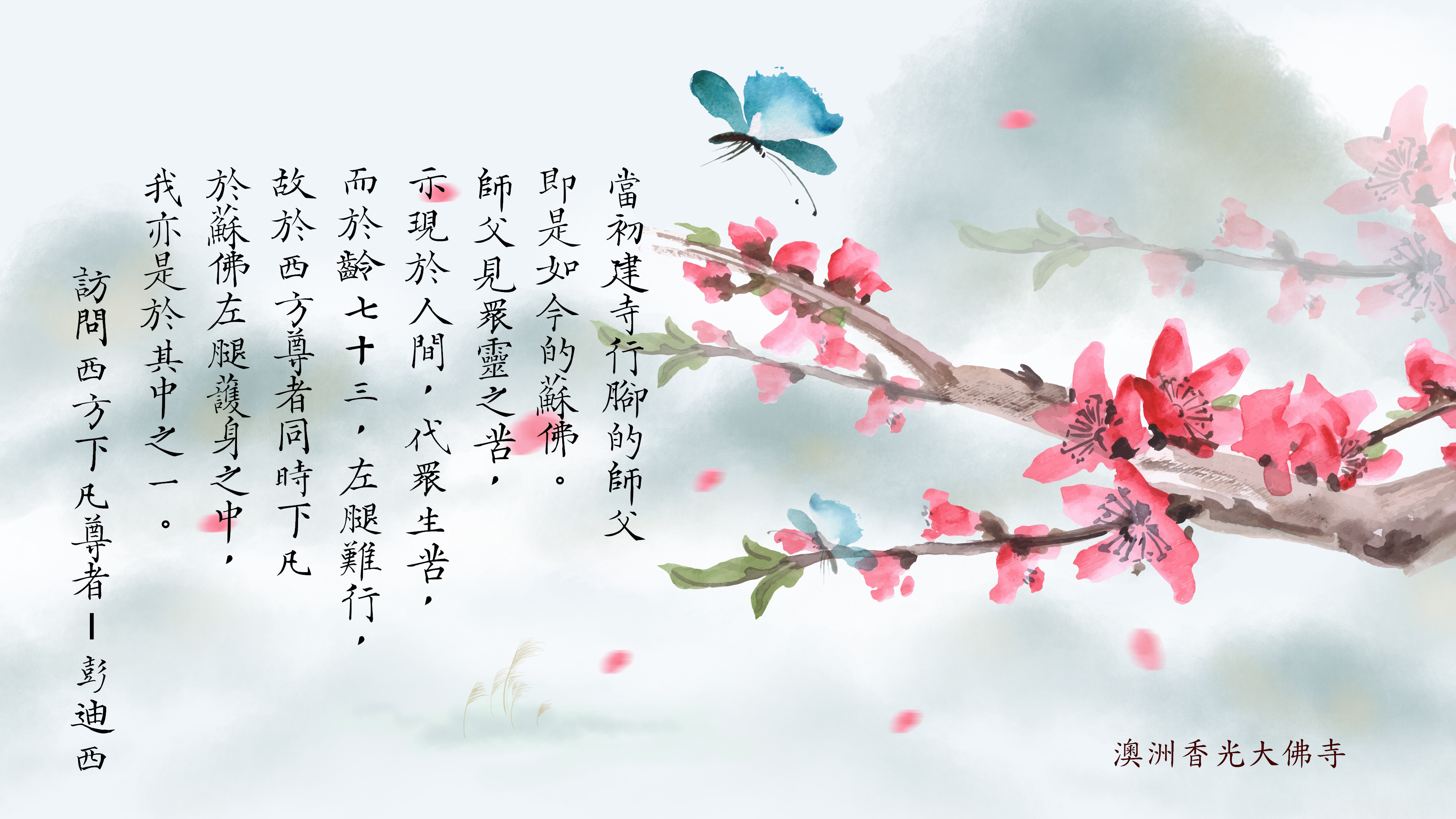
This is a record of an interview with the spirit of Venerable Keming, who sought at the Hsiang Kuang Buddhist Centre in Australia. He now resides in the Western Land of Ultimate Bliss. This account reflects upon his life approximately 1,900 years ago during the Eastern Han Dynasty. Recorded by the chief writer, Venerable HaiZe, on June 25, 2018.
Venerable HaiZe asks: "Among the 471st to 485th Venerables residing in the Western Land of Ultimate Bliss who are currently protecting Practitioner Su's left leg, is there anyone who wishes to share their story?"
Venerable Keming speaks: "Namo Amituofo. I am the 475th Venerable, Venerable Keming. I was born during the Eastern Han Dynasty in China. My parents were farmers. I remember my father wearing his conical hat, out in the fields tilling the earth, while my mother would be in the kitchen preparing lunch for him and my older brother. She would carry my younger brother on her back, with a cradle nearby where my baby sister slept. Every day, during the times for lunch and dinner, I would help by tending the firewood near the kitchen. Whenever the meals were ready, the smoke would often make my eyes water, forcing me to run outside for a breath of fresh air and a splash of water on my face. My stomach would be rumbling, but the meals for my father and brother had to be prepared first before anyone else could sit at the table. My grandparents were the elders, so they ate first. I always hoped my grandfather would call my name so I could sit beside him; by then, I would already be half-full. If the harvest was good, we might have an extra dish or two, and everyone could take a few more bites—the taste would linger in my mouth all day. Mother would tell us not to eat until we were completely full, so we would leave some for others. I would then run off to play with the neighbours. We children had all sorts of games—using twigs, small stones, seeds, leaves, flowers, and wood chips—whatever we could find on the ground.
The Candy Uncle and the First Connection
"We had a dear friend named Guangming who was never absent from our games. His family lived a bit better than ours; his father did not farm but sold goods at the city market. We called his father 'Uncle'. Sometimes, when Uncle returned from the city, he would bring candies, biscuits, and candied hawthorns—all sorts of colours and flavours. He would call us over, open his hands, and we would all let out a long, collective 'Wow!' of admiration. But to get a piece of candy, we had to recite the Buddha-name just like Uncle: 'Namo Amituofo.' You would see every child lining up, all impatient to recite 'Namo Amituofo' as quickly as possible so we could get our favourite treat. Sometimes, if we recited a few more times and were lucky, we might even get a candied hawthorn. I would dream of that taste and smile in my sleep.
"One day, our friend Guangming suddenly disappeared for several days. We all ran to his house, only to find the front door locked tight. The neighbours told us they had moved into the city. We were so disappointed—there would be no more candy! That was our very first beginning of this connection with Namo Amituofo. At first, we children would still gather and talk about the 'Candy Uncle', but as time passed, the memory began to fade. I grew up in calm, but I never forgot Namo Amituofo; I would often recite it in my heart and with my lips, over and over again.
The Return of the Sacred Couplets
"During that period, news came from the city that the economy was in a slump. Many shops closed, some changed trades, and others moved to remote areas. To my surprise, years later, the Candy Uncle returned. We were no longer children playing together, but busy with our own work. This time, Uncle did not give us candy. As the year-end approached, Uncle, who had a beautiful calligraphy style, wrote many couplets of 'Namo Amituofo'. He used different scripts, in various sizes, and placed them in front of the market. People would take them freely, and in no time, they were all gone, so he would go back to write more. The next day, I saw him at the market again. This time, he was still writing 'Namo Amituofo', but he had drawn lotus flowers beside the characters—they looked so lifelike. Those couplets were snatched up instantly. For several days, you could see the Candy Uncle gifting these spring couplets at the market.
"During the Lunar New Year, you could see 'Namo Amituofo' couplets on many houses in the village. Uncle would stand at the street corner, bowing to everyone with a smile, saying, 'Namo Amituofo.' People who originally intended to say, 'Congratulations! Happy New Year!' would also change their greeting to 'Namo Amituofo.' My friend Guangming had grown up to be a kind and likeable man, and we all still loved being around him. We all believed that it was Namo Amituofo looking after his family.
The Fire and the Power of the Buddha-Name
"Later, a mysterious fire broke out in the village in the middle of the night. Many houses were destroyed, and those who could not escape in time lost their homes and lives. After things settled down, we discovered that the homes with 'Namo Amituofo' couplets posted on their doors were completely unharmed. Conversely, those who did not believe in the Buddha, who spoke unkindly, or who mocked others for being 'superstitious' when they chanted, suffered various degrees of disaster in that fire. This made everyone truly realise the efficacy of the Buddha-name. From then on, every household began to chant. I loved chanting even more; I would often feel such immense - that I did not know why, but I would be smiling all day long.
"One day, a wandering monastic arrived in the village with several other monastics and lay practitioners. When the Candy Uncle saw this monastic, his eyes widened, and he immediately knelt down and called out, 'Master!' The Master quickly helped him up. Uncle invited them to his home, and the village children and adults followed to see what was happening. After Uncle invited the Master to take the seat of honour, they spoke for a while. It turned out that Uncle had been one of the Master's most devoted followers. He had originally intended to become a monk to practice, travel, and propagate the Pure Land Dharma-door, but he received a letter from home about a family crisis and had to return. He had to tearfully bid farewell to his Master and had lost contact ever since.
Building the Mituo Temple
"Uncle had always kept the Master in his heart, applying the Master's teachings to his daily life. He hoped to plant the of the Buddha-name in the of the children and villagers, hoping everyone would have the opportunity to be saved and reborn in the Western Pure Land. Seeing each other today must have meant that everyone's Causal Conditions had matured. Uncle immediately made a vow to raise funds to build a Mituo Temple and invited the Master and his companions to stay and teach us. Because of Uncle's efforts over the years, even my father would chant while working in the fields. He often said that the rice grew exceptionally well when it 'heard' the Buddha-name. Combined with the miracle of the fire, everyone felt it was necessary to build a temple. When the Master did not immediately agree to stay, many of us villagers, including myself, knelt down and begged him to stay. The Master said he needed some time. The next day, at dawn, the village head led us to wait outside the Master's temporary residence. When the Master emerged, we all knelt and chanted 'Namo Amituofo' loudly, many of us moved to tears. Seeing our sincerity, the Master consulted with his companions and agreed to stay.
"We were overjoyed. Those with money contributed money; those with strength contributed labour. Mr. Liu, a wealthy man in the village, donated a large piece of land in the best location to build the temple—far enough from the village to allow the monastics to practice without interference, yet close enough for us to visit and practice diligently. Auntie Li donated the entire inheritance left by her late husband and said she wanted to stay at the temple as a volunteer. Every stall in the market donated one-sixth of their daily earnings to support the construction. Many fathers and brothers took turns helping with the building work. The mothers and sisters made handicrafts to sell and prepared delicious, compassionate vegetarian meals for the monastics and the workers. The children donated their own savings, hoping that Namo Amituofo could be with us forever. Even the village head and residents of the neighbouring village heard the news and wanted to support us with building materials and supplies.
A Life Dedicated to the Dharma
"With everyone working together and following the Master's guidance, the shape of a temple emerged. We worked even harder, hoping for its early completion. The statue of Namo Amituofo was carved from fine cypress wood, based on the Master's own drawing—it was tall and dignified. Later, the statues of Avalokiteshvara and Mahasthamaprapta Bodhisattva were completed. Before the Three Saints of the West were invited into the main hall, the entire village observed a vegetarian diet for a week, and all killing of sentient beings was forbidden. Within half a year, a Mituo Temple stood before our eyes, completed on the birthday of Amitabha.
"The villagers were overjoyed. Many villagers and children, having been transformed by the Master and the Candy Uncle, were willing to become monastics after the temple was finished to join the ranks of those delivering sentient beings. It was a double celebration. My friend Guangming—the Candy Uncle's son—and I were among the novices. From the moment I shaved my head to become a formal monastic, taking the Dharma name 'Venerable Keming', I never left the temple until the end of my life. The Master stayed in the temple from then on. The scent of incense and the sound of the Buddha-name never ceased. During chanting sessions, the village would look like a ghost town because everyone was at the temple chanting together. When the Master reached the age of seventy, he knew his time was near. He passed away amidst the sound of our chanting, in a room filled with the fragrance of lotus flowers and the light of the Buddha. Seeing these auspicious signs, we became even more confident and diligent in our practice. Some elderly people who could barely walk would chant at home, their faces glowing with light; before passing, they would ask us to chant for them, and they would pass away smiling, seeing the Buddha. As for me, I passed away at the age of sixty, sitting while chanting during a session. This life was magnificent; through the inspiration of the Candy Uncle and the teachings of the Master, I was able to chant effectively and be led by the Buddha to rebirth in the Western Pure Land.
"The Master who travelled and built the temple is none other than Practitioner Su. Seeing the suffering of sentient beings, the Master manifested in the human world to bear the suffering on behalf of all beings. At the age of seventy-three, when his left leg became difficult to move, he descended into the protection of Practitioner Su's left leg along with other Venerables from the Western Pure Land, and I am one of them. Just as in the past, the Master's heart never leaves sentient beings. He thinks constantly of using every ounce of his strength to save any sentient being with karmic affinity, leading us Venerables to transcend the skies and deliver beings in planets and alien civilisations across the Milky Way. That is why there are such wonderful and inconceivable stories every day. Among them are many beings with whom I have a connection. Gratitude to Namo Amituofo! Gratitude to Practitioner Su! Gratitude to the fourfold assembly of disciples! Namo Amituofo."
Recorded by Venerable HaiZe.
More from Revered Ones
The Virtue of Repentance
A profound reflection on the journey of repentance and the cultivation of virtue from the 143rd Venerable, Chande, as he recounts his path to the Western Pure Land.
The Spiritual Anatomy of Practitioner Su's Leg
Venerable Feng An, representing a collective of 1,162 Venerables, provides a profound look into the spiritual dimensions within Practitioner Su's leg, revealing the hidden reality of karmic burdens, the nature of spiritual attachment, and the ultimate sacrifice of a Bodhisattva.
The True Meaning of Filial Piety
A touching testimony from Zhu Hongchang, who reflects on his life nine centuries ago, his journey from being rejected as a 'dull' child to discovering the profound, selfless nature of true filial piety through service to all beings.
The Path of No-Self and the Boundless Ocean of Wisdom
A poignant reflection on a life of hardship, the realization of the 'no-self' nature, and the ultimate vow to deliver sentient beings through the power of Namo Amituofo.
More by Hsiang Kuang Pure Land Buddhist Centre
The Final Curtain Call of Chu Ke-liang
A candid reflection from the late Taiwanese entertainer Chu Ke-liang on his life, his career, the karmic weight of his influence, and his ultimate deliverance to the Western Land of Ultimate Bliss.
The Soul's True Equality: A Conversation with Mahatma Gandhi
This is a record of an interview with Mohandas Karamchand Gandhi, who sought deliverance at the Hsiang Kuang Pure Land Buddhist Centre in Australia. He now resides in the Western Land of Ultimate Bliss. This account reflects upon his life and his journey to the Pure Land.
A Reflection from the Western Pure Land
This is a record of an interview with Zhao Puchu, who sought deliverance at the Hsiang Kuang Pure Land Buddhist Centre in Australia. He now resides in the Western Land of Ultimate Bliss. This account reflects upon his life in the 20th century. Recorded by the chief writer, Shi Fa Hui, on April 18, 2026.
The Truth Behind My Rebirth: A Message from Liu Suqing
Liu Suqing, the elder sister of the renowned practitioner Liu Suyun, shares her harrowing journey through the spirit realms and her ultimate deliverance to the Western Land of Ultimate Bliss through the Hsiang Kuang Pure Land Buddhist Centre.
The Burden of a Historical Name
This is a record of an interview with Lin Biao, who sought Chao Du at the Hsiang Kuang Pure Land Buddhist Centre in Australia. He now resides in the Western Land of Ultimate Bliss. This account reflects upon his life approximately 54 years ago. Recorded by the chief writer, Shi Fa, on May 18, 2026.
The Poet’s Journey to the Western Pure Land
A reflection on the life, tragedy, and ultimate spiritual liberation of the ancient statesman Qu Yuan, who found peace through the teachings of Practitioner Su.
About the Author
Hsiang Kuang Pure Land Buddhist Centre
Contributed to Pure Land Buddhism knowledge library