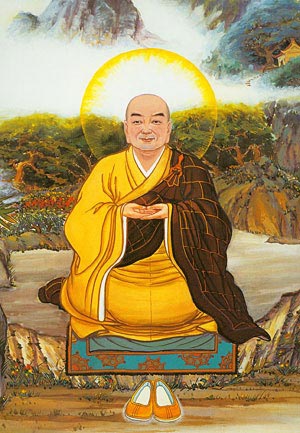
An Interview with Master Sheng Chang
Ending the Dusty Journey: Teachings from Master Chewu
The Essence of Sincerity: An Interview with Master Shaokang
The Great Deliverance of the Earth and Space: An Interview with Master Chengyuan
Aligning Hearts and Righteous Power: An Interview with Great Master Lianchi
The Dharma Body Deliverance: An Interview with Master Shandao
On the twenty-first of April, 2017, the disciple Fa Xi performed ten prostrations to the Buddha. With a sincere and reverent heart, the disciple invited the Seventh Patriarch of the School, Master Sheng Chang, to share his wisdom. The disciple Fa Xi sought to interview the Master regarding his life story, his journey of practice, and his guidance for future generations. We humbly request the Master's compassionate teachings and direction. .
Master Sheng Chang offered these teachings: The temple is a vessel of inconceivable wonder. The magnificent dignity of the Western Pure Land manifests right here. There is no other place but this one. Everyone should recite the name of Namo Amituofo, for it is the Buddha himself who guides us. My child, is it not a rare and wondrous thing that you have drawn my name? In the past, you were a dear junior fellow practitioner of mine, and this is the deep Causal Conditions that bind us together. Encountering the magnificent Pure Land in this life, even though you currently manifest in the form of a bhikshuni, you should maintain the dignified bearing of a great practitioner. Together, we must exert every effort for the sake of the Buddha’s teachings in this final age. Our mission is to spread the Pure Land teachings so that they are not lost in the vast ocean of .
It is not easy to obtain a human body. It is even more difficult to encounter the True Teachings, as there are many obstacles. Yet, you have the surplus of merit to follow the Buddha’s path. The ocean of karma is vast, and the mountains of our past transgressions are steep. My child, regardless of whether your past lives were filled with good or bad deeds, they are all in the past. Your identity as a practitioner, Fa Xi, is one that connects and resonates with the Buddha’s teachings. You represent the role of a teacher of celestial beings and humans, and all your fellow practitioners should act with the same resolve.
The interview today is a most ingenious event. The merit and benefits contained within it are beyond imagination, and you must not let this opportunity slip away. In particular, this is a rare chance to illuminate and extinguish the endless dust and defilements that have accumulated over aeons. It is a vital opportunity and a powerful aid for your spiritual achievements. The Buddhas and Bodhisattvas are compassionately protecting and guiding the Hsiang Kuang Pure Land Buddhist Centre as it sails forward on its true course. While we say they are protecting us, it is more accurate to say they are watching over us with earnest, heartfelt anticipation. The five young monastics, including the future bhikshu Fa Ci, are all precious talents in the transmission of the Buddha’s teachings. You must never disregard the depth of your own skills. Understand clearly that behind everything, there is truly a power of protecting and watching over you. This is a magnificent time, and a magnificent world.
Although we speak of the final age of the , it does not necessarily have to be so. It all depends on how those who uphold the Dharma steer the ship onto the right track. When the space of the Truth is clear and bright, it can resonate with the virtues of all Buddhas and sages. If you encounter such a rare opportunity, why worry about not understanding or facing obstacles? I spoke these few words at the beginning because I see the difficulties of practice in this final age, and I see that the Hsiang Kuang Pure Land Buddhist Centre is built upon this world of karma. The connection between karma and vows is profound, and I hope that many more who are connected by karmic affinity will seek the Western Pure Land. Rebirth in the Western Pure Land is not truly difficult. The only question is whether you are willing to wipe away the dust from your own heart. There are no obstacles to being reborn in the Pure Land; the difference lies entirely in how one maintains their practice.
Disciple Fa Xi: We are deeply grateful for your compassion, Master Sheng Chang. Could you please share with us your own experiences of practice in the past, so that future generations of Buddha’s disciples may have a path to follow?
Master Sheng Chang: I was not born into wealth; we were poor, yet we had a home. I also had a pair of compassionate parents who were devout followers of Avalokiteshvara . From a young age, they worshipped her with great sincerity. As for the holy name of Amitabha Buddha, I knew nothing of it when I was small. I only knew of Avalokiteshvara Bodhisattva, who possesses great compassion and saves beings from suffering. From my childhood, she was the embodiment of kindness in my heart. I grew up prostrating to the White-Robed Avalokiteshvara. She was the guardian spirit of our family’s faith, and naturally, she became my foster mother. I once heard my mother describe the circumstances of my birth, so let us begin there.
My parents were childhood sweethearts. They were betrothed at twelve and married at fifteen. They gave birth to me when they were twenty, and I was the only son in the family. For a long time, there was no news of a child, which caused great anxiety for the entire family. My family name was Chen, and all our relatives and friends were concerned about the continuation of the family line. In the five years since their marriage, there were many suggestions from matchmakers for my father to take another wife. However, my father firmly believed that the Causal Conditions had not yet matured, so he was not in a hurry. His steadfastness angered many of the elders at the time. My father was a simple, honest, and upright man—a rare quality for a man in those days. He was devoted, especially in his for my mother, and it was this devotion that moved her heart. She was determined to work hard to have a child and restore the family’s honour. During those five years, no matter how hard my parents tried, there was no news. They went from seeking from Taoist deities to prostrating to the Buddhas, and they consulted every famous doctor and folk remedy, but my mother tried everything to no avail.
Finally, they turned to Avalokiteshvara Bodhisattva. The connection with her was formed on an afternoon five years after their marriage. My mother was walking down the street, feeling dejected, contrasting her inner sadness with the bustling noise of the crowd. She was carrying fresh flowers, fruits, and incense, heading toward a temple to pray, though she had no specific destination in mind after years of searching. Suddenly, a torrential downpour soaked her, waking her from her daze. She ran to find shelter, not knowing how far she had walked. Eventually, she arrived at a small, inconspicuous nunnery she had never seen before. In her urgency, she simply wanted to escape the rain.
Upon entering, she saw a small but kind-faced statue of the White-Robed Avalokiteshvara. My mother knelt on the prayer mat and began to weep. She cried uncontrollably for a long time, and eventually, due to the cold wind, she fainted. When she awoke, three days had passed. She had been sleeping in the nunnery for three days and nights. When she woke, she saw a kind nun wiping her body. After understanding what had happened, my mother intended to thank the nun and rush home to report her safety, worried that her husband would be anxious. The nun calmly instructed her not to disturb the child in her womb and compassionately gifted her a statue of the White-Robed Avalokiteshvara. She told my mother to place it in the living room or the main hall upon returning home. She promised that in seven months, the child would be born—a smart and kind boy, but one whose life was destined to be dedicated to the Buddha’s teachings.
My mother was in such a state of panic that she did not fully grasp these words. She thanked the nun, hired a carriage, and rushed home. The journey was bumpy, and she did not know how far she had travelled. It was late at night when she arrived, and everyone seemed to be asleep. She sat at the door until dawn. When her husband returned at daybreak, having spent the night searching for her at her parents' home, he was overcome with emotion to see her safe. However, due to the cold of the night, my mother fainted again. When the doctor arrived and checked her pulse, he confirmed she was pregnant. The whole family was overjoyed. Only after my mother had rested and recovered did she recount the events of the past three days. It was only then that she remembered the nun’s final instructions. Everyone was delighted, believing this was truly a child sent by Avalokiteshvara. They were full of anticipation. Because it was a boy, relatives and friends sent their blessings, but they all ignored the message that this child was destined to become a monk. They were simply happy to welcome the child sent by Avalokiteshvara.
Seven months later, I arrived in this world on time. I was small in stature, but my face was bright and full of spirit, possessing the dignified bearing of a great man. However, I was much slower than others in learning things. The joy of my birth filled the entire family. Although we were not wealthy, it was said that I was born with a silver spoon in my mouth. My mother described that I was born with a smile on my face. The midwife was pleasantly surprised as she handed me to my mother, but as soon as I felt the wind, I began to cry loudly, my voice clear and strong. As I grew month by month, others were amazed at how quickly I developed. Whenever guests visited, they were astonished to see how much I had grown.
My family was in the tea business, a trade passed down through generations. My father and his brothers managed it together, and guests often came to drink tea and chat. I was a cheerful child and smiled at everyone. At that time, some customers even came to the shop just to see me. My parents always brought me along when they managed the tea business. I would crawl on the floor of the shop, and no one paid much attention to me. I crawled very fast and was quite mischievous, but I learned to stand a year later than other children. When I finally stood, I was very steady, but I was always stumbling when I learned to walk, covered in bruises and scrapes. Yet, I never cried over small things. My mother said that I had this personality from a young age; even when blood was streaming from a wound, I would continue playing as if nothing had happened.
In the tea shop, I was the only child, so I played by myself. I could sit on the floor and be perfectly happy. A child does not understand what space is, but in truth, my space was open. I was playing with the benevolent spirits or kind-hearted beings around me, and even in my dreams at night, my mother said I was often laughing happily. My personality remained the same as I grew up—optimistic and resilient. I always greeted people with a smile, and I had no afflictions as I grew day by day.
I eventually learned to run, which made me even more lively. My parents knew I was full of energy, so they set clear boundaries for me. I was very obedient and followed the rules. I would run, jump, and tumble within those boundaries, never interfering with others, finding my own joy within that space. I rarely interacted with others and grew up on my own. It was not until I was five that I had a companion—my younger sister. Her physical constitution was also very special, so my parents watched over her very carefully. As I grew older, I understood more about human emotions and the philosophy of the Dharma. I was considered a very bright child, and I had many questions.
Next to our tea shop was a temple, and I always had many, many questions to ask the Venerable there. I would ask things like, "Why do little ants become little ants?" or "Why does it rain from the sky?" or "Why did the Buddha become the Buddha?" I asked so many small questions. My parents were very comfortable with me playing in the temple because they trusted that the Venerable could teach me many principles. Without me realising it, my connection to the Buddha’s teachings grew deeper and deeper.
At the age of seven, my parents wished to send me to a private school to study. Out of curiosity, as I had never been to one, I agreed to go. However, within a month, I asked them to let me stop. I explained to my parents that the school did not teach as well as my Master did. Since the age of five, I had been visiting the temple to see my Master, and he had taught me so much. Therefore, the Confucian and Taoist texts, such as the Great Learning or the Doctrine of the Mean taught at the school, were not beyond my grasp because they were difficult, but because the perspective from which they were taught was different. Even at such a young age, I understood that the perspective of the Buddha’s teachings was vastly different from that of the secular world. My parents understood my meaning; while they were pleased by my intelligence, they were also worried about whether I was destined to embark on the path of practice so early in life.
It was indeed true; I shaved my head and left the home life that very year at the age of seven. Yet, this did not happen suddenly. After I stopped attending the private school, I returned to my original routine of visiting the temple to chat with my Master. Knowing my choice, my Master began to teach me the sutras and academic studies according to my potential. He did not ask me to merely understand them; he wanted me to learn with an open heart. He appreciated my willingness to learn at such a young age, but he did not want me to study with the attitude of a scholar. Instead, he wanted me to approach the teachings from the perspective of practice. I did not fully understand my Master’s intentions at the time; I simply enjoyed the time I spent in nature and the moments of solitude I had for study.
I was always happy and filled with Dharma joy, so I never developed the habit of being lazy. My Master was quite at ease with this and did not impose any rigid rules. We had our daily time for study, but I was free to visit him whenever I wished. He trusted me deeply and gave me plenty of freedom; being with him was a source of great happiness. The sutras were profound, and as I was young and did not yet know many characters, my Master taught me to first look at the structure of the characters. For example, regarding the character for Buddha, he guided me to understand its inner meaning. He explained that within the character for Buddha lies golden light, because those who study the Buddha’s teachings must aspire to possess the immeasurable auspicious characteristics and immeasurable light of the Buddha—this is the spirit of studying the Buddha’s teachings. If I had only learned the character as a mere word, I would have forgotten that the Buddha represents golden light and immeasurable auspicious characteristics. My Master said that while the words for studying the Buddha’s teachings and studying to be a Buddha are identical, they carry different meanings depending on how one approaches them.
After half a year of leaving the private school to study with my Master, I realised that the fundamental reason for practice is to end the cycle of birth and death and transcend the three realms, because I had witnessed the suffering, the causes of suffering, the cessation of suffering, and the path to that cessation in the human world. I did not know much, but I understood that the profundity of the Buddha’s teachings and the mystery of the Truth were far removed from the secular world. Why is there suffering and happiness in the world, while in the Buddha’s teachings there is only the gateway to liberation? Following this opportunity, I spoke to my parents. At that time, becoming a monastic was not seen as a bad thing; monastics were highly respected and revered. Although my parents were reluctant to let me go, they silently agreed. From the time I was in the womb, they had felt that this might happen, though they had not expected it to come so quickly.
I did not become a monastic at the temple I usually frequented. My Master wanted me to go out and learn, to seek my own karmic connections. But I was only seven years old, and I could not travel very far. Because of my age, it was very easy for me to seek alms. Many kind-hearted women and aunts gave me hot buns or warm drinks, which were sometimes enough to sustain me for the day. I had no money, only a few sutras, my clothes, and a water filter bag gifted to me by my Master. I had never travelled before, so even near my home, I did not know where I was. I simply kept walking forward; when night fell, I would find a safe place to rest, and at dawn, I would rise and continue. I walked like this for about half a month, and eventually, I returned to my starting point. My direction had always been forward, without turning or changing paths, yet miraculously, I had returned to where I began.
In truth, I did not understand that cities in those days were small, enclosed by walls, and as long as one did not leave the city gates, one would eventually return to the start. To my young self, however, this was both a surprise and a joy. I did not yet understand the principle, only how to return to the temple. Along the way, I had not met any monastics with whom I had a karmic connection, nor had I found a temple to take me in; I had only met many kind people who offered me support. I ran and jumped into the temple, shouting, “Master! I have returned!” My Master walked out from the door, as if he had known all along. He sat down calmly and asked only one question: “What have you seen during these days?” Asked by my Master, I was even happier. I said, “Master, I saw that everyone works so hard, but they do not know what they are working for. Every day, people die, people fall ill, people are born, and people marry. I saw the many facets of life. In these two weeks, I felt so much, but what I felt most deeply was: Master, how did I return here? Master, this is a karmic connection! Please, Master, shave my head and accept me as your disciple!” My Master could not help but laugh. “Child, that is good. You have realised the many facets of life that I hoped you would see.” He asked, “Is there permanence in human life?” I replied, “Impermanence.” He asked again, “Is there reason in the dust of the world?” I replied, “Only the Truth is seen.” My Master laughed heartily and told me to stay in the first room of the East Gate meditation hall. I was so happy! After thanking him, I moved in joyfully. Before stepping out of his room, I hesitated, thinking I had no luggage: what was I to move in? My Master sensed this thought. I do not know when he had stood behind me, but he placed his hand on my shoulder and said softly, “Everything is prepared, child! Welcome, disciple of the Buddha, into the Buddha’s gate. The path ahead will be vast. Impermanence is everywhere, but if you follow the Truth, there will be no faults. From now on, your Dharma name shall be Sheng Chang. Study well! There are many tests waiting on the path; do not lose your spiritual resolve.” My Master compassionately led me to my room and told me that a little junior brother was already staying there. He was only five years old and had not yet been ordained, but he was staying as a little novice to learn. My Master said he was waiting for the boy to ask to join the monastic order himself. I smiled; having a junior brother of a similar age to keep me company was wonderful!
My Master chose an auspicious day for my ordination ceremony and sent word to my biological parents. In truth, many temples omit this step, but my Master insisted that gratitude for one’s parents is a fundamental virtue of respect. Whether or not they wished to attend was left to their own karmic affinity. Upon receiving the news, my parents arrived early that morning, bringing my younger sister, who was five years my junior. The ceremony was completed quickly. My Master taught me to bow in gratitude for my parents’ kindness in raising me; without their gift of life, I could not have attained the path in this lifetime. To end the cycle of birth and death and transcend the three realms, I must bring my compassionate parents along. With tears in their eyes, my parents held my small hands and told me to practise diligently, to become a capable monastic who would lead the people to leave suffering behind and find peace and happiness. After saying this, they picked up my sister and returned home. That was the last time I saw my family in this life. Later, when I grew up and they passed away, I was not notified.
I never had any further contact with my secular family, focusing entirely on my spiritual achievements. I never felt this was wrong, for all beings are manifestations of the spirit. Parents are merely a result of matured karmic connections, a bond of blood, but they are also among all beings. Since I had left the home life to pursue the path of practice and had let go of family ties, was I not then, in the work of saving beings, in the same place as all my family members? Why worry about not having family by my side? On the contrary, everywhere I looked, there were family members and relatives. I did not fall into the trap of attachment to one or two individuals, and I remained cool and at ease. Why would I not choose this? At the age of seven, I was ordained and began my diligent practice in the Buddha’s gate.
My junior brother in the same room was ordained shortly after, with the Dharma name Sheng Wu. He was a relative of my Master, the son of my Master’s younger sister, who had been sent to the temple after both his parents passed away. Sheng Wu and I were very close; we studied together and grew through many challenges. Being of similar age, we had much to talk about and understood each other’s character well. At the age of a lively little novice, having a companion was truly a blessing! Yet, on the path of practice, one is ultimately alone. When I was fifteen, my Master allowed me to receive the full , and I became a Bhikshu. I moved out of the room and began to take on duties, becoming busy with temple affairs and focusing on my studies. For a long time, I had no news of my junior brother, even though we were in the same temple. The temple was not large—smaller than the courtyard of many wealthy families—yet we did not see each other for about three years. I only occasionally heard news of him. Was he doing well? So many years had passed!
Disciple Fa Xi: Namo Amituofo.
Master Sheng Chang’s Teachings: The cycle of rebirth is ever-changing! Sheng Wu! If one knows the suffering of reincarnation, one should be truly diligent, find one’s own original true self, and never allow for laziness! A lazy heart is a chaotic heart. With a chaotic heart, how can one find the pure meaning? And how can one extinguish the dirt to let the light shine forth? The status of reincarnation is already different; one should see the truth of events and principles, let go of attachments, and seek the path of Truth. Save the deluded people from their chaotic hearts, transcend the three realms, and see the Pure Land of Amitabha, the Land of Ultimate Bliss.
Disciple Fa Xi: Namo Amituofo. Disciple Fa Xi is grateful for Master Sheng Chang’s compassionate teachings. It is as if I can see the past; it is so intimate, so very intimate. I am grateful for the compassion of the Buddha. Namo Amituofo.
Master Sheng Chang’s Teachings: Reincarnation is ever-changing; everything is like waking from a dream last night. When I saw my junior brother again after those three years, he had become a dignified and majestic Bhikshu. My Master had sent him to another temple to serve as the abbot, and my Master assisted him from the side. My junior brother was young and capable, and my Master praised him highly.
Disciple Fa Xi: May I ask Master Sheng Chang, disciple Fa Xi seems to see this tranquil temple deep in the mountains, and at first, there was only one dog and one attendant in the temple, but later, it seems there were many monastics and lay followers.
Practitioner Sheng Chang continued his teachings: "Indeed! The Dharma name has now become Fa Xi. Many years have passed since then. My Master’s kind intention in sending me to that temple was based on his recognition of my potential for Wisdom. He wanted to allow me to truly purify myself so that I could eventually serve the Dharma well. I did not disappoint my Master. That temple was left behind by a friend of his after he passed away, and later, I was able to revitalize it. People came and went in an endless stream; it was truly a magnificent thing! The path of practice is filled with so many unimaginable turns. Relationships and circumstances gather and disperse; there is no truly permanent state to follow. Why then should one hold onto attachments of what is real or illusory? The fellow practitioners of the 'Sheng' generation were gradually assigned to various places to spread the Dharma, while I remained by my Master’s side to receive the teachings, inheriting the lineage of the Pure Land school. The Pure Land path is a supreme Dharma. Its essential gate lies in cultivating the heart, achieving a state of purity, ease, and coolness."
As I approached my twentieth year, I requested my Master’s permission to enter into a period of seclusion to focus on my studies, following the principles of the Infinite Life Sutra and delving deep into the treasury of the sutras. However, seclusion is certainly not an easy task. It is a moment for truly subduing one's character. One must restrain all sorts of deeply hidden personal habits, as well as the problem of . Since ancient times, no one on the path of spiritual achievement has ever had a completely smooth journey. Tests and tempering are normal phenomena. But why do some great masters say that practice is not difficult, or even that there are no obstacles? Because they are cultivating the heart, not . If one feels obstruction, fatigue, or suffering, are these not all thoughts arising from the body? If one puts in the work within the heart, how can there be any obstacles? Yet, does working on the heart also have obstacles? Yes! One may feel weary, retreat, become stifled, feel anger, or experience joy and Dharma bliss, or sadness and depression. All these are obstacles to the path. But if cultivating the heart is not the way, and cultivating the body is not good either, then what is to be done?
"Dedicate your body and mind to the infinite realms." It is easy to say these words, but truly doing it is extremely difficult unless one is a sage. Many people tell themselves, "I am not a sage, so of course it is difficult." But if you are not a sage, who will become one? Namo Amituofo has said that everyone is an Amituofo; Zen Master Zhongfeng also said, "This heart is Buddha, this heart makes Buddha." So, are you not a Buddha? Indeed, you are! Our body and mind will sooner or later return to emptiness; they are truly not worth clinging to or being attached to. Once you have attachment, obstacles arise. This was the first realization that my seclusion brought to me. Although I had been in contact with the Buddha’s teachings for many years, learning from the innocent perspective of a child was completely different from truly delving into the sutras.
At first, I began to suffer from drowsiness. Even when I picked up my brush to write calligraphy, I would doze off, and a single nap would ruin an entire piece of work. I once had unwholesome thoughts, but I quickly repented and changed my ways. The first time I ruined work I had spent days on, I felt endless frustration and anger in my heart. But the moment that thought arose, it ruined several more days of pure practice, which I spent almost entirely in a state of drowsiness. I realized I could not continue like this. I began to look for ways to break through!
I chose to face this obstacle positively, rather than looking for someone to blame. I explored why I could not move forward. The spearhead was pointed at myself, not outward. Remember, in practice and changing one's habits, one only looks at oneself; one does not look at others. There is no right or wrong in others, only in oneself. One must look inward, reflect, and examine oneself. This is very important! Only in this way can one avoid greater mistakes in practice, and see that everything is pure and good.
Drowsiness is something everyone encounters in the process of practice; it is a path one must walk. But how does one break through? It depends on how much work one puts in. Why is drowsiness considered something that must be overcome? Because it stems from laziness. A lazy heart wastes one's spiritual achievements and causes the heart of the path to retreat. Without a heart of diligent practice, how can one achieve the fruit of ? I also agree that this drowsiness is related to the from many lifetimes, and is inseparable from karma. When I was extremely drowsy and truly could not wake up, I repented. I sincerely communicated with myself. Although I did not necessarily see immediate results, I calmly accepted the fact of this drowsiness. There is a cause and an effect; it was certainly not a hurdle encountered without reason. I was also willing to believe that this drowsiness could further temper my firm heart of the path. With an increasingly strong vow, I worked hard to break through each instance of drowsiness. Gradually, after about half a month, I broke through!
Whenever I felt drowsy, I used an even stronger vow to tell my inner heart: no matter how difficult this practice is, for the sake of all beings, I must be diligent! I must put in more effort than others so that I will not fail my identity as a monastic, and will not fail the well-being of all beings in the world.
During my seclusion, I constantly tempered myself, including my sleep, diet, and habits. I made my sleep schedule the same as what Shakyamuni Buddha established in his time, which meant I had to wake up around one o'clock in the morning to begin my daily lessons. My diet also followed what the Buddha established, eating only after the light of dawn. To curb drowsiness, I ate as little as possible. Because seclusion required lay practitioners or disciples to deliver meals, I tried my best not to cause inconvenience to everyone if I did not need to eat. Everything was kept simple. From two meals a day, I eventually moved to eating only at noon. The rest of the time was spent in diligent practice, and I did not feel tired or hungry at all. My mental state, following the purification of studying the sutras, washed away the filth of the body and mind. Furthermore, I was filled with immeasurable Dharma joy. I was energetic almost every day, and the heavy, dull feeling of drowsiness never appeared again. I gained infinite Dharma joy in my practice, and my vows and perseverance were further strengthened, all because of the Infinite Life Sutra.
During this period of seclusion, I relied on the Infinite Life Sutra. It is a sutra that can be recited in less than a few dozen minutes, yet it contains unfathomable mysteries. The deeper one goes, the harder it is to pull oneself away. The ultimate essence of the Pure Land is nothing but guiding all back to the Western Land of Ultimate Bliss, and the Infinite Life Sutra introduces the Western Land of Ultimate Bliss so beautifully! It is magnificent and dignified, and its simple words are breathtaking. It is even harder to describe its profound implications and realms. I am loyal to the Pure Land and have vowed to promote it. In my heart, I silently made a great vow to propagate the Buddha’s work. During my seclusion, because I was young and inexperienced, I was afraid that I would not see things clearly and would mislead the Buddha’s disciples. Although I was not yet leading disciples in the practice of the Dharma, I believed that I would in the future. If the foundation is not laid firmly now, it may become a great disaster in the future, making it difficult to subdue.
Therefore, I have always tried my best to find the Truth and the right direction. Now that I have found the Truth, it is very simple: it is to be reborn in the Western Land. This is the most ultimate path of vows. Although the direction was still blurry, I believed that by moving forward slowly, relying on true spiritual friends, my Master, and the predecessors, I would succeed—but I would not rely on my own ego-attachment or my own thoughts. I would rather have the advice of many true spiritual friends than rely solely on my own arrogant determination. This time, I ended my seclusion after three months because I felt I had found the answers I needed. More importantly, at this stage, I needed to lay a solid foundation, learn from my seniors, and temper my own character. I was very firm in my request for rebirth in the Western Land, and I also prayed that I would have the ability to lead others to be reborn there. I engraved this sense of mission deep in my heart, constantly reminding myself.
At that time, I was not yet twenty-one years old when I left seclusion. My Master saw my youthful energy and would smile at me from time to time. When I left seclusion, my Master did not say much, and I simply followed the monastic community back into the established daily routine: morning and evening chanting, working in the fields, and leading the public in chanting Namo Amituofo. We were already leading the public in chanting at that time. The brother in charge would strike the wooden fish to lead the crowd. Every day, morning and evening, there would be at least one incense stick of time to lead the visitors from the ten directions, all for the purpose of purifying the heart, chanting Namo Amituofo to seek a state of deep peace and wisdom, and chanting to seek liberation.
Because of the various merits and benefits of chanting Namo Amituofo, there were always many beings from the ten directions in the temple every day. Everyone chanted with a focused heart and sincere intention. It was during these times that many miraculous responses occurred. Everyone believed that the Buddhas and Bodhisattvas were right by their side, protecting the Buddha’s disciples. At that time, the sounds of chanting included fast-paced, rhythmic beats and slow, resonant tones. The former was for chasing the sound of the Buddha-name, which some described as seeking a response, while my own explanation was that it was seeking the Buddha’s compassion and protection. The latter, the slow, resonant tones, belonged more to the meaning of repentance. Many people were able to feel the compassionate power of the Buddhas and Bodhisattvas, or the suffering of beings. Each sound of the Buddha-name focused the heart, and when bowing down, one could prostrate fully at the Buddha’s feet with true sincerity, which was quite magnificent!
After the chanting lessons, the visitors would leave, and the monastics would perform the morning and evening chanting. Apart from these times, the rest was for diligent practice. The scale and space of the temple were not large, but the atmosphere was quiet and secluded. I often read the sutras or wrote calligraphy in my room or under the trees. The Pure Land school focuses on cultivating and gathering the body and mind, so I never dared to mix too many things into my direction and goals, seeking only purification and more purification. I would consult my Master or fellow practitioners about the sutras, collections, or writings of predecessors I had read, asking what was acceptable and what was not; I dared not make my own conclusions.
After all, in the eyes of others, one is the most real, without any possibility of bias. The most pitiful thing is to pity oneself; but on the path of practice, if you pity yourself, you will never be able to achieve anything. This point must be clearly understood. One must grind, grind again and again, until one is covered in wounds without crying out in pain; only then is it possible to find the true self and see the true self. Where is the "true self"? As long as you are willing to grind away the baggage of your own personality, the true self is right inside, shining with light and color. There is no being without a true self; it is only covered by delusions, discriminations, and attachments. There is no being that cannot become a Buddha; all are simply sinking in the ocean of immeasurable karma and habits.
The greatest benefit of practising the Pure Land path lies in the ability to achieve true purification. Everyone can speak clearly and logically about purification, but how many can truly realise it in a clear and profound way? It is like a glass of water; to make it crystal clear and free from even the slightest impurity sounds easy, but in practice, it depends entirely on the effort one puts in. If one's verbal skills are top-tier but one lacks the corresponding inner work, the practice is in vain. Just like in this current age of the Dharma’s decline, there are so many so-called practitioners who are merely going through the motions. This era of decline truly requires all disciples of the Buddha to wake up and exert themselves! Even becoming a monastic at the age of twenty is not too early, because impermanence is unfolding every single second. Who can truly know what will happen in the next moment, or even if death might arrive? I realised this when I was twenty years old. Given the terrifying nature of these subtle moments, how should one cultivate the mind? After less than three months of seclusion, I hurried out to continue my practice among the community.
What is the Buddha’s teaching? If you believe that only the sutras or the formal precepts constitute the Dharma, then your life of practice is destined to be in vain. You will have wasted your time as a monastic, and one might even say you have come to this world for nothing—having only formed a magnificent connection with the Dharma, waiting for a future life when you are awake enough to truly begin your practice. Why do I say this? Because you have bound yourself and become obsessed with forms; the Dharma absolutely does not exist solely within tangible appearances. My three months of seclusion taught me one fundamental truth: the principles expounded in the sutras are never just mere theories. The Diamond Sutra states, "All phenomena are illusory." Can you understand this? If one could reach Awakening simply by reading the words in the sutras, then the path of practice would not be ultimate; it would be illusory.
"Appearances are not true appearances; only when one sees the absence of appearances within appearances does one see the true reality." Are you willing to accept this? Why did I come to this realisation? During those three months, which were not a particularly long time, I relied solely on the short text of the Amitabha Sutra. It can be recited in just a few minutes. Even if one spends several hours every day studying it, one can clearly understand that the entire sutra is meant to describe the beauty of the Western Land, to urge people to chant the name of Amitabha Buddha, to seek rebirth in the Western Land of Ultimate Bliss, to transcend life and death, to exit the Three Realms, to forever leave behind the suffering of the six realms of rebirth, and to attain the ultimate bliss of the Pure Land. However, such a superficial understanding is not only shallow, but it also leaves countless questions unanswered. The reason is that such an interpretation lacks the nourishment of the spirit.
What is meant by the nourishment of the spirit? It is like describing the practice itself. If one only cultivates the external appearance, it may look beautiful, dignified, and full of proper decorum at first glance; yet, there is an indescribable difference. However, if the practice is focused on cultivating the mind, the resulting perfection is truly magnificent! This is the result of a complete Body-Mind-Spirit purification. If practice stops at external appearances, one cannot attain the true, perfect fruit of Buddhahood. Similarly, if the sutras are limited to their literal text, it is difficult to delve into their profound mysteries.
So, how does one add this spiritual nourishment? You must put it into practice! A piece of fine jade is only perfected after being meticulously carved and polished. Can a good practitioner truly attain the fruit of the path without undergoing tempering and education? The sutras expound the path to Buddhahood, which requires the tempering of time and the application of one's own physical and mental efforts to truly resonate with the principles, the timing, and the logic of transcending life and death. However, the breadth and depth of these meanings cannot be grasped if one has not achieved perfection in practice, and one cannot break through to higher states. This is because no matter how you practise, if you cannot let go of the "self," you cannot achieve success within the attachment to the ego.
Why is the Buddha’s teaching so magnificent? It is because the World-Honoured One, with His great Wisdom (Prajna), had already clearly foreseen all of this. That is why He left behind the 84,000 Dharma gates, allowing beings of different capacities to find the practice that suits them. The Truth expounded in the sutras must be realised through true practice. True practice means doing what others cannot endure and walking the path that others cannot walk; only then might you realise the Truth the World-Honoured One intended to teach. The Dharma is actually everywhere—in daily life, in big and small affairs, and in every action. Ultimately, it is all about the mind. Returning to the source, "practice lies in cultivating the mind." This is the great key, the great and wonderful Dharma.
If the Pure Land can be attained, it is because one has fundamentally resolved the various defilements of the heart, attained great liberation, and achieved a state of purity and coolness. How could one fail to attain the fruit of the path? Success is certain! So, how should one practise to reach the Pure Land perfectly? Without hesitation, I left my seclusion. The friction of life is necessary to grind away one's personality and habits; every sharp edge must be polished until it is smooth, round, and bright. This is not easy, but this is what it means to put in the work. Changing one's personality is true diligent practice. If your verbal skills are excellent and you are filled with knowledge of the sutras, but your heart remains the same, then nothing has changed.
At the age of twenty, I began to integrate into the life of the community, the monastic community, and I participated in the daily chores. My teacher asked me what kind of service I wished to perform, and I replied that I wanted to do the work that no one else wanted. My teacher smiled and gave me a very light task: sweeping the open space in front of the main hall. This work was indeed very easy. How many fallen leaves could there be each day? Not many. The task was finished very quickly. My station was located at the junction between the main hall and the outside world, an open and public area where I could clearly see the outside. Therefore, when I finished my duties, I would sit and watch the people coming and going, and I would also observe what my fellow practitioners were doing within the temple. The variety of human life is truly vast.
Habits and personality traits are always triggered when interacting with others. The relationships between people are like pulling on a thread, causing changes. I thought to myself, this must be the true practice. Modifying one's own behaviour—the sutras can tell us the theories and the Truth, but to internalise them into the heart and apply them in reality is a much deeper skill! I told myself that if I wanted to practise, I had to do it for real. Every day, amidst the myriad states of human life, where did I stand? Which state was I in? Were there shortcomings that needed correction? Practice lies in internal self-reflection. If one does not change oneself through practice, why bother putting in the work?
I allowed myself to undergo this ordinary tempering in the monastic community for ten years. I aspired to seek the extraordinary within the ordinary. Sometimes people do not like the monotonous and rigid lifestyle, and in the monastic community, every day is governed by strict regulations and schedules. When living together in a community, with people coming from all sorts of family backgrounds, there are simply too many things that need to be harmonised! This is the best foundation for practice and the best medicine for adjusting one's true self. How to be flexible, how to endure, and how to remain unmoved by thoughts—this is great wisdom, the Patience (Endurance) of Prajna.
During those ten years, amidst the morning bells and evening drums, I did not wake up early for any extra reason; I simply followed the community's schedule. During the lunch break, when everyone else was resting, I was not tired, so I continued my diligent practice. Relying on the operation of the community and the guidance of the venerable masters and true spiritual friends, both reasonable and unreasonable discipline served as training. I practised with great peace of mind. During those ten years, I was not afraid of going astray. For ten years, I dared not have my own opinions or ideas, even if my own perspective might have been more convenient. I wanted to cultivate true humility and modesty, and to view all as one body. This is very difficult for ordinary people, because one always hopes for one's own views to be seen and valued; this is a common habit of the world. Arrogance and the desire for gain and loss also spread from this.
During those ten years, from twenty to thirty, is this not the very stage in a person's life when one is hot-blooded, headstrong, and when ego-attachment and one's own views are at their strongest? I was a young man, and of course, I was no exception. One does not have "no opinions" unless one is born a pure and good Bodhisattva, and I was not. I was just like everyone else—an ordinary being with a physical body. At first, I had all the seven emotions and , and they were all obstacles to my practice. I walked that path too. As for the titles of "patriarchs and venerable masters" or "great masters," these are all beautiful names bestowed by later generations. If one were to call oneself such things while still alive, would that not be arrogance? It is not acceptable.
Throughout my journey of practice, until I cut off desires and sought purity, no one could claim that their path was smooth. I, too, had to stand up after experiencing bitter tempering and setbacks. But was it bitter? It was not bitter, because it was worth it. Because there is nothing to be gained, and the heart is not attached to anything, the state of mind is naturally peaceful. Why worry about the heart being moved or shaken? Knowing the truth of reality—that nothing can be taken with you and nothing can be held onto—why not let go and find liberation? Of course, this is not easy; it is truly not easy. I did not have an easy time during those ten years. If I were to falsely claim that those ten years were easy, like a fish in water, I would only be falling into the trap of self-satisfaction.
How obedient can a boy be during his so-called adolescence? To have no thoughts or rebellions at all? If that were the case, one would not be born into this Saha world. Although if a Buddha were to come, perhaps He could be different from the secular, being a Sage; but I know that I am an ordinary person, so I put even more effort into subduing my own heart. "Submit, subdue"—it is not complicated. For those ten years, I demanded only these two things of myself. To submit to the discipline of those in higher positions, to be respectful, and to obey—to be convinced from the bottom of my heart by the person, the matter, and the principle. Sometimes, even when I knew something was wrong or unreasonable, I would turn my perspective: in this world, what is truly right? And what is a wrong view? If one does not clearly understand, how can one believe that one's own thoughts and views are correct? Since ancient times, the World-Honoured One has required us to rely on our teachers and the sages who came before us; there is certainly a reason for this.
Every individual carries karmic habits and personality traits accumulated over countless lifetimes. If you find yourself judging whether you like what someone says based solely on your current mood, is that not a terrifying form of pollution? Greed, anger, delusion, arrogance, doubt, and the Five Desires—wealth, lust, fame, food, and sleep—are the fundamental traps. For a monastic, guarding against these is the most basic duty; it is the threshold of your vocation. If you lose this, you should not continue to wear the robes of a monastic, for you would only be confusing the hearts of others and slandering the Sangha Jewel. This is also for your own protection. Why is it said that the gates of hell are crowded with monastics and practitioners? This is a well-known saying, yet does it not fill you with fear and dread? For the past ten years, this is what I have been practising, and indeed, one’s entire life of practice is dedicated to this very task. In these ten years, I have had to reflect on how to truly transform this polluted character and behaviour, and how to truly discipline myself into a pure monastic. I have certainly put in a great deal of effort throughout this process.
Greed for beauty, or for any object—whether tangible or intangible—is something that cannot be attained. In this Saha world, there are men and women, feelings of love, and desires of the flesh. A monastic must not engage in these; to do so is to stray far from purity and to invite demonic thoughts. A disciple of the Buddha must not act in this way. Throughout my life, apart from my mother and sister, I have never been close to women, including female devotees. I have always maintained a respectful distance, avoiding even looking at them, to prevent any potential desires from arising. In ancient times, one’s reflection was only cast upon a bronze mirror, and it was not always clear. Some of my fellow practitioners, including myself, have at times fallen into the trap of being enamoured with our own appearance. This, too, is a pursuit that leads nowhere. Firstly, it damages the heart of humility; secondly, if there is attachment, how can one be pure? The physical body is false. If you are attached to it, how can you attain the path of liberation?
When I first awakened to this, I felt a deep sense of shame. I vowed never to look into a bronze mirror again in this life, as a warning against the growth of narcissism. This also helps to subdue my arrogance and cultivate a humble, lowly heart. What is good or bad, after all? By letting go of the thoughts of gain and loss, I realised that even a single desire can permeate every aspect of daily life. These thoughts persist in both large and small ways, and one must have a heart of vigilance even in the most subtle moments.
Severing desire is the most fundamental task, yet it is not an easy one. Humans are beings of emotion and desire, governed by the seven emotions and five desires. All these manifestations of desire arise naturally. How can one cut them off? It relies entirely on one word: concentration. With concentration, wisdom arises. With concentration, one can remain untouched by the world, like a lotus leaf that sheds water. With concentration, one can manifest all phenomena without being shaken. One’s internal state does not need to be swayed by external circumstances. The three studies of Precepts, Concentration, and Wisdom are the essential guidelines, and through listening, reflecting, and practising, one seeks the righteous path. Greed is merely the coarsest manifestation; beyond it lie anger, delusion, arrogance, and doubt, as well as the Five Desires. When do these manifest to test you? They appear in your unguarded thoughts and intentions. Whether you have truly let go or not is perfectly clear; there is no room for falsehood.
You may say you have truly let go, but when a minor test arises, you may fail completely. Letting go is indeed difficult, but it is a necessity on the path of practice, for only by letting go can one attain purity. The Diamond Sutra states: "All conditioned phenomena are like dreams, illusions, bubbles, and shadows; like dew and like lightning; thus should you view them." If one can realise this state of being "unmoved," one can be considered a true practitioner.
I chose to focus my efforts during these ten years, a time when my personality and habits were most volatile. Although I did not know what would happen by the age of thirty, I did not dwell on it; I simply did my best to move forward. The merit of one day of diligent practice is inconceivable; if one day is wasted, the loss is equally inconceivable. Therefore, disciples of the Buddha, "the human body is hard to obtain, and the Buddha’s teachings are hard to hear!" Since you have heard them, you must walk the path of truth. As I mentioned before, I follow the monastic community’s daily schedule of practice every single day. My main goal is to practise within these Five Desires and , to test how much I have let go and what still requires effort.
Although the Buddha’s gate is a place of purity and far less chaotic than the outside world, when people are in close contact, differences inevitably arise. How can we become one? The "Six Harmonies and Respect" are required of all disciples: harmony in views, harmony in practice, harmony in sharing benefits, and harmony in speech without dispute. If the Buddha’s gate, especially the monastic community, is not harmonious within itself, how can it lead the masses? Let alone the thought of rebirth in the Western Land—that would be a distant dream! What the Buddha established was meant to ensure that his disciples could be pure and unstained, empty of all things, and free from discrimination. The Five Turbidities and Evil World are terrifying precisely because of the depth of our delusions, discriminations, and attachments. This is the primary reason we cannot realise our ; otherwise, everyone is a Buddha, so why are we all trapped in this Saha world? If we can purify this part of ourselves, then when our true self is revealed, will rebirth in the Western Land not be an easy matter? This is the greatest purpose of the Pure Land: purification. There is no other thought; it is simply purification! The key to purification lies in adjusting the heart, changing the heart, letting go of the heart, becoming selfless, and purifying the heart. Fundamentally, it is all about putting in the work within the heart.
Interpersonal relationships are not just about surface-level efforts; the true work of the heart is what matters. How so? A person is two sides of the same coin. If you are kind to one person but speak ill of them to another, you must know that for a monastic, such behaviour creates the greatest karma! This brings us back to the "harmony in speech without dispute" in the Six Harmonies. A monastic community that cannot be harmonious within itself cannot cause the Buddha’s teachings to flourish. If you want the Buddha’s teachings to flourish, monastics must praise one another—this saying is truly profound! In our past interactions, while there was no overt competition or fighting, small disputes were indeed common. It is easy for fellow practitioners to have thoughts of "self," to protect and look after one’s own interests, which is perhaps inevitable. Therefore, adjusting the heart means removing even these tendencies; otherwise, one is still far from purity. You must be completely free of even the slightest stain to be a Pure Land. The pure cannot tolerate even a speck of filth.
My teacher places great importance on the discipline and peaceful coexistence of the monastic community. The teacher does not care about the depth of your practice or your wisdom; he only cares about whether your heart is clean. If the slightest stain is detected by the teacher, even if you are the senior disciple, he will not give you any face; you will be punished with cleaning duties or kneeling in incense. The teacher often angrily reprimands us: "There are already few people truly dedicated to the Dharma lineage; if you continue to kill each other off, it is equivalent to cruelly pushing all sentient beings into the ocean!" The teacher’s words are heavy with meaning, as if he always knows something. In truth, he is only afraid that his disciples will create karma! Monastics are not ordinary people; it is not allowed, not permitted, and not possible for them to have any emotional fluctuations. If you disturb the cool, quiet heart of a practitioner, you are creating sin!
Never abandon your path because of a momentary feeling or an obstacle you cannot overcome. Another difficulty in practice is that we have too many sensations. Our bodies are covered in countless pores and hairs, all of which absorb and draw things toward us—how foolish! How can one practise well like this? Practice requires us to cultivate selflessness and to cultivate the state of "having nothing." If you are attached to "having," you will never succeed; this is a major lesson of the Pure Land! However, if you only see "nothingness," you will fail to see the root of the problem. One must understand the truth of the facts, and only after seeing clearly can one truly change. The Pure Land is a practice of the heart; it is an inconceivable method. In these ten years of practice, I have fundamentally changed in many ways, especially in the internal conflict that arose when I was unwilling to be disciplined, yet had to suppress it and submit—especially regarding the voice within my heart.
Practice is meant to modify those corners that are hardest to discover, to make a thorough and perfect correction; only then is practice complete. Practice is very unique; it will test you with various situations that you cannot handle. Whether in dreams or in reality, there will be one test after another, all to encourage you to let go, to correct yourself, and to truly purify. Do not fear the arising of thoughts, only fear being slow to awaken. Every test is a test of your awareness. As long as your awareness is raised, you will slowly progress and grow, and you will be able to see your most fundamental and deep-seated problems. I know this feeling best; every subtle fluctuation of thought, if you calm your heart and truly wish to change, can be understood. If you can purify them one by one, regardless of how long it takes, sooner or later, you will become increasingly clear and pure.
Sometimes the Pure Land is difficult because of the need to face and see through things. Sometimes the delusion is too deep or too firm to be broken all at once, but iron can eventually be ground into a needle; diligent practice can overcome all obstacles. All circumstances are the best learning environment, and the cultivation of one’s own heart is the best bodhimanda for purifying karma. All beings are the best teachers. You must remember this; it will help you directly realise the Western Land. In the fifty-three visits of Sudhana, was there anything he saw or heard that was not teaching us? Everything—the good and the bad—is a teacher! The Analects of Confucius also say: "In a group of three, there must be a teacher for me." All things and all conditions are the most perfect scriptures and arguments. This is why I am willing to detach myself from the beautiful illusions of the world.
The Amitabha Sutra describes the Western Land of Ultimate Bliss as extremely beautiful and magnificent. Who would not want to seek rebirth in such a wonderful place? But during the period of study, if one does not truly understand whether this is real or just a delusion, it might be more grounded to turn back and focus on the state of one’s own heart. I asked myself: how does one go to the Western Land? To be honest, at the time, I really did not know. For a long time, I pondered this: can I really go to such a wonderful place? What conditions are required? In fact, no conditions are needed; it requires you to have nothing at all—no conditions, just an empty you. You do not need to bring anything; even if you have a fortune, you do not need it. You are then a part of the West. It is that simple. Will you go?
Namo Amituofo
Every practitioner understands that the ultimate goal is to transcend the cycle of birth and death and to seek the Truth. While some schools may have different objectives, the Pure Land Dharma Gate is very clear: we seek rebirth in the Western Land of Ultimate Bliss. As a practitioner of the Pure Land path, I often wondered in my youth: Can I truly attain rebirth in the Western Land? This doubt stirred within me, and I began to seek answers. I chose to take refuge under a true spiritual friend, hoping to find a clear path to follow. In truth, I initially only wanted to know what others were bringing with them to the Western Land and how I should arrange my own path of practice. I never expected that among these people and this environment, I would learn even more than what the sutras taught us.
The sutras contain the Truth and the teachings, but the substantive realisation and feelings come from the sensations, frustrations, and impacts brought about by the seven emotions and the Five Desires of this physical body. It is through these that one is inspired to realise one's true nature. By following the Buddha's teachings in this way, one can truly awaken quickly. The most important thing is to be receptive to instruction. Understanding this, one must learn to be humble, without holding onto personal opinions or preconceived notions, in order to truly learn. I never thought about what I would encounter or gain during my practice; I simply moved forward naturally, without looking left or right, diligently applying myself. I fulfilled the tasks arranged by my teacher with all my heart, including cleaning the grounds. Everything I saw and heard helped me awaken. The fundamental requirement is to have no personal thoughts. Once you achieve this, you will awaken, clear the blockages in your six , and see things more clearly and deeply.
Practice allows one to see very deeply into the true meaning of life. It allows one to thoroughly understand oneself. Truly, this physical body is worth nothing compared to the merit of dedicating one's body, mind, and spirit to the service of the Dharma. My vow deepened time and again as I witnessed the joys and sorrows of the marketplace, the hardships of human life, and the reality of impermanence. As a disciple of the Buddha, a bhikshu, how could I not walk the path of reality? How could I not propagate the True Teachings? Is it not the fundamental mission of Shakyamuni Buddha to lead more beings to break through delusion and attain enlightenment? How could I not fulfil this?
Once, when I was feeling low and discouraged, I asked my teacher for leave to go out. In truth, my teacher knew I was going to find my junior fellow practitioner. It had been a very long time since I had walked in the outside world, and this time, the experience brought a different perspective. The human world is truly full of suffering! Especially when witnessing the gap between the rich and the poor, the collusion between officials and merchants, and the plight of the people, I could not help but shed tears of sorrow. I vowed to propagate the True Teachings and ensure they remain in this world for a long time. That year, I was twenty-five. On the eve of my birthday, I walked through the outskirts of Hangzhou until I arrived at the temple managed by my junior fellow practitioner. He had managed the temple very well; it was serene, and the number of monastics had increased to nearly twenty. No one in the temple recognised me, so I respectfully prostrated to the monastics and asked them to inform the abbot that Shengchang requested an audience.
The monk who delivered the message had barely been inside for a quarter of an hour when my junior fellow practitioner, whom I had not seen for a long time, rushed out with a radiant smile. Seeing his senior brother, his face beamed with joy, and he hurried to welcome me. I expressed my intention to stay for a few days of quiet practice. He agreed without hesitation and instructed his disciples to arrange a room immediately. He generously provided a very quiet room, rarely frequented by others, which was perfect for purifying the heart.
As it was time for the midday meal, he asked me to sit while he hurried off. It turned out that he always personally prepared the vegetarian meals for the temple community. He believed that if the food was prepared well, the day's practice would be filled with vitality and would naturally go well. By leading everyone personally, he could also prevent them from becoming lazy. Everyone had their own duties, and by managing themselves well, they were practising correctly. By helping one another, how could there be any disharmony? Seeing how he had transformed a temple that once had only one monastic into what it was now, I could not help but feel both admiration and relief. This trip was worth it, no matter what.
My relationship with him was excellent; we were like brothers, and he respected me deeply. Seeing me arrive with something on my mind, he did not ask questions, but I knew he understood. He used his unique methods to guide me out of my distress. I stayed for about three days and was very grateful for his help. The temple needed me, and I could not stay away for too long. When I bid him farewell, he was a bit reluctant to see me go, but he was happy to see that I had regained my confidence.
His growth truly astonished me! Later, I heard that he had nurtured many talented individuals who were all excellent, and most importantly, they were all willing to work and practise. Because he led everyone by changing himself, there was no hierarchy in the temple; everyone was one, like a big family. That meeting revealed his even more dignified appearance. I understood then that he was a person of the West; he had turned his temple into the Western Land of Ultimate Bliss. What moved and inspired me the most was the realisation that the Western Land is not far away; it resides within one's own heart. If everyone's state of mind is a Pure Land, then where is it not the Western Land of Ultimate Bliss?
At the age of thirty-two, I heard that he had passed away, having known the time of his departure in advance. He had expanded the temple to a larger and more dignified scale and had handed it over to a young and capable talent. Before he left, he arranged all the temple affairs and demonstrated a peaceful passing for the fourfold assembly to witness. At that time, the temple had over three thousand people and was very famous in the Buddhist community, yet few knew who he was. This event only made his temple flourish even more. His demonstration gave me much motivation and resolve. His bodhimanda did not have complex daily lessons; everything was a teaching adapted to the situation, spoken according to Causal Conditions. He loved to chant Buddha's name and led the fourfold assembly in doing the same. His diligent practice bore fruit; passing away at thirty, he was a truly remarkable practitioner!
Many fellow practitioners sighed and asked why he did not stay longer to save more people. I think I understand his intention: he wanted to pass the legacy to the next generation. The group of disciples he led and taught were quite excellent and managed the temple affairs very well. The student had surpassed the teacher. His retirement was likely to pass on an even higher level of Pure Land teachings and to show his disciples the final lesson: to have faith and attain rebirth in the Western Land with ease. My dear junior brother, your actions at that time filled me with immense confidence. In the Northern Song Dynasty, there were very few people propagating the Pure Land teachings, and I had never heard of anyone demonstrating such a passing. His performance truly made me make a great vow, and in my subsequent practice, I became even more diligent, giving everything I had.
I began to contemplate how to walk my future path of practice. Through the arrangement of Causal Conditions, I also began to accept disciples. By the age of thirty-two, I had truly attained a great awakening. Although I had not yet reached the stage of Awakening, I understood clearly how to move forward and how to propagate the Dharma. As the number of my disciples increased, I understood that the responsibility on my shoulders could not be neglected! Furthermore, my teacher passed away in the same year I turned thirty-two. Losing both my most cherished junior brother and my most respected teacher in an instant brought a sense of sorrow, but I dared not dwell on it, for I had to work hard for the Dharma lineage. I knew clearly that I was still some distance from the Awakening described in the sutras. I often maintained a heart of shame and repentance, studying diligently, and the Pure Land lineage seemed to gain new vitality. I believed that the Pure Land teachings would surely flourish in the future, so I dared not be lazy—I was even more diligent than before. I would rise before the morning bell to practise, prostrating or reciting the sutras, usually around one or two in the morning.
I believe my teacher was an awakened being, and my junior brother was as well. I do not wish to compare, but I must attain Awakening, for I need greater Wisdom to pass on this wonderful lineage. I began to study the sutras, prostrate, and chant the Buddha's name. If there were believers willing to listen to the Dharma, I would teach them, even if there was only one person. I believed that there would eventually come a day when the Dharma would be widely propagated. The daily chanting of the Buddha's name, established since my teacher's time, continued, and I even formed a chanting group.
I also gave teachings—though I dare not call them that, I simply shared what it meant to chant the Buddha's name. As long as there were believers willing to learn, I would spare no effort to teach them according to their capacity. To provide enough resources for all the believers and disciples who wished to learn, I began to strive for purification and Wisdom, studying the classics and works of many great masters. The Western Land is truly magnificent and inconceivable. In truth, when propagating the Buddha's teachings, regardless of the outcome, the greatest beneficiary is oneself. The one who truly attains liberation is oneself; the one who is saved is oneself, no one else.
I have been very happy throughout my journey of propagating the Buddha's teachings. I have forgotten myself, focusing solely on propagating the True Teachings and striving to be a role model. If my external appearance is poor, I am slandering the Sangha Jewel; if my image is poor, I am slandering the Precepts, which is the Dharma Jewel; if I do not stand on the path of propagating the Dharma, I am slandering the Buddha Jewel. I constantly admonish myself and my disciples. Following the strict education of my teacher, I lead my disciples in the same way: I do not care about your external appearance; I care about your heart. I do not allow any ripples or impurities in the heart; I demand purification and then more purification, doing everything possible to cultivate the mind. I care about the conduct of the fourfold assembly in all their activities, and I adjust them whenever they go astray.
My severity was unyielding, and I was known as a notoriously strict teacher during that time. Everyone understood that my goal was to lead them all to rebirth in the Western Pure Land. I was extremely stern with the monastics, yet I held great compassion for the lay practitioners. Leading everyone to seek rebirth in the Western Pure Land is, in reality, no easy task; one only needs to observe the process of leading Buddha-recitation to understand this. The spiritual capacity of beings varies greatly. While it was easier to manage the monastics, the lay practitioners would often forget everything the moment they returned home, and the purification they achieved each day would be tainted once again. I constantly sought a way to break through this cycle, and I finally decided that the answer lay in teaching the Dharma. I officially set a fixed time for lectures when I was thirty-five years old, as the Causal Conditions had finally matured. At first, there were only twenty lay practitioners, while the rest were monastics from the temple and those visiting for study. After about three years of teaching, some monastics truly manifested auspicious signs upon their rebirth, and only then did everyone begin to realize the true value of Buddha-recitation and the importance of seeking liberation from the ocean of birth and death.
The number of followers and monastics studying the teachings together grew steadily, as did the number of those participating in Buddha-recitation. We focused exclusively on holding the name, chanting, "Namo Amituofo" and "Amituofo." Everyone felt great Dharma joy and developed deep faith in the practice of Buddha-recitation for rebirth. More and more people came to identify with the study of Buddhism, and eventually, even some government officials began to participate, leading the temple to receive support from the imperial court. I hoped that everyone could engage in a simple, ultimate, and unmixed practice. The followers and monastics who came to participate simply prostrated, chanted the Buddha's name, and listened to the lectures. It was not always necessary for me to teach, as I had nurtured many excellent students. These young monastics needed constant practice, so I encouraged them to give lectures in rotation; through repeated practice, they naturally became proficient. Only when everyone is capable of spreading the Dharma in their respective locations can the Pure Land teachings truly flourish.
When I was in my fifties—fifty-two, perhaps?—I withdrew from external lecturing. I began to teach only internally to my disciples, focusing on training the monastics. Although they were excellent and capable of handling great responsibilities, they still lacked refinement in subtle matters and required further guidance. Therefore, I continued to give lectures every morning and checked to see if any of my children needed my assistance. Throughout this journey, the Buddha-recitation society grew increasingly organized, and the collective resolve to chant the Buddha's name became gradually stronger. The purpose of the society was very clear: to guide everyone toward the Western Pure Land of Ultimate Bliss. The disciples followed the society's charter, but although these rules were written down, this small collection of texts was merely intended to remind everyone of the true direction of Buddha-recitation: to be unmixed, uninterrupted, and to possess Faith, Vows, and Practice, while single-mindedly chanting "Namo Amituofo" or "Amituofo."
The Buddha is the Great Physician who can extinguish all the sufferings of beings. For those who are just beginning their Buddhist practice, this is the minimum standard: to devote oneself to Buddhism, to seek liberation from the cycle of birth and death, to strive for rebirth in the Western Pure Land, and to follow the great compassionate Namo Amituofo. Although this is called the minimum standard, there is actually no other standard; it is simply to develop Bodhicitta and to truly make the vow to chant the Buddha's name and attain Buddhahood. The ancients said it well: Buddha-recitation is the cause, and Buddhahood is the fruit. I often admonished my disciples that while we should spare no effort in lecturing and teaching the Dharma, we must remember to introduce the Western Pure Land. If you teach someone a hundred different skills but fail to teach them how to let go and attain liberation, how can they be liberated without the Western Pure Land? One must seek rebirth in the Western Pure Land; the lineage of the Pure Land school must never be forgotten.
If one is filled with techniques and skills but does not know how to let go, what other path can they take besides falling into self-satisfaction and arrogance? Always remember to teach the importance of letting go. It is better to be an ordinary, unremarkable monastic than to chase after fame and profit. What do we need fame and profit for? The temple provides for all our needs—food, clothing, shelter, and daily necessities—so what is left for us to hold onto? The four elements are empty, and there are no family members to cling to; having already renounced all worldly ties, for whom are we performing this show of fame and profit? There is only one audience: King Yama, who will judge us upon our death.
Do you all know how to recite the repentance verses? You often say that you were ignorant in the past and no one taught you, but now that I am your teacher, if the student does not learn well, it is the fault of the teacher. This is merely a metaphor, but it is clear that if a disciple does not learn well, the teacher must reflect upon themselves. Throughout my life, in my role of spreading the Dharma and educating others, I have always paid close attention to this core responsibility. Every member of the fourfold assembly is vital; if we fail to teach them well, the consequences are too great to bear. No one dares to take such a risk. In my fifties, I chose to step back and let my disciples take the lead, supporting the growth of these children from behind the scenes. In truth, this allowed me to better guide their development and gave me more time to help them resolve their problems. While I am still here, I will do my best to contribute as much as I can. If the children can grow well, I will have fulfilled my life's mission to pass on the Pure Land teachings and propagate the Dharma lineage. As long as there is someone to carry the torch, I can truly let go, for the student will surely surpass the teacher. My disciples are young and capable; as I grow old, I yield my position to let them shine. I serve as their mentor, overseeing them with the experience of a lifetime, which is far better than clinging to power myself.
The children are all very diligent and outstanding. Most of the time, I remained in my room for quiet practice, and on the irregular occasions when I emerged to observe them, the results were always satisfying. I truly had no more worries; the work of transmission and my mission were finally in good hands. The disciples were deeply respectful and cared for me with the utmost devotion. I was not yet very old, so I would often sweep here and there, silently helping with trivial matters or assisting the children in handling affairs more perfectly. The daily morning lectures continued as usual, with the disciples attending in order for about one shichen, or two hours. Only after the session did everyone begin their respective duties for the day. In truth, the disciples had understood everything I taught over the years, often surpassing my own knowledge, yet they were still willing and eager to listen.
During my lectures, I observed every disciple. If there was even a subtle deviation, I would immediately stop them before it became too great. On this path of practice, staying on the middle path, without leaning to either side, is crucial. No matter what, one must keep this in mind: one's internal cultivation must achieve success. In this Five Turbidities and Evil World, fellow practitioners should remind and help one another, never letting anyone get lost in the ocean of karma. Temporary confusion is possible, but remember: do not fear the arising of thoughts, only fear being slow to awaken. I accompanied the children in their growth for about six or seven years, after which each developed their own areas of expertise and targets for spreading the Dharma. The transition of the temple went very smoothly, and I felt truly at ease and gratified.
In my final two years, I was mostly in a state of seclusion, yet I constantly observed the situation of the fourfold assembly. The door to my room was always open to my disciples; if they had problems, they were to bring them forward. In those last two years, I did nothing but chant the Buddha's name, remember the Buddha, and prostrate to the Buddha. I had no other thoughts and no distractions; I simply single-mindedly recited the sacred name of Amituofo. When I was tired, I slept; when I was not, I continued to chant. However, whenever beings were in need, I was always willing to give everything I could. Sometimes it seemed as if two or three days had passed without me closing my eyes, though I did not know the year, month, or day. No thought or contemplation could shake me; I simply purified myself in silence, chanted in silence, and waited to help any child who encountered a bottleneck. That was all. During my time in samadhi, I saw many realms, but none could shake my single-minded focus on Buddha-recitation. Since the time for my rebirth had not yet arrived, why should I let my mind wander? There is no need to be greedy; all that has form is illusory. To be deceived is to be foolish.
In the spring of my sixty-first year, I felt deeply that my work was complete. One morning, during breakfast, I barely touched my food. I signaled for the disciples to clear the meal away so as not to waste it, then stood up and bowed deeply to them, telling them, "The Master is leaving!" I returned to my room, and the entire temple was filled with a thick, lingering scent of lotus flowers. My sharpest lead disciple understood the meaning and signaled the others. They knelt and prostrated countless times, sincerely and truthfully expressing their gratitude for the Master's kindness. In my room, I calmly turned my prayer beads, sitting in the lotus position, each syllable clear and distinct. With the final four syllables—A! Mi! Tuo! Fo!—extraordinary colors suddenly appeared in the sky. Disciples with clairvoyance saw a colorful lotus and smiled through their tears, knowing the Master had entered Parinirvana. The scent of lotus flowers in the temple did not fade for about seven days, and the sky remained filled with auspicious colors. The disciples held a magnificent Buddha-recitation retreat, chanting with utmost sincerity. I came into this world empty-handed, and I shall leave empty-handed; in the end, everything is empty. Nothing can be taken away, and no worldly attachment can cling to the body. The Dharma affinity of the Pure Land is magnificent; future students must practice with great diligence.
Disciple Faxi: May I ask Master Shengchang, with compassion, what was your Master's Dharma name? And what were the names of your parents and sister? If there is an opportunity, perhaps we can help them be reborn in the Western Pure Land together.
Master Shengchang's Teachings:
Why call me Master? We are of the same lineage. From now on, just address me as "Brother," as in the past. My Master's Dharma name is no longer important. We were both raised by Manjushri Bodhisattva; is that clear enough? As for my parents and sister, those were merely names and forms resulting from the gathering of Causal Conditions, not worth mentioning. Today, they are all in different parts of the Western Land, and there is no true gathering. Thus, you should know: we come alone and we go alone; there is nothing that lasts forever. All is illusory; worldly people should awaken to this.
Disciple Faxi: I am grateful for Master Shengchang's great compassion in sharing this; I have benefited greatly, and it is of immense help to the present world. Thank you, Master. Namo Amituofo. This morning, on the 29th of the fourth lunar month, during the walking meditation, Sister Su compassionately moved the Master's temple from that time and the temple of his past awakening into the Hsiang Kuang Pure Land Buddhist Centre. I am grateful to the Buddha for his compassion. Namo Amituofo.
Master Shengchang's Teachings:
The Dharma-spreading temple of the Thirteenth Ancestor, and the virtues of the sages of the past, have now arrived here due to the timing of Causal Conditions.
Together we propagate the Great Dharma in this temple. I already know of its magnificent and subtle nature. Practitioner Su is truly possessed of great Dharma wisdom.
The visits to the ancestral masters and past sages are truly important; one must practice diligently.
Hai Ze will visit Master Yongming Yanshou.
Hailiang will visit the Living Buddha of Jinshan. After Faxi visits Master Ouyi and Master Hanshan, he will meet Master Huiyuan.
Faxin will visit Guan Yin, as well as the three monks who attained rebirth.
Fajing will visit the great sages. Rudi, Baiya, and Jiaxian will visit the great sages.
After this, Faci will continue his journey to visit the great Master Xuanzang and Practitioner Xia Lianju. These great virtuous ones, much like the various patriarchs of the Avatamsaka tradition, are waiting to share their wisdom with those who are ready to receive it.
The beings whom the Buddha's disciples visit are all those who have dedicated their lives to saving the world. Whether these encounters manifest in reality or through other means, do not let them weigh upon your heart. When you allow your mind to become preoccupied with such concerns, it is easy to disturb your inner clarity and lose sight of the Truth. You must remain focused on the path of liberation.
The very spacing between the words reveals the state of the heart. When words are written with a sincere and respectful heart, they possess a natural, profound power to awaken the people. Only after the manuscripts have been carefully proofread will they be published by the Hsiang Kuang Pure Land Buddhist Centre Publishing House. All future publications will be meticulously archived. In the future, we will surely encounter a prosperous age, and these words, obtained with such great difficulty, will serve as a beacon for all.
You should treat these teachings as a great canon for the Dharma-Ending Age. Master Shengchang has spoken these few words in his humility. His only sincere wish is for the Buddha's disciples:
Disciple Faxi: I am deeply grateful for the compassionate teachings of Master Shengchang. Namo Amituofo.
The content of this interview was recorded by the Buddha's disciple, Shi Faxi.
Master Chewu shares profound insights on the nature of the Dharma-Ending Age, the vital mission of Practitioner Su, and the urgent necessity for all beings to awaken from the cycle of rebirth.
Master Shaokang discusses the profound nature of sincerity, the vastness of space, and the compassionate work of Practitioner Su in saving infinite sentient beings through the power of Namo Amituofo.
Master Chengyuan shares his profound insights on the power of the Pure Land practice and the miraculous efficacy of Practitioner Su’s Dharma-Body Visualisation Deliverance in resolving the global pandemic and saving sentient beings across all realms.
Great Master Lianchi reflects on the profound suffering of beings in the Dharma-ending age, the unwavering dedication of Practitioner Su, and the miraculous power of collective Faith, Vows, and Practice in transforming the world.

A candid reflection from the spirit of Elizabeth Taylor, who shares her journey from the blinding lights of Hollywood to the serene, transformative teachings of the Buddha in the Western Land of Ultimate Bliss.

Michael Jackson shares his journey from the pressures of global fame to the peace of the Western Pure Land, revealing the truth behind his life and his ultimate deliverance.
Helen Keller, the renowned deaf-blind philanthropist, shares her journey from the darkness of the ghost realm to the light of the Western Pure Land of Ultimate Bliss, guided by the compassion of Namo Amituofo and Practitioner Su.
Albert Einstein, once considered the most brilliant mind in human history, reflects on his life, the nature of 'science' versus the Truth of the Dharma, and his existence in the Western Pure Land.

Ronald Reagan, the 40th President of the United States, reflects on his life, his political career, and his profound journey from the depths of hell to the Western Land of Ultimate Bliss through the compassion of Namo Amituofo and Practitioner Su.
This is a record of an interview with Kim Il Sung, the founder and former leader of North Korea, who sought deliverance 32 years ago. He now resides in the Western Land of Ultimate Bliss.
Hsiang Kuang Pure Land Buddhist Centre
Contributed to Pure Land Buddhism knowledge library