Thoughts and Space: Teachings from Master Xuanzang
A Discourse by Master Xuanzang
Recorded on March 13, 2019
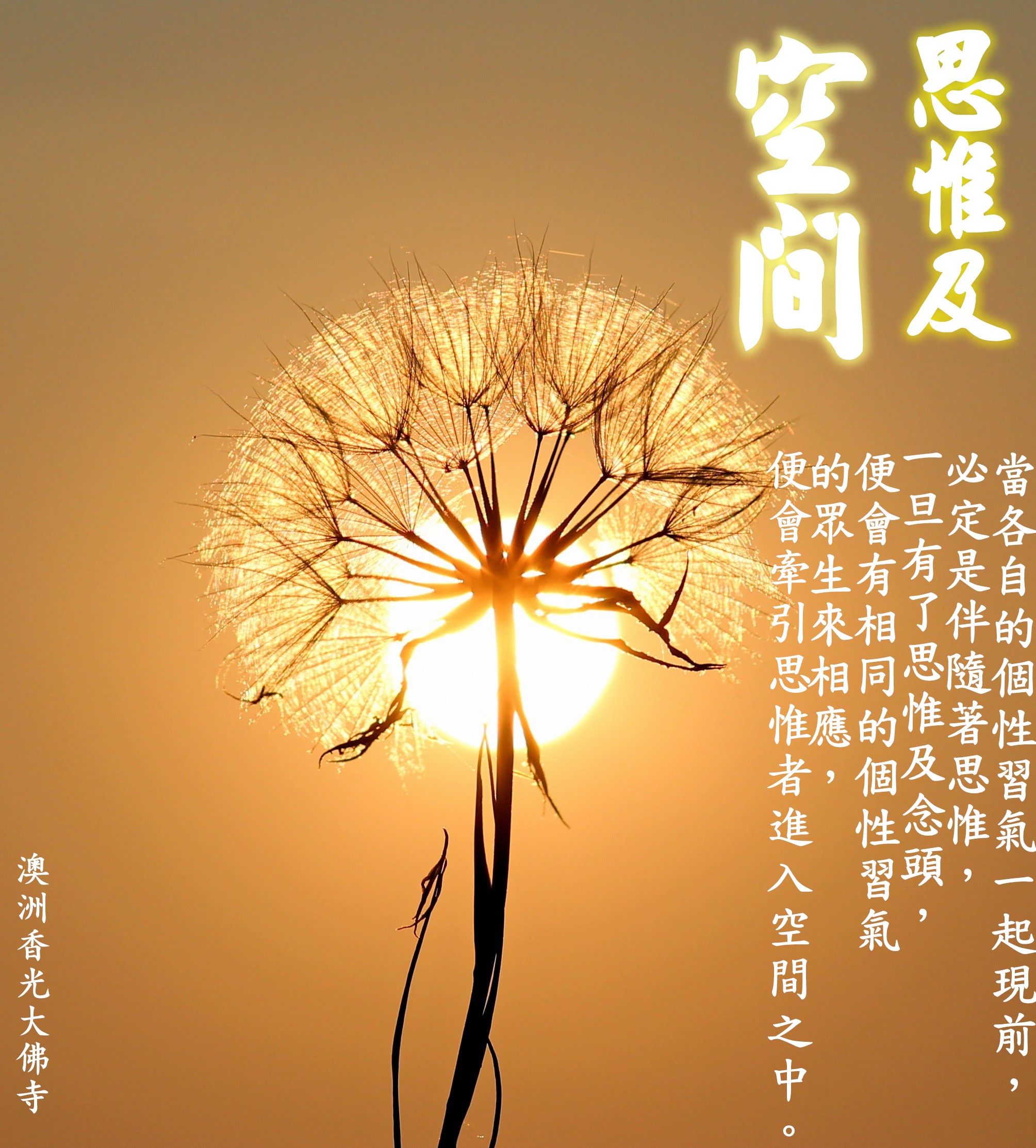
The Burden of the Ego
Changing the 'self,' personal ego, and selfishness is a fundamental challenge that every practitioner must face and overcome. If one does not confront these internal obstacles and instead allows one's ego to manifest and create , it becomes a significant barrier to one's spiritual progress. We must realise that these traits are not merely personality quirks; they are the very substance of our attachments.
The 'self,' personal ego, and selfishness exist within all beings caught in the cycle of rebirth and governed by karma. Those who fall into the hells possess the specific ego and spaces associated with those realms. Similarly, beings in the animal realm—such as chickens, ducks, cattle, sheep, fish, cats, and dogs—each possess their own unique ego and corresponding spaces. This is even more pronounced in the human world. Even in the heavenly realms, if one has not yet realised one's true self, one will still encounter situations that trigger the ego and create new spaces. The asura realm, in particular, is renowned for its stubbornness and volatile temper.
The Architecture of Thought and Space
When these various forms of the 'self,' personal ego, and selfishness manifest, they are invariably accompanied by thoughts. Once a thought or a mental intention arises, it will inevitably attract other beings who share the same ego and tendencies. This process pulls the thinker into a specific space. Often, the entities pulling the practitioner into these spaces are their own and attached spirits. Once the soul is pulled away in this manner, the practitioner will experience a state of being drowsy and unable to focus. This is why Practitioner Su often reminds the disciples: whenever you have thoughts, your own opinions and ego will enter these spaces.
How long does it take to return to one's after entering such a space? The duration varies greatly. It may last for only a few seconds or minutes, but it can also persist for hours or even days. In some cases, the soul does not return at all, or the karmic creditors take advantage of the situation to control the person's mental state. This results in persistent absent-mindedness, a lack of focus, and a loss of direction, often leading to panic and confusion. If one seeks medical help for these conditions, it can only address the symptoms rather than the root cause. In severe cases, even 's other functions are affected, leading to profound mental health issues that become a burden on family members and society. Some individuals remain trapped in that specific space and mental state until the end of their lives, even after their physical bodies have deteriorated.
The Body as a Universe of Infinite Dimensions
These various situations create countless different spaces. If you reflect on your life from childhood to the present, you will realise how many spaces you have created yourself. Thus, there exist immeasurable and boundless spaces. Some of the beings within these spaces reside inside our bodily cells, while others are external attached spirits. Our bodies are composed of fifty trillion cells, and fundamentally, each cell has its own space. Karmic creditors and attached spirits can reside within cells that are prone to illness or transformation. Therefore, it is no exaggeration to say that the body is a small universe, containing countless spaces.
The beings existing within these many spaces can be in a static state, a dynamic state, or a state of dormant sleep. Once a thought or intention arises, it will immediately attract beings who are in sync with that thought. They will interfere with the body and intensify that specific thought. If the energy of these beings is strong, they may even seize control of the thought process, becoming the dominant force and driving the body to commit negative karma. In Buddhism, the mere arising of a thought is enough to form karmic consequences, let alone the physical actions that follow.
The Path Back to the True Self
It can be said that our thoughts drive our karma, causing the laws of karma and cause and effect to manifest and forming these various spaces. Whether it is good karma leading to good results or negative karma leading to negative results, we are always the ones who create the causes and reap the consequences. This is why the Buddha’s teachings, the patriarchs and venerable masters, and even Practitioner Su constantly remind the disciples: 'give rise to all and achieve the fruit of .' This is the fundamental truth of our practice.
To break free from these spaces, one must transform the 'self,' personal ego, and selfishness. We must cultivate a selfless, pure mind and pure thoughts, eventually progressing to a state of no-thought, no-mind, and no-attachment. By keeping the Buddha-name, Namo Amituofo, continuously in our hearts, we can sever our connection to these spaces. Only then can we become truly pure and good, achieve success in our practice, and find our way back to our true self.
This message was recorded by the Buddha's disciple, Venerable HaiZe.
More from Teachings of Great Master Xuanzang
The Vision of Great Master Xuanzang
Great Master Xuanzang shares his profound vision for the Hsiang Kuang Pure Land Buddhist Centre, reflecting on the power of the Dharma, the mission of Practitioner Su, and the ongoing work of saving infinite suffering beings through the light of Namo Amituofo.
Great Master Xuanzang's New Year Joyful Purification Dharma Assembly
Great Master Xuanzang offers profound guidance on the occasion of the New Year, reminding us that the path to the Western Pure Land of Ultimate Bliss requires constant purification, the letting go of ego, and unwavering devotion to Namo Amituofo.
Awakening and the Path to the Western Pure Land
A profound exploration of how to transcend worldly attachments, purify the mind, and secure one's path to the Western Pure Land of Ultimate Bliss through Awakening and diligent practice.
Realising the Profound Meaning of the Dharma
Great Master Xuanzang explains that the Dharma is vast and boundless, transcending worldly knowledge. To truly realise the profound meaning of the Dharma, one must move beyond attachment to words and names, cultivate a pure heart, and engage in diligent practice to attain Awakening.
More by Hsiang Kuang Pure Land Buddhist Centre
The Final Curtain Call of Chu Ke-liang
A candid reflection from the late Taiwanese entertainer Chu Ke-liang on his life, his career, the karmic weight of his influence, and his ultimate deliverance to the Western Land of Ultimate Bliss.
The Soul's True Equality: A Conversation with Mahatma Gandhi
This is a record of an interview with Mohandas Karamchand Gandhi, who sought deliverance at the Hsiang Kuang Pure Land Buddhist Centre in Australia. He now resides in the Western Land of Ultimate Bliss. This account reflects upon his life and his journey to the Pure Land.
A Reflection from the Western Pure Land
This is a record of an interview with Zhao Puchu, who sought deliverance at the Hsiang Kuang Pure Land Buddhist Centre in Australia. He now resides in the Western Land of Ultimate Bliss. This account reflects upon his life in the 20th century. Recorded by the chief writer, Shi Fa Hui, on April 18, 2026.
The Truth Behind My Rebirth: A Message from Liu Suqing
Liu Suqing, the elder sister of the renowned practitioner Liu Suyun, shares her harrowing journey through the spirit realms and her ultimate deliverance to the Western Land of Ultimate Bliss through the Hsiang Kuang Pure Land Buddhist Centre.
The Burden of a Historical Name
This is a record of an interview with Lin Biao, who sought Chao Du at the Hsiang Kuang Pure Land Buddhist Centre in Australia. He now resides in the Western Land of Ultimate Bliss. This account reflects upon his life approximately 54 years ago. Recorded by the chief writer, Shi Fa, on May 18, 2026.
The Poet’s Journey to the Western Pure Land
A reflection on the life, tragedy, and ultimate spiritual liberation of the ancient statesman Qu Yuan, who found peace through the teachings of Practitioner Su.
About the Author
Hsiang Kuang Pure Land Buddhist Centre
Contributed to Pure Land Buddhism knowledge library