The Different Appearances of Practice
Teachings from Ashvaghosha Bodhisattva
Recorded on March 16, 2019
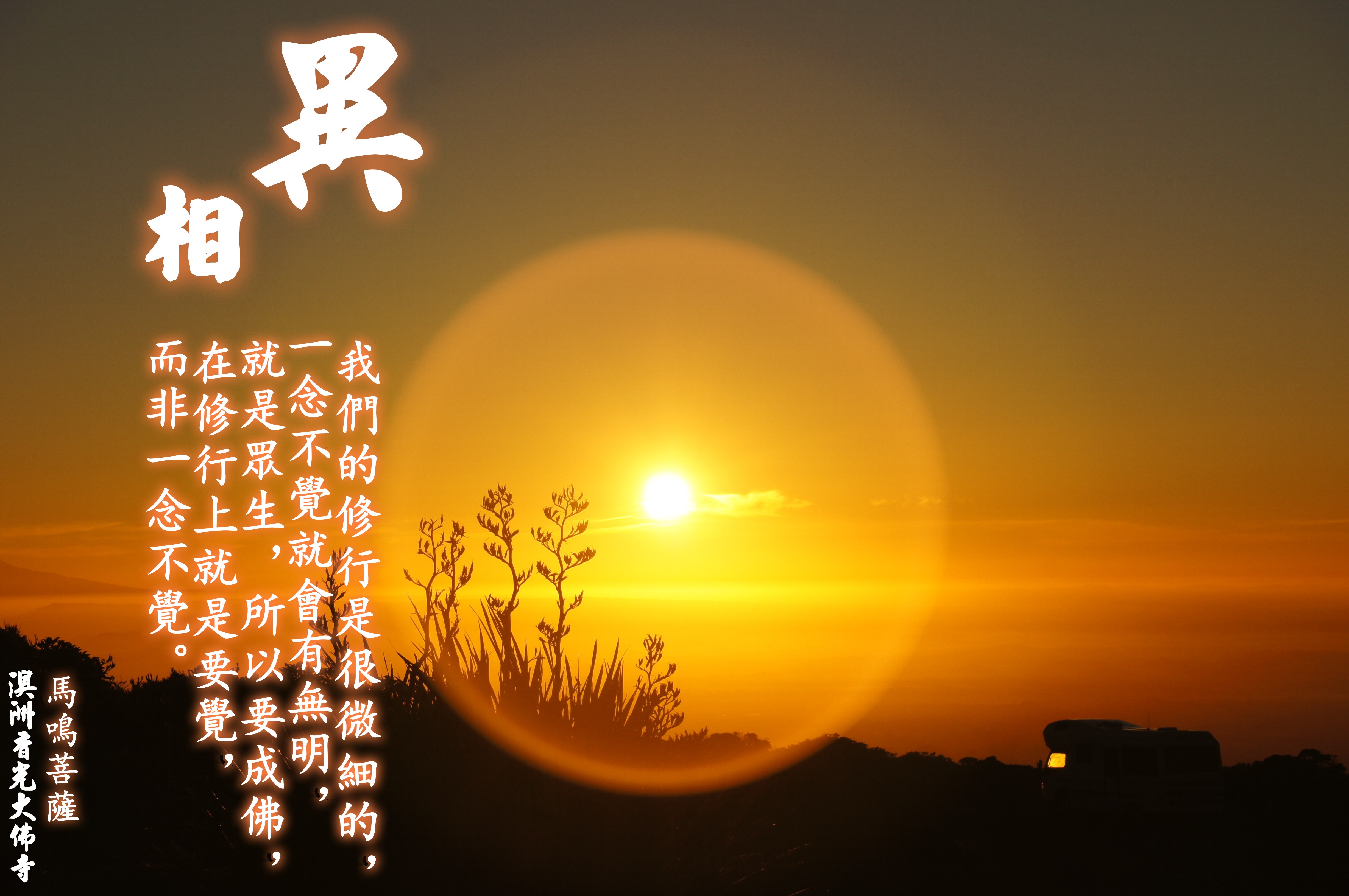
Every single person possesses the inherent Buddha-nature. Although we have begun our journey of practice, started to awaken, and dedicated ourselves to reciting sutras and chanting Namo Amituofo, this does not mean that everyone fully understands their current progress or the depth of their awareness. Consequently, the way we manifest in our daily lives differs from one person to another. These differences arise primarily from our individual habits, our tendency to make discriminations, and our deep-seated attachments. When our Six Roots interact with , the resulting states of mind vary, yet the essential nature within us all remains the same.
The Roots of Our Differences
When we fall into a single moment of confusion—perhaps by blaming others or feeling blamed by them—we generate afflictions. This state of mind does not assist our practice in any way. In the world, people often engage in debates over various issues, each holding onto their own distinct views. This is simply the result of one thought of confusion leading to another, creating individual perspectives. As we encounter the external world, we form opinions and make discriminations. These thoughts are driven by our heart, our intentions, and our . Our ability to see, what we choose to see, and our attachments are all products of this initial moment of confusion. When these thoughts continue in a sequence, we eventually become unaware of them, and they solidify into habits. Based on these habits, we use our speech and actions to create , which ultimately causes our body, mind, and spirit to lose their sense of ease and freedom. If we find ourselves in this state of confusion, how can we transform it into awareness?
Peeling the Layers of
Our practice is a very subtle process. A single moment of confusion gives rise to ignorance, which is the very definition of a being. Therefore, to become a Buddha, our practice must be rooted in awareness, not in confusion. The concepts of the three subtle and six coarse states are essentially signs of non-awareness. Why is it necessary to understand these states? It is to help us observe the coarseness or subtlety of our thoughts during our practice, and to help us recognise our own attachments and greed. When we seek to understand why things happen, we must realise that it is because of our own discriminations and attachments. By observing the nature of our thoughts, we can cut through these afflictions. Breaking through these afflictions allows us to address the most painful aspects of our lives first. When we observe the phenomena of our own afflictions, we must look deep within our hearts. Like peeling an onion, we must strip away these layers one by one to gain a more subtle understanding of every thought and intention. What was once unknown to us can now be understood, layer by layer, just like peeling that onion. We must ask ourselves: is this current state of mind, this arising thought, one of awareness or one of confusion? When we understand that our practice is about moving away from confusion, we will no longer demand that others accept the phenomena we currently manifest. This is the very process of practice.
The Path of Respect and Purity
When we discover that we have fallen into confusion and generated afflictions, we have the power to notice it ourselves. This is why we have the habit of chanting Namo Amituofo; when afflictions arise, we tell ourselves to chant, allowing the name of the Buddha to stop the cycle of negative thoughts. The Bodhisattvas in the Western Land of Nature have become Buddhas by learning the Buddha's awareness. They have preserved their original, pure, and unstained true self, keeping it free from the pollution of the world. This purity is what truly aids our practice. Therefore, we must respect every practitioner who is currently on this path. Each person manifests different phenomena based on their own journey. If we are in a state of confusion, we give rise to ignorance and afflictions; however, if we are in a state of awareness, we attain purity and true ease. Let us continue to chant Namo Amituofo, returning to our true self.
Recorded by the Buddha's disciple, Shi Haiyuan
More from Teachings of Aśvaghoṣa Bodhisattva
The Endless Compassion of the Buddha: An Interview with Bodhisattva Asvaghosa
Bodhisattva Asvaghosa shares his profound insights on the salvation work conducted by Practitioner Su and the salvation team during the global pandemic, revealing the boundless compassion of Namo Amituofo.
Bodhisattva Asvaghosa’s Teachings in the Dharma-Nature Land
Within the Western Dharma-Nature Land, Bodhisattva Asvaghosa manifests in infinite forms to guide beings toward rebirth in the Western Pure Land of Ultimate Bliss, demonstrating the boundless compassion of Namo Amituofo and the saving power of Practitioner Su.
Exhaustion, Suffering, and Freedom: Teachings from Bodhisattva Asvaghosa
Bodhisattva Asvaghosa shares profound insights on the origins of human exhaustion and suffering, and how we can transcend these through the practice of Namo Amituofo and the cultivation of Precepts (Discipline), Concentration, and Wisdom.
A New Phase: Teachings from Bodhisattva Ashvaghosha
A new phase brings a new atmosphere. After a period of deep cultivation and seclusion, the time has come to step forward and serve all beings. Bodhisattva Ashvaghosha shares profound insights on the necessity of the Three Learnings of Precepts, Concentration, and Wisdom, and the vital mission of the Hsiang Kuang Pure Land Buddhist Centre in saving infinite suffering beings.
More by Hsiang Kuang Pure Land Buddhist Centre
The Final Curtain Call of Chu Ke-liang
A candid reflection from the late Taiwanese entertainer Chu Ke-liang on his life, his career, the karmic weight of his influence, and his ultimate deliverance to the Western Land of Ultimate Bliss.
The Soul's True Equality: A Conversation with Mahatma Gandhi
This is a record of an interview with Mohandas Karamchand Gandhi, who sought deliverance at the Hsiang Kuang Pure Land Buddhist Centre in Australia. He now resides in the Western Land of Ultimate Bliss. This account reflects upon his life and his journey to the Pure Land.
A Reflection from the Western Pure Land
This is a record of an interview with Zhao Puchu, who sought deliverance at the Hsiang Kuang Pure Land Buddhist Centre in Australia. He now resides in the Western Land of Ultimate Bliss. This account reflects upon his life in the 20th century. Recorded by the chief writer, Shi Fa Hui, on April 18, 2026.
The Truth Behind My Rebirth: A Message from Liu Suqing
Liu Suqing, the elder sister of the renowned practitioner Liu Suyun, shares her harrowing journey through the spirit realms and her ultimate deliverance to the Western Land of Ultimate Bliss through the Hsiang Kuang Pure Land Buddhist Centre.
The Burden of a Historical Name
This is a record of an interview with Lin Biao, who sought Chao Du at the Hsiang Kuang Pure Land Buddhist Centre in Australia. He now resides in the Western Land of Ultimate Bliss. This account reflects upon his life approximately 54 years ago. Recorded by the chief writer, Shi Fa, on May 18, 2026.
The Poet’s Journey to the Western Pure Land
A reflection on the life, tragedy, and ultimate spiritual liberation of the ancient statesman Qu Yuan, who found peace through the teachings of Practitioner Su.
About the Author
Hsiang Kuang Pure Land Buddhist Centre
Contributed to Pure Land Buddhism knowledge library