The Six Roots and the Six Dusts: Teachings from Master Xuanzang
A Discourse on the Body and Spiritual Purification
Recorded on February 11, 2019

The Vessel of the Spirit
Our physical body is our most constant companion, yet how much do we truly understand about it? From the moment of our birth until we depart from this human world, this body remains with us through every passing day. While we can observe the external changes of our physical form, we remain largely ignorant of the intricate processes occurring within. For ordinary people, even the visible aspects of are in a constant state of flux; how much more mysterious, then, are the parts we cannot see? To truly understand our journey, we must examine the body from the perspective of spiritual practice.
Our physical form is composed of the four elements—earth, water, fire, and wind—along with the internal organs, muscles, bones, blood circulation, heartbeat, respiration, body temperature, hair, and the countless cells that form our structure. This physical vessel accompanies us from the womb until the moment our reach their end, and we face the inevitable process of birth, aging, sickness, and death. Throughout our lives, we experience , anger, sorrow, and happiness, all while navigating the and the various states of mind. It is through this body that we carry out every action. Without the body, these experiences would remain mere thoughts, unable to manifest in reality. Therefore, the body is the essential instrument through which our spirit can express itself and perform its work.
The Path of the Awakened Practitioner
For the practitioner, the body is a vital partner, present with us at every moment and in every place. But what distinguishes the body of a practitioner from that of an ordinary person? For most, the (eyes, ears, nose, tongue, body, mind) are constantly interacting with —sights, sounds, smells, tastes, touch, and thoughts. When the eyes see forms, the ears hear sounds, the nose smells scents, the tongue tastes flavours, the body feels sensations, and the mind engages with phenomena, ordinary people generate various delusions, discriminations, and attachments. These interactions extend into the seven emotions and the Five Desires, ultimately creating the that keeps us trapped in the cycle of reincarnated existence. A practitioner must understand that these emotions and desires are the very roots of our sins and the cause of our continued suffering in the six realms of existence.
Practitioners utilise the external environment and their internal spiritual growth to purify the body and the six sense organs (eyes, ears, nose, tongue, body, mind). They strive to fully manifest the true function of these roots. By letting go of and relying instead on the root-nature, they allow the six sense organs (eyes, ears, nose, tongue, body, mind) to receive the Six Dusts with absolute clarity, without allowing a single thought or intention to arise. As one’s level of practice deepens, this ability becomes more refined. When it is needed, the practitioner can perceive everything with perfect clarity; when it is not needed, the senses remain still and dormant, ready to be used at any moment.
The Six Roots in Harmonious Practice
Let us look at how the six sense organs (eyes, ears, nose, tongue, body, mind) interact with the Six Dusts in the life of a practitioner:
- Eyes and Sights:
- While ordinary eyes see only the physical world—mountains, rivers, flowers, and trees—a practitioner can express what they see truthfully, without adding subjective opinions or thoughts. By not allowing consciousness to dissect the experience, they can objectively respond to external conditions with the utmost sincerity. As purification deepens, a practitioner’s vision can transcend the physical. They may perceive the past, present, and future. The deeper their skills, the further they see, even to the point of boundlessness. This ability is used to save beings; by looking at someone, a practitioner can discern their , spiritual attachment, and the specific nature of their physical ailments.Ears and Sounds:
- While ordinary hearing often declines with age, a practitioner’s hearing is reflected in their daily life. Even if the physical structure of the ear is compromised, purification allows the practitioner to receive sound frequencies that are beyond the range of ordinary human hearing, including the voices of the spiritual realm.Nose and Smells:
- The nose is sensitive to gases and scents. A practitioner, through purification, can distinguish between subtle odours that ordinary people cannot detect. They can smell the unique scents of different beings of the six paths, which allows them to identify and save those in need.Tongue and Tastes:
- The tongue is sensitive to flavours. A practitioner with refined taste can distinguish the most subtle nuances in food. This allows them to prepare food with unique characteristics to offer to others, just as Practitioner Su does.Body and Touch:
- The body reacts to external stimuli such as temperature, pain, or pressure. A practitioner, having reduced their internal obstacles through purification, possesses a highly acute sense of touch. This allows them to immediately detect and prevent harm to the body from external sources.Mind and Thoughts: The mind categorizes phenomena and creates various interpretations, leading to discriminations in Body, Speech, and Mind. A practitioner understands that these thoughts are major obstacles. Therefore, they learn to stop the flow of thoughts, remaining still and maintaining a state of purification.
The Unobstructed Light of Awareness
For ordinary people, the interaction between the six sense organs (eyes, ears, nose, tongue, body, mind) and the Six Dusts leads to pollution. However, for an awakened being, there is no such dust. Instead, there is the inter-functioning of the six sense organs (eyes, ears, nose, tongue, body, mind), where one sense organ can simultaneously possess the qualities of the others. The barriers between cells become unobstructed, leading to a state of profound awareness. When facing any situation, the practitioner can respond quickly and correctly. This is the ultimate goal for all who study the Buddha’s teachings.
Recorded by the Buddha's disciple, Venerable HaiZe.
More from Teachings of Great Master Xuanzang
The Vision of Great Master Xuanzang
Great Master Xuanzang shares his profound vision for the Hsiang Kuang Pure Land Buddhist Centre, reflecting on the power of the Dharma, the mission of Practitioner Su, and the ongoing work of saving infinite suffering beings through the light of Namo Amituofo.
Great Master Xuanzang's New Year Joyful Purification Dharma Assembly
Great Master Xuanzang offers profound guidance on the occasion of the New Year, reminding us that the path to the Western Pure Land of Ultimate Bliss requires constant purification, the letting go of ego, and unwavering devotion to Namo Amituofo.
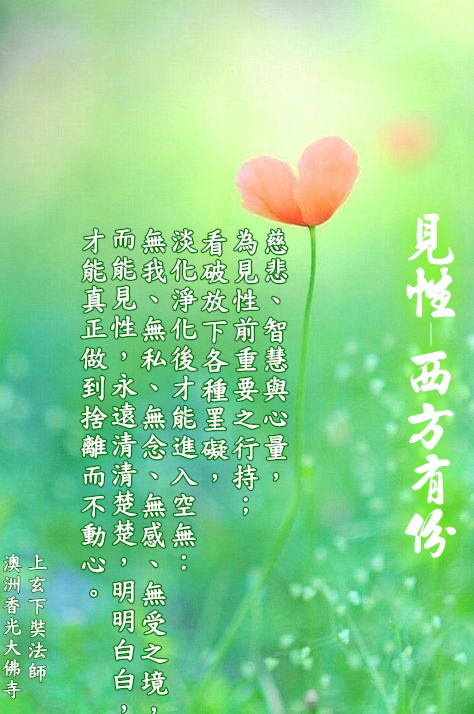
Awakening and the Path to the Western Pure Land
A profound exploration of how to transcend worldly attachments, purify the mind, and secure one's path to the Western Pure Land of Ultimate Bliss through Awakening and diligent practice.
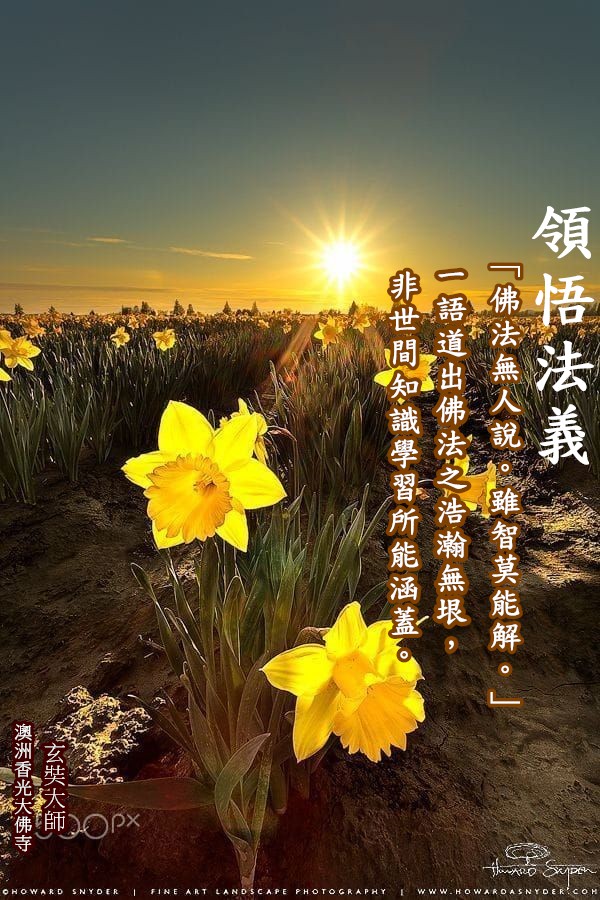
Realising the Profound Meaning of the Dharma
Great Master Xuanzang explains that the Dharma is vast and boundless, transcending worldly knowledge. To truly realise the profound meaning of the Dharma, one must move beyond attachment to words and names, cultivate a pure heart, and engage in diligent practice to attain Awakening.
More by Hsiang Kuang Pure Land Buddhist Centre
The Final Curtain Call of Chu Ke-liang
A candid reflection from the late Taiwanese entertainer Chu Ke-liang on his life, his career, the karmic weight of his influence, and his ultimate deliverance to the Western Land of Ultimate Bliss.
The Soul's True Equality: A Conversation with Mahatma Gandhi
This is a record of an interview with Mohandas Karamchand Gandhi, who sought deliverance at the Hsiang Kuang Pure Land Buddhist Centre in Australia. He now resides in the Western Land of Ultimate Bliss. This account reflects upon his life and his journey to the Pure Land.
A Reflection from the Western Pure Land
This is a record of an interview with Zhao Puchu, who sought deliverance at the Hsiang Kuang Pure Land Buddhist Centre in Australia. He now resides in the Western Land of Ultimate Bliss. This account reflects upon his life in the 20th century. Recorded by the chief writer, Shi Fa Hui, on April 18, 2026.
The Truth Behind My Rebirth: A Message from Liu Suqing
Liu Suqing, the elder sister of the renowned practitioner Liu Suyun, shares her harrowing journey through the spirit realms and her ultimate deliverance to the Western Land of Ultimate Bliss through the Hsiang Kuang Pure Land Buddhist Centre.
The Burden of a Historical Name
This is a record of an interview with Lin Biao, who sought Chao Du at the Hsiang Kuang Pure Land Buddhist Centre in Australia. He now resides in the Western Land of Ultimate Bliss. This account reflects upon his life approximately 54 years ago. Recorded by the chief writer, Shi Fa, on May 18, 2026.
The Poet’s Journey to the Western Pure Land
A reflection on the life, tragedy, and ultimate spiritual liberation of the ancient statesman Qu Yuan, who found peace through the teachings of Practitioner Su.
About the Author
Hsiang Kuang Pure Land Buddhist Centre
Contributed to Pure Land Buddhism knowledge library