The Vastness of the Mind-Capacity
Teachings from Mahasthamaprapta Bodhisattva
Recorded by Venerable HaiZe on 20 January 2019
The Boundless Nature of the Heart
Today, Mahasthamaprapta wishes to speak with all of you regarding the concept of mind-capacity. The capacity of the mind is formless and colourless, yet it possesses an immense and flexible volume. Its true scale depends entirely on how broad and expansive your heart is. Your mind-capacity can be as vast as you wish it to be; it is truly without limits or boundaries. Conversely, it can be contracted to any size you desire—it can become as small as a single hair or a tiny particle of dust, or it can expand to encompass the infinite void. Mind-capacity is not restricted by space or time, yet it exerts a tremendous influence. It can nurture a heart of and save countless helpless, sorrowful spirits.
Those who possess a great mind-capacity are able to practise the Six Paramitas of the Bodhisattvas. Furthermore, they can successfully complete their study of the Buddha’s path, become a Buddha, and save the world.
The Practice of Generosity
Generosity requires both a great mind-capacity and courage. There are many ways to practise Generosity in your daily life, and you should be ready to offer these at any time:
- Generosity of :
- Rejoicing in the virtues of others and offering praise.Generosity of Talent:
- Sharing your unique skills and abilities to benefit others.Generosity of Time:
- Dedicating your hours to the service of the and those in need.Generosity of Support:
- Providing food, shelter, and basic necessities to those who lack them.Generosity of Merit and :
- Sharing the fruits of your practice with all beings.Generosity of Presence:
- Offering a warm smile to brighten the lives of others.The Three Traditional Forms: Practising the giving of wealth, the giving of the Dharma, and the giving of fearlessness.
When you commit to this path of compassionate giving, your life will undergo a profound transformation.
The Essence of Mind-
Maintaining Discipline and Precepts also requires a great mind-capacity. Those with a compassionate heart understand the vital importance of the Precepts. The more strictly you observe them—ensuring you do not harm yourself or other beings—the sooner you will achieve success in Discipline, Concentration, and Wisdom. Only then will you have the true attainment to help other beings, allowing them to leave suffering behind and find rebirth in the of Ultimate Bliss.
You must be cautious and diligent in your practice of the Precepts. Do not observe them only when others are watching, and do not break them simply because you believe no one sees you. Whether you are seen or unseen, your conduct must remain consistent; this is the mark of a true practitioner of the Precepts.
The Buddha’s teachings uphold the highest form of discipline: the Mind-Precepts. If your thoughts and intentions violate the Precepts, you have already committed a transgression. Therefore, all students—especially the monastic community—must listen to the Buddha’s instructions. There are things you must not think, must not say, and must not do. Do not even allow such thoughts to arise in your mind. Once a thought arises, you have already violated the Precepts; if you proceed to speak or act upon it, your transgression is compounded. This is a very serious matter. Many practitioners suffer greatly because they are unaware of, or ignore, the importance of the Mind-Precepts, sometimes even facing the punishment of the hells. You must be extremely careful.
This is why the practice of Meditation and Concentration is so essential. If you possess true meditative concentration, you will not be influenced by the environment, people, or external events. Only then can you subdue your thoughts and prevent them from arising. By progressing further, you can reach the state of cutting off thoughts entirely—attaining a state of no-thought. Only at this stage can it be said that your practice of the Precepts has reached true attainment.
Patience, Diligence, and Wisdom
Patience and Endurance also require a compassionate mind-capacity. If these two can support one another, your progress will be much swifter. Those with a compassionate heart and a great mind-capacity can tolerate the faults and unkindness of others. They do not engage in conflict, do not seek out the shortcomings of others, and do not dwell on the mistakes of others. Instead, they see only the goodness, the virtues, and the kind nature of others. A true practitioner does not look for the faults of the world. If you can achieve this, you are truly a member of the Buddha’s gate; otherwise, you are no different from an ordinary person who sees faults and becomes angry.
When you possess a compassionate mind-capacity, you can remain unmoved even when others speak harsh words, make mistakes, or act maliciously toward you. By not becoming angry, not arguing back, not responding, and not falling into emotional , you prevent the other person from creating negative . This is the achievement of Patience.
Diligent practice requires perseverance and a great mind-capacity. You must understand the suffering of all beings and be willing to work hard on the Buddha’s path. Maintain your practice consistently without interruption until you achieve success, open your Wisdom and Prajna, and realise your true nature. This is the achievement of Diligent practice.
Meditation and Concentration also require a great mind-capacity. Those with a large mind-capacity possess a vast inner world. In the midst of activity, they see all things in the world without their hearts being moved. If your heart is moved, you have caused harm—harm to yourself and harm to others. Those with a great mind-capacity hope that everyone will receive the benefits of the Dharma and avoid harm. Even if your body is in motion, your heart remains unmoved; this is the achievement of Meditation and Concentration.
Prajna Wisdom is the ultimate manifestation of mind-capacity. Without a great mind-capacity, one cannot realise Prajna Wisdom. Only through the accumulation of an infinite mind-capacity can one see the great light of Prajna Wisdom. Prajna is the state of knowing nothing, yet knowing everything; this is the achievement of Prajna.
A Call to the Students of Hsiang Kuang
From the above, we can see the vital importance of a great mind-capacity. Students of Hsiang Kuang Pure Land Buddhist Centre, if you wish to succeed in your study of the Buddha’s path, you must put in the work to expand your mind-capacity. The size of your mind-capacity determines how much you can encompass. Remember that a Buddha’s mind-capacity is boundless. Your mind-capacity cannot be separated from your own being. You should manifest this great mind-capacity in your practice of the Six Paramitas, in your daily life, in your speech, in your interactions with others, and in your every action. You should, at every moment, act with a great mind-capacity when working and living with the public. Pay close attention to all your actions, and do not allow yourself to commit transgressions. If you realise you have made a mistake, correct it immediately and admit your fault. If your actions have caused harm to others, the transgression is even greater. You must be extremely cautious.
Namo Amituofo
More from Teachings of Mahasthamaprapta Bodhisattva
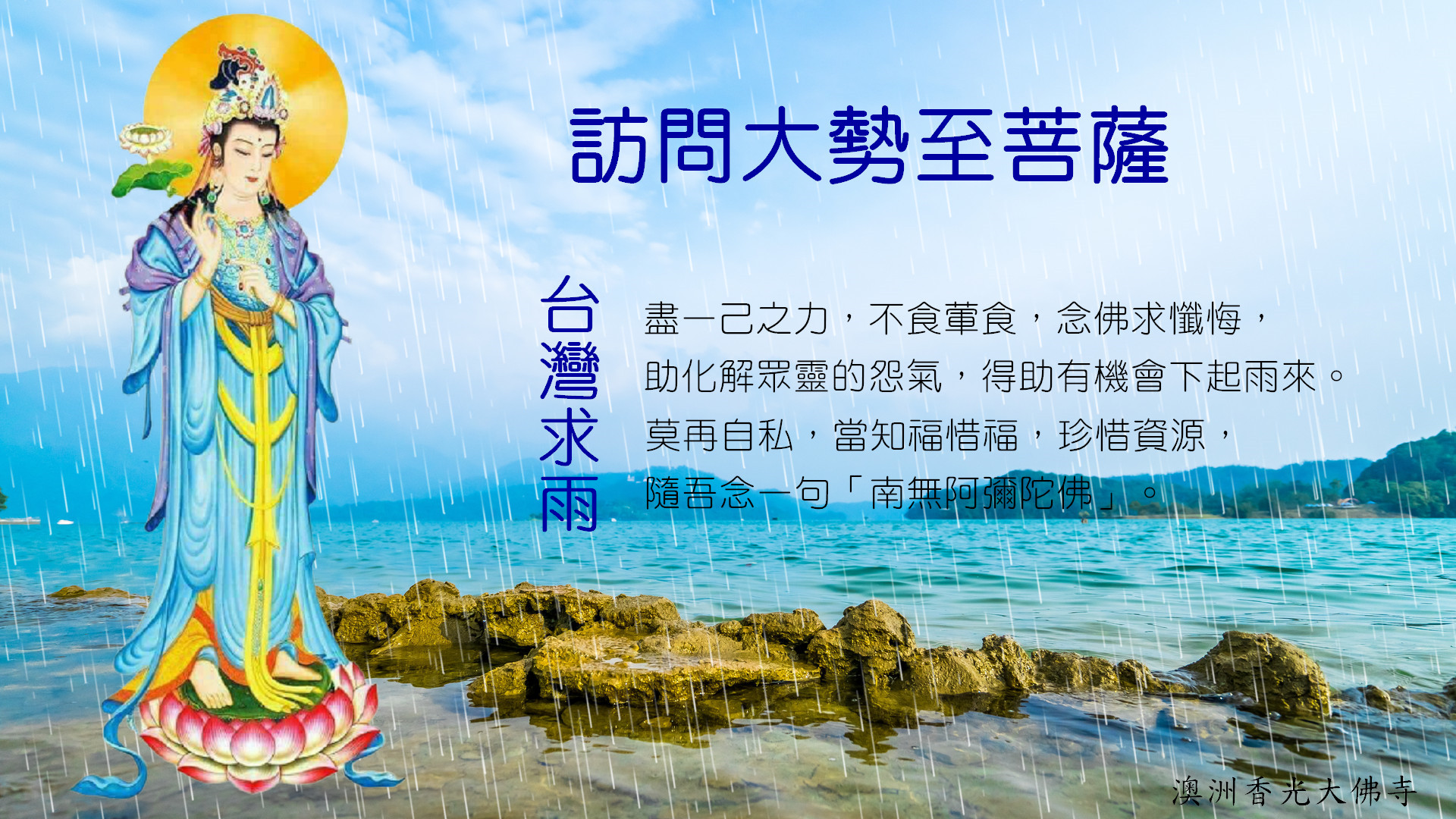
The Wisdom of Cherishing Blessings: An Interview with Mahasthamaprapta Bodhisattva
In this profound dialogue, Mahasthamaprapta Bodhisattva offers guidance on the spiritual significance of the drought in Taiwan, the importance of cherishing our blessings, and how the compassionate intervention of Practitioner Su and the power of Namo Amituofo can restore harmony to the land.
The Path to Buddhahood: An Interview with Mahasthamaprapta Bodhisattva
Mahasthamaprapta Bodhisattva shares profound insights on the suffering of the world, the mission of Practitioner Su, and the vital importance of the Buddha-name in guiding all beings back to the Western Pure Land of Ultimate Bliss.
The Compassionate Call for Rain: An Interview with Mahasthamaprapta Bodhisattva
Mahasthamaprapta Bodhisattva shares the profound significance of the collective prayer for rain at the Hsiang Kuang Pure Land Buddhist Centre, highlighting the power of the Buddha-name to nourish all sentient beings.
The Energy of Thoughts and the Energy of the Buddha-Name
A profound teaching on the nature of thought energy, the enduring power of the Buddha-name, and the path to liberation through Namo Amituofo.
More by Hsiang Kuang Pure Land Buddhist Centre
The Final Curtain Call of Chu Ke-liang
A candid reflection from the late Taiwanese entertainer Chu Ke-liang on his life, his career, the karmic weight of his influence, and his ultimate deliverance to the Western Land of Ultimate Bliss.
The Soul's True Equality: A Conversation with Mahatma Gandhi
This is a record of an interview with Mohandas Karamchand Gandhi, who sought deliverance at the Hsiang Kuang Pure Land Buddhist Centre in Australia. He now resides in the Western Land of Ultimate Bliss. This account reflects upon his life and his journey to the Pure Land.
A Reflection from the Western Pure Land
This is a record of an interview with Zhao Puchu, who sought deliverance at the Hsiang Kuang Pure Land Buddhist Centre in Australia. He now resides in the Western Land of Ultimate Bliss. This account reflects upon his life in the 20th century. Recorded by the chief writer, Shi Fa Hui, on April 18, 2026.
The Truth Behind My Rebirth: A Message from Liu Suqing
Liu Suqing, the elder sister of the renowned practitioner Liu Suyun, shares her harrowing journey through the spirit realms and her ultimate deliverance to the Western Land of Ultimate Bliss through the Hsiang Kuang Pure Land Buddhist Centre.
The Burden of a Historical Name
This is a record of an interview with Lin Biao, who sought Chao Du at the Hsiang Kuang Pure Land Buddhist Centre in Australia. He now resides in the Western Land of Ultimate Bliss. This account reflects upon his life approximately 54 years ago. Recorded by the chief writer, Shi Fa, on May 18, 2026.
The Poet’s Journey to the Western Pure Land
A reflection on the life, tragedy, and ultimate spiritual liberation of the ancient statesman Qu Yuan, who found peace through the teachings of Practitioner Su.
About the Author
Hsiang Kuang Pure Land Buddhist Centre
Contributed to Pure Land Buddhism knowledge library